The First US Tinnitus Guideline Update Since 2014 Names Bimodal Neuromodulation, Handing Neuromod’s Lenire a Coverage Argument
A guideline listing is the first thing a payer asks a device maker for, and Neuromod’s Lenire now has one in tinnitus.

A guideline listing is the first thing a payer asks a device maker for, and Neuromod’s Lenire now has one in tinnitus.

Out of 452 brain regions mapped in mice, an overlooked hypothalamic nucleus carried the memory of past stress.
The efficacy is the headline. The competitive case sits in the side effect line, and it points at AbbVie’s Vraylar.

The NDA and the enrolment pause went out in one release. Xenon says the events match the mechanism, not the indication.

Jazz committed $820 million at signing for an epilepsy drug with one early trial behind it. The justification is a regulatory pathway, not the data.

FDA approved the first medicine treating narcolepsy type 1 as a disease rather than a symptom set. Takeda cannot sell it for up to ninety days.

ABILITY Neurotech recorded human neural data for the first time during tumour surgery in Munich, its first step toward a long-term implantable brain-computer interface.
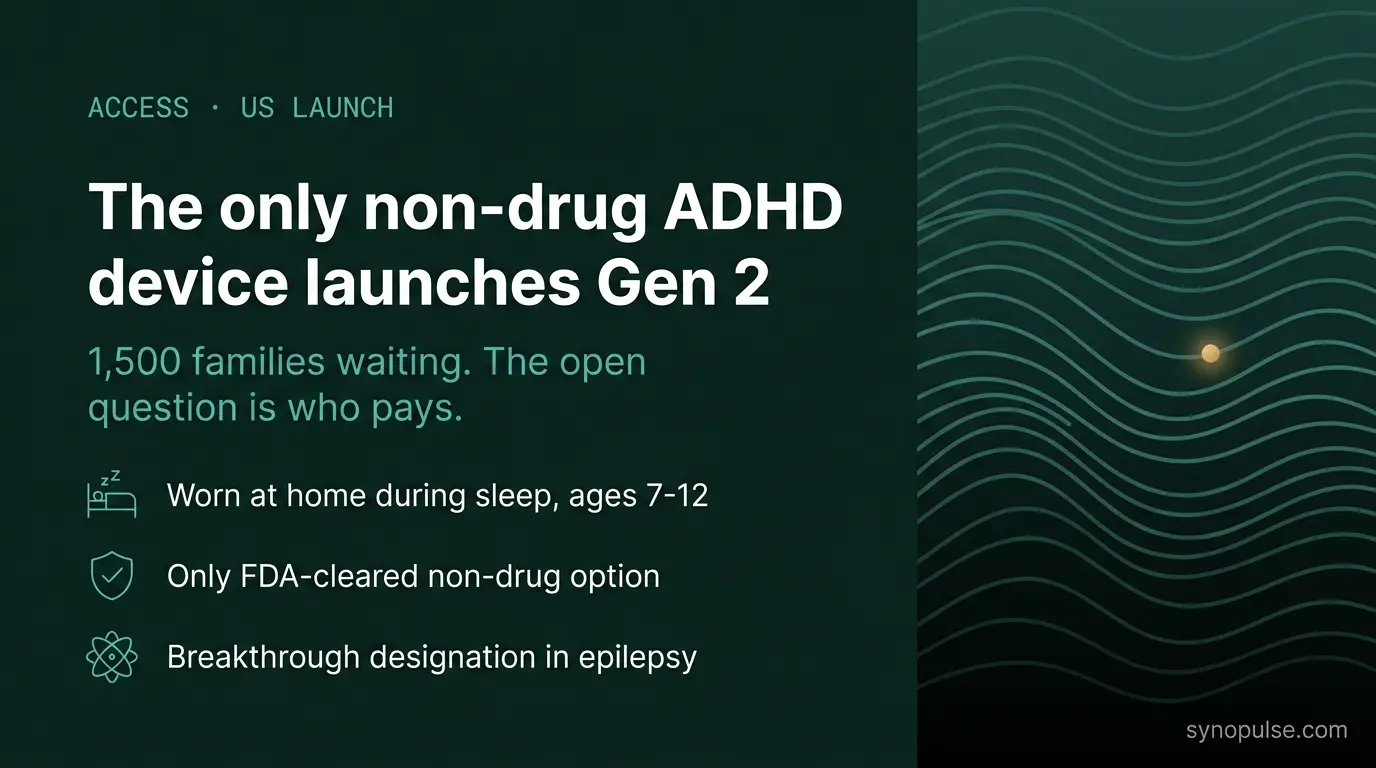
The only FDA-cleared non-drug treatment for pediatric ADHD launched its second generation into a 1,500-family waitlist, with reimbursement still the open question.

IZCARGO, a therapy engineered to cross the blood-brain barrier, won its first marketing authorization outside Japan five years after launching there.

The Alzheimer’s Association International Conference drove the week’s pipeline news, but the signal that mattered most came from a lab: the first brain link that let one paralysed person move and feel through another. Around it, a tau target validated and contested in the same week, an oral entrant scaling in Huntington’s, and anti-amyloid therapy fighting its real battle, which is access.