NeuroPulse Wk 30: Three Orexin Programmes in Two Weeks

Lundbeck’s Fast Track makes three orexin programmes in two weeks. Plus a Duchenne filing with a January date, and a CHMP slip caused by a contract manufacturer.

 Athithi Verma
Lundbeck’s Fast Track makes three orexin programmes in two weeks. Plus a Duchenne filing with a January date, and a CHMP slip caused by a contract manufacturer.

Dassault took a safety-data platform, Tempus took the diagnostics layer it already sold, Repligen took biopreservation tools. Three deals, no molecules.
Agilent won its eighth CE-marked companion diagnostic indication for a single PD-L1 assay, each one riding on a label expansion Merck paid to generate.

China approved Haisco’s ciprocopan for PNH, the world’s first once-daily oral complement Factor B inhibitor, a month after a US small-cap licensed ex-China rights.

Accord made two interchangeable denosumab biosimilars commercially available with Cigna preferred status already secured on the pharmacy benefit since 1 July.

Momentis won FDA clearance for multiport surgery, making Anovo the first robotic platform cleared for natural orifice, single-port and multiport approaches.

NeuraNova, formerly StrokeDx, won FDA clearance for a bedside device measuring cerebral fluid asymmetry, cleared as an adjunct rather than a diagnostic.

Dassault Systèmes will pay $1.8 billion cash for ArisGlobal, whose platform processes more than 12 million patient safety reports annually for 200 customers.

Trump gave generic drugmakers until August 2028 before a 100% tariff, rising to 200% in 2029. The problem is the margin those drugs actually carry.
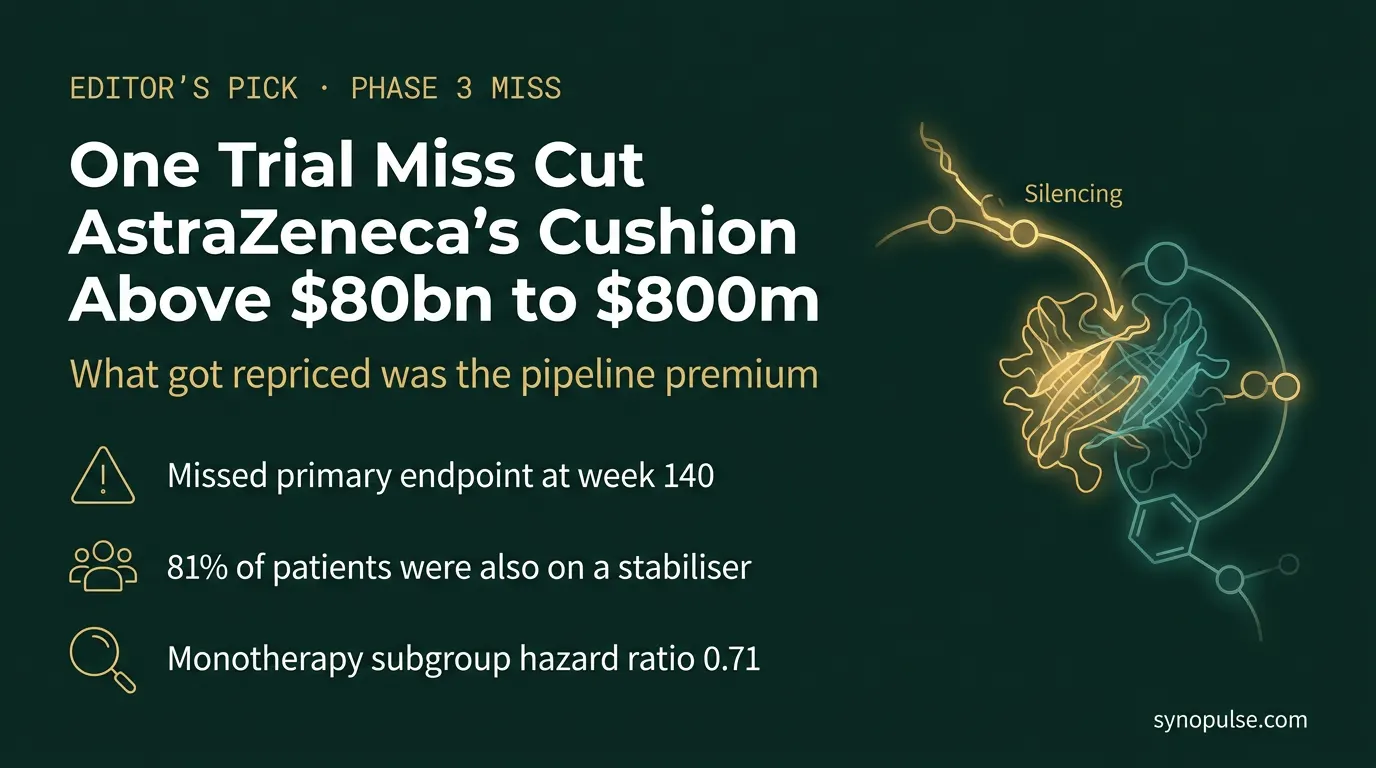
A drug worth $1.9bn of 2030 revenue cost AstraZeneca £19bn in a day, leaving roughly $800m of headroom above its $80bn goal with the risky readouts still ahead.