
One Trial Miss Cut AstraZeneca’s Cushion Above $80bn to $800m
A drug analysts valued at $1.9 billion of 2030 revenue cost AstraZeneca roughly £19 billion of market value in a single day, its worst session since March 2020. Most analysts put the damage to their valuation models at 2 to 4 percent. The shares lost about twice that. When a loss is ten times the asset, the asset is not what is being repriced.
The cushion, not the drug, is what disappeared
AstraZeneca has told the market it will reach $80 billion in revenue by 2030. Company-compiled consensus sat at roughly $82.7 billion, a cushion of about $2.7 billion. Strip out the $1.9 billion that analysts had assigned to Wainua in cardiomyopathy and consensus falls to roughly $80.8 billion.
That is a margin for error of around 1 percent on an $80 billion target, four years out, with the higher-risk readouts still ahead. The goal has not been abandoned and management has not revised guidance. But the buffer that made it look comfortable is effectively gone, and a target without a buffer is a promise that now depends on everything else landing.
The trial may have been designed into failure
CARDIO-TTRansform enrolled 1,432 patients across 20 countries, randomised to 45mg of Wainua or placebo every four weeks on top of standard care, with a primary composite of cardiovascular mortality and recurrent cardiovascular events through week 140. It missed.
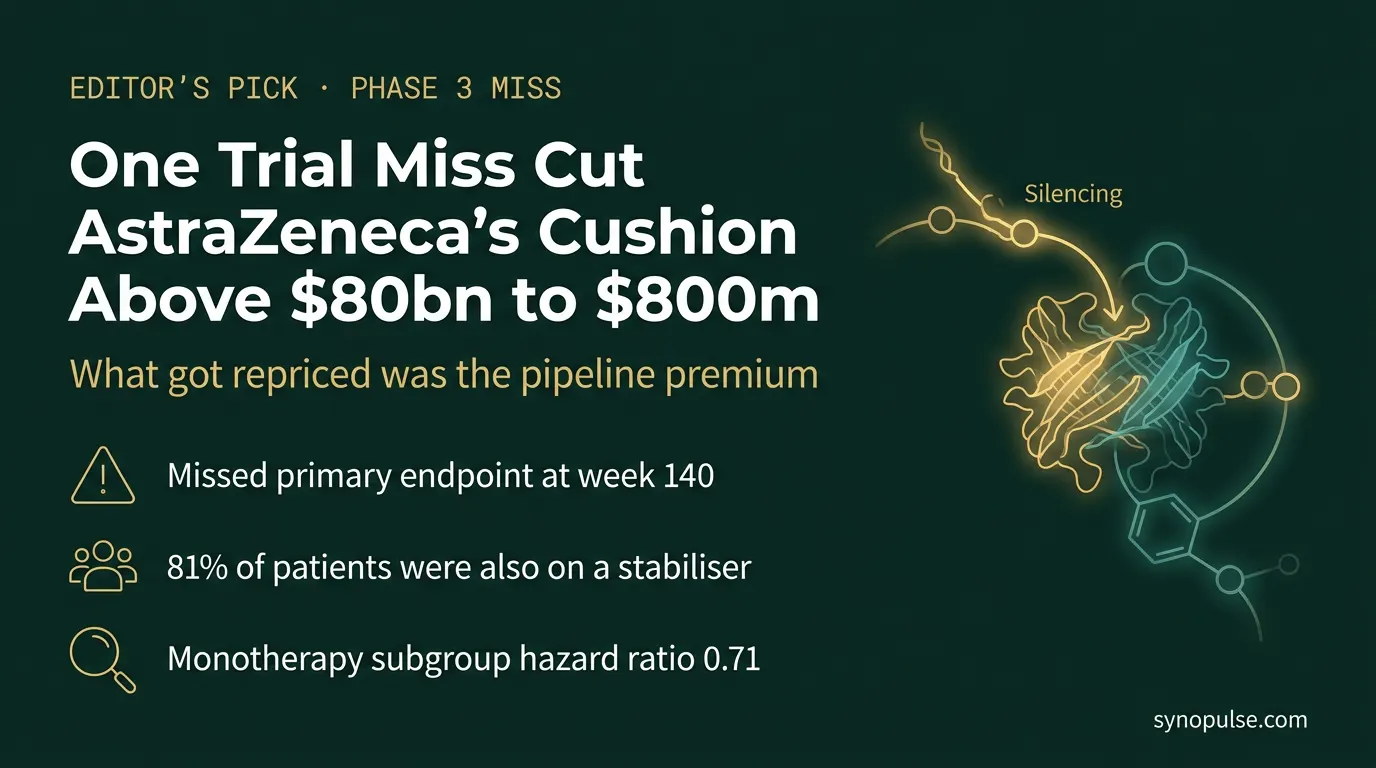
Then read the composition. About 57 percent of patients were already on a stabiliser at baseline and roughly a further 24 percent started one during the study, so approximately 81 percent were taking a drug doing a related job by a different route. Stabilisers hold the faulty transthyretin protein together; Wainua silences its production. Layer one on the other and disentangling the second becomes very difficult.
The subgroups say exactly that. In the prespecified monotherapy population, the hazard ratio was 0.71 and nominally significant. Among patients already on a stabiliser, there was no treatment effect at all. That pattern is consistent with a drug that works in a setting the trial could barely observe, because standard of care moved underneath a study that ran for 140 weeks.
This is the structural risk in long cardiovascular outcome trials, and it has nothing to do with the molecule. When the standard of care improves mid-study, the control arm improves with it and the effect being measured shrinks. Any trial running close to three years in a fast-moving field is exposed to the same problem, and ATTR cardiomyopathy has been one of the fastest-moving fields in cardiology. The design was rigorous. It was also overtaken.
Why the market punished a small loss so heavily
Because it was not really pricing Wainua. AstraZeneca has carried one of the richest pipeline premiums in European pharma, built on a reputation for late-stage execution, and Bank of America analysts said afterwards they had not even debated the likelihood of a primary endpoint miss. A surprise of that kind does not just remove an asset, it questions the confidence interval around every other asset in the pipeline. Jefferies made the point precisely: the $80 billion target survives, but credibility takes the hit.
That is the difference between a financial event and a narrative one. Two to four percent came off the models. Nine and a half percent came off the shares. The gap is the premium being tested.
What to watch next
Full CARDIO-TTRansform data arrives at the European Society of Cardiology Congress in August, and the monotherapy subgroup will be the section everyone reads first. Wainua’s existing approval in hereditary transthyretin-mediated polyneuropathy is unaffected, in more than 20 countries and marketed as Wainzua in the EU. AstraZeneca has not outlined a filing plan for the cardiomyopathy indication.
The company remains, on most analyst reckoning, the best pipeline in European pharma. The question this miss raised is not whether that is true, but how much an investor should pay for it in advance of proof. Between now and 2030, with $800 million of headroom, every remaining high-risk readout is load-bearing.