
Agilent Has Built an Annuity on Merck’s Clinical Programme, One Indication at a Time
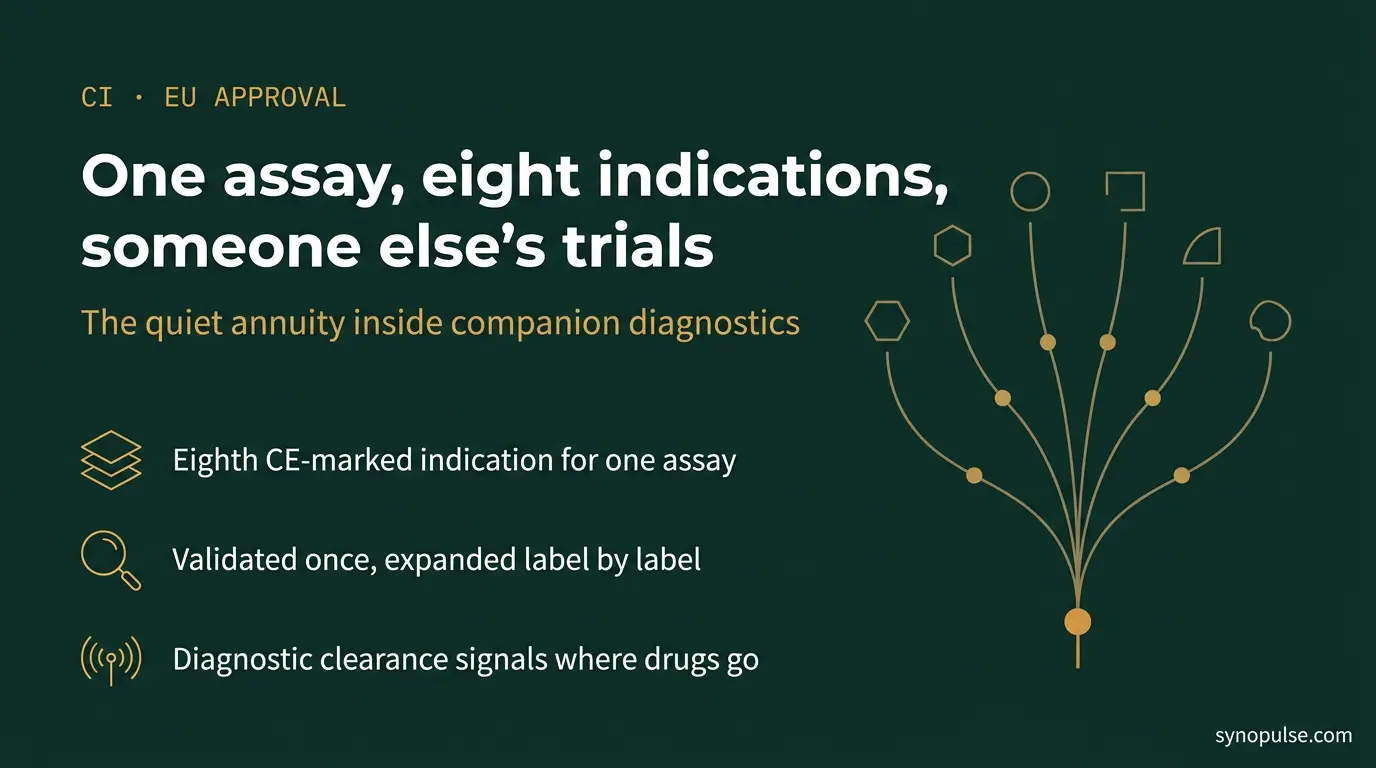
- Agilent received EU approval for PD-L1 IHC 22C3 pharmDx (Code SK006) in epithelial ovarian, fallopian tube and primary peritoneal carcinoma, its eighth CE-marked companion diagnostic indication for the same assay.
- It was evaluated in the KEYNOTE-B96 / ENGOT-ov65 trial, and supports identifying patients eligible for pembrolizumab (Keytruda). Agilent developed the assay in partnership with Merck, known as MSD outside the US and Canada.
- Note the positioning: the EU approval addresses the platinum-resistant setting, while Agilent’s February 2026 FDA approval in the same tumour types was framed around first-line patients.
- The same assay already covers non-small cell lung, oesophageal squamous, cervical, head and neck, triple-negative breast, and gastric or gastro-oesophageal junction cancers.
CI read
The business model is the story, and it is quietly one of the best in diagnostics. Agilent validated a single antibody assay once, then added an indication every time its pharma partner expanded a label. Eight CE-marked indications in Europe, seven approvals in the United States, one assay. Agilent did not run KEYNOTE-B96; Merck did. Agilent collects the testing volume that follows. That is an annuity funded by someone else’s clinical programme, with switching costs that rise each time a pathology lab standardises on the assay. For anyone tracking pharma, there is a second use here worth adopting: companion diagnostic approvals are a public early-warning system for label expansion, because the diagnostic must clear before the drug can be prescribed against it. Watch the assay and you see where the drug is going. One detail to keep an eye on: the EU cleared this for the platinum-resistant setting while the FDA framing in February was first-line, so the same evidence has landed in two different places in the treatment pathway.