
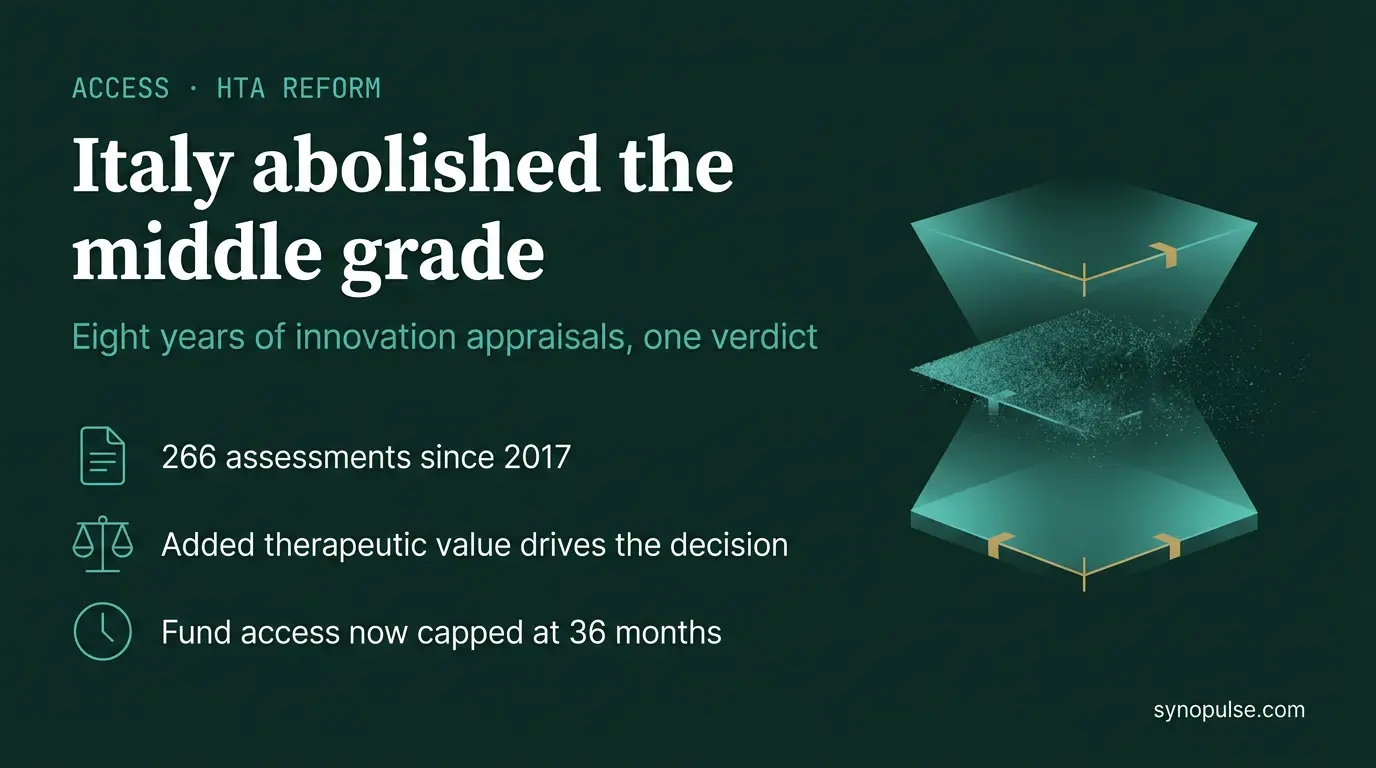
Italy Ran an Innovation Test for Eight Years. The Verdict Is In, and One Grade Has Been Abolished.
- Since 2017 Italy’s medicines agency has graded new drugs on three criteria, therapeutic need, added therapeutic value and quality of evidence, awarding full, conditional or no innovativeness status. Published analyses now cover roughly 266 assessments through the 2025 reform.
- The reward is real. Full innovativeness brings access to the dedicated innovative medicines fund, immediate inclusion in regional formularies and exemption from Italy’s payback requirements. Conditional status brought formulary inclusion only.
- The evidence shows the decision is driven overwhelmingly by added therapeutic value. Rare disease medicines were markedly more likely to receive conditional rather than full status, while paediatric indications were more likely to receive full status.
- The July 2025 reform abolished conditional innovativeness entirely, on the basis that only four cases were ever converted to full status. Fund access is now capped at 36 months, and antibiotics reserved for multi-resistant organisms gain automatic inclusion.
Access read
Eight years of published appraisals amount to something rare in market access: a natural experiment with its results in the open. Two findings deserve attention. The first is that conditional innovativeness failed on its own terms. It was designed as a halfway house for drugs with promise and incomplete evidence, and almost none of them ever graduated, which means it functioned as a soft refusal rather than a provisional yes. Abolishing it is an admission that a middle grade with no route upward is worse than a clear decision either way. The second finding is the harder one for anyone building a rare disease case in Italy. Rare disease medicines were the group most likely to land in that conditional category, precisely because added therapeutic value is the dominant criterion and small single-arm trials struggle to demonstrate it against an ill-defined comparator. With the middle grade removed, those same submissions now face a binary outcome, and the fund is the difference between a launch that works commercially and one that does not. The automatic inclusion of reserve antibiotics is the quiet counterpoint, an explicit acknowledgement that some medicines cannot be assessed on comparative benefit at all, because their value lies in being held back.