
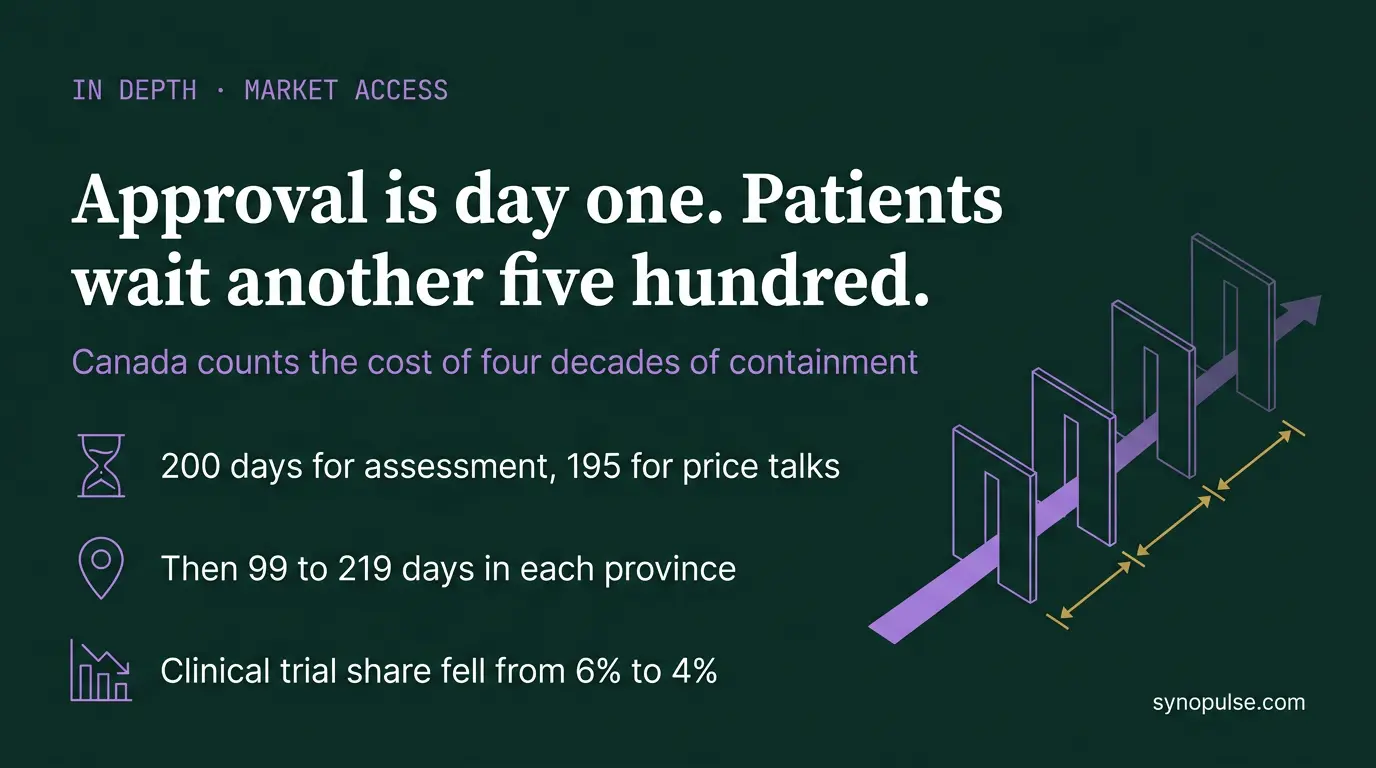
Approval Is Day One. In Canada, Patients Wait Another Five Hundred Days.
Canada has just published the arithmetic of its own access problem, and the numbers are worse than the argument. A government task force reporting to the health and industry ministers set out, step by step, how long a medicine takes to reach a publicly insured Canadian patient after it has been judged safe and effective. Health Canada is not the bottleneck. Everything after it is.
- Once Health Canada authorises a medicine, the remaining steps take 200 days for health technology assessment, 195 days for pan-Canadian price negotiation and a further 99 to 219 days for each province to decide on listing. That is roughly 500 to 600 days after approval before public coverage.
- Before any of that, manufacturers file in Canada about 262 days later than in peer jurisdictions. The report says plainly that industry should file earlier, which makes the delay partly self-inflicted and partly a rational response to the market it is filing into.
- The competitiveness case is quantified too. Canada’s share of global clinical trials fell from 6 percent in 2021 to 4 percent, an opportunity cost the report puts at $2.5 billion and about 20,000 jobs.
The task force delivered 39 recommendations and noted that not all its members support all of them, which is itself informative. Read together, they describe a country concluding that four decades of price containment succeeded on its own terms and produced a market that companies now file into late, launch into slowly and, increasingly, skip. A reader can stop here with the full picture. The sections below are the detail.
The delay is in the queue, not the review
Health Canada performs well by international standards, with service standards of roughly 300 days for new drugs and 180 for generics, alongside priority pathways. The problem sits on either side of that review.
On the front end, submissions arrive in Canada a median of 262 days later than in comparable countries. On the back end, health technology assessment through Canada’s Drug Agency takes around 200 days, pan-Canadian price negotiation another 195, and then each province and territory decides separately, taking anywhere from 99 to 219 days more. Stack them and a medicine that cleared safety and efficacy review still waits the better part of two years for public coverage, with the wait differing by province. The report calls the result a postal code lottery, which is unusually direct language for a government document.
The circular problem at the centre
The 262-day filing gap is the most uncomfortable number in the report, because responsibility for it is contested. The task force states that the lag can and should be addressed by industry filing earlier. Industry’s position, reflected elsewhere in the same document, is that companies file late precisely because the reimbursement environment that follows is slow, fragmented and oriented toward price containment, which makes an early Canadian filing a poor use of regulatory resources.
Both are true, and that is what makes it hard to fix. A slow reimbursement system produces late filings; late filings make the country look like a low-priority market; a low-priority market attracts less investment and less urgency. The report’s answer is to compress every stage at once rather than argue about who moves first.
What the recommendations would actually change
Three deserve attention beyond the headline. The first is regulatory reliance, with Health Canada urged to lean systematically on trusted foreign regulators across oncology, HIV, antimicrobials, vaccines and rare disease, and to run its first reliance review by the end of 2026. That is the same mechanism Japan used to get an enzyme replacement therapy into the United Arab Emirates this month, now proposed by a G7 country for its own market.
The second is a rethink of the PMPRB. The task force asks government to consider whether international price referencing of list prices remains appropriate, and the report notes that a United States Trade Representative document in April criticised the exclusion of Switzerland and the US from Canada’s comparator basket as artificially devaluing innovative medicines. A domestic pricing institution created in 1987 is now being reviewed with an eye on American trade pressure.
The third will get less coverage and deserves more: the task force recommends that Canada’s Drug Agency stop publishing its price reduction recommendations. The competitiveness logic is clear enough, published reduction figures travel to other countries’ reference baskets. But it is a proposal to reduce transparency in a public assessment process, and it should be argued for on those terms rather than slipped in among procedural fixes.
The most striking section is not about access at all. Over fifteen years, 21 Canadian life sciences companies were acquired by foreign buyers at more than $500 million each, averaging $1.8 billion. For financing rounds above $50 million, international investors account for 76 percent of participants. Of the top twenty Canadian therapeutic exits since 2013, Canadian investors captured 23 percent of the returns. There is no Canadian institutional ownership in any of the country’s three largest publicly traded biotechs.
Canada builds companies well and sells them early, and the report links that directly to the access environment. Sponsors weigh not only where to run a trial but whether a viable domestic market will exist at the end of it. A country that is slow to reimburse is also, in the end, a country that struggles to keep the companies it creates.
The same question, asked in four places
Canada is not doing something unusual. It is arriving late at a question every developed system is now confronting. Spain has written automatic price erosion into a draft law. China admitted patented molecules into procurement by transferring patent risk to bidders. Washington is pegging US prices to the lowest paid abroad while threatening tariffs on the cheapest medicines in its own supply.
Each is an attempt to hold two things at once: pay less, and remain a market worth launching into. Canada has answered that question the same way for forty years, and this report is the first serious federal count of what the answer cost. Whether anything follows is a different matter, and the honest signal to watch is the recommendation that implementation teams be stood up within three months. Reports of this kind are common. Implementation teams with deadlines are not.