
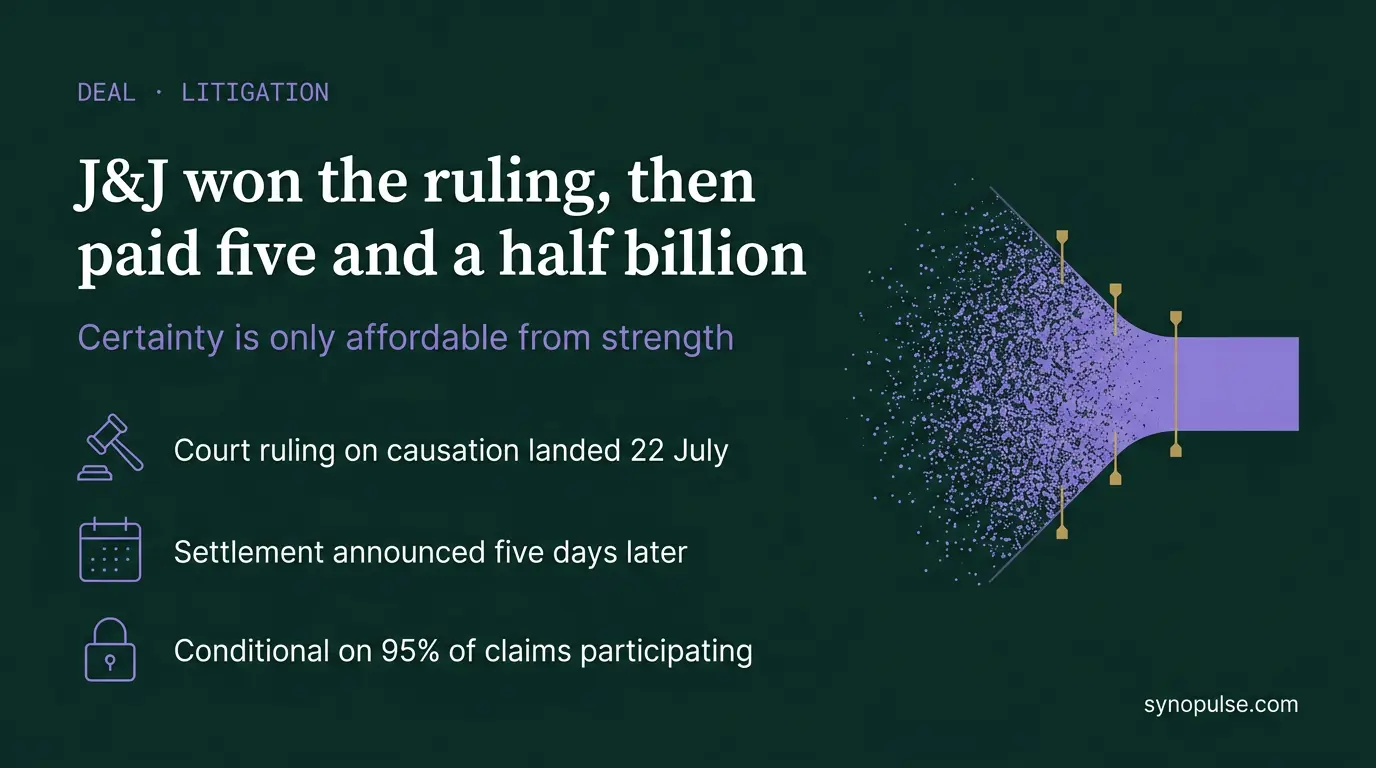
J&J Won the Ruling on 22 July. Five Days Later It Agreed to Pay $5.5 Billion.
- Johnson & Johnson reached agreement with the plaintiff firms leading the federal multi-district litigation for a comprehensive resolution of the remaining ovarian talc claims, roughly 76,000 of them, ending litigation the company describes as running 15 years.
- The commitment is $5.5 billion, structured with a first payment of no more than $3 billion in 2027 and no further payments due before 2028. It is conditional on participation by lead plaintiff firms representing at least 95 percent of remaining claims.
- It follows a ruling in J&J’s favour. On 22 July the MDL court ordered plaintiffs to show why the remaining claims should not be dismissed for inability to prove specific causation, after plaintiffs withdrew their causation experts in two bellwether cases.
- J&J had already settled about 95 percent of filed mesothelioma suits, all state consumer protection claims and all talc-supplier disputes. It retained all talc liabilities on separating Kenvue in August 2023 and discontinued talc-based Baby Powder globally the same year.
Deal read
Read the calendar. The court ruling that put plaintiffs in an untenable position landed on 22 July. The settlement was announced on 27 July. The company states it is confident it would ultimately have prevailed, and its own record supports that. So the question is not whether J&J could have won, it is why a company winning chose to write a $5.5 billion cheque five days later. The answer is that litigation of this scale is unbounded in both time and outcome, and an unbounded liability cannot be modelled, financed or explained to a market. What the agreement does is convert it into a scheduled payable: a capped number, first instalment in 2027, nothing more before 2028, conditional on 95 percent participation so the tail cannot reopen. That is a company buying certainty at a price it can name, from a position of strength rather than exposure, which is the only position from which certainty is affordable. The timing has a second explanation worth watching. J&J is preparing to separate its Orthopaedics business, and no one carries 76,000 unresolved claims into a corporate separation of that size if they can help it.
Read the original source (Johnson & Johnson via Business Wire) →