
A B7-H3 Antibody Drug Conjugate Just Won a Second Phase 3, in a Second Tumour
- Hansoh Pharma, GSK’s licensor, reported that the pivotal Phase 3 ARTEMIS-011 trial of risvutatug rezetecan (Ris-Rez) met its primary endpoint of progression-free survival in patients with osteosarcoma who had progressed after at least two prior lines of therapy.
- The B7-H3-targeted antibody-drug conjugate showed statistically significant and clinically meaningful PFS improvement over chemotherapy, with consistent benefit across secondary endpoints including overall survival, and no new safety signals. The data support a Chinese regulatory submission.
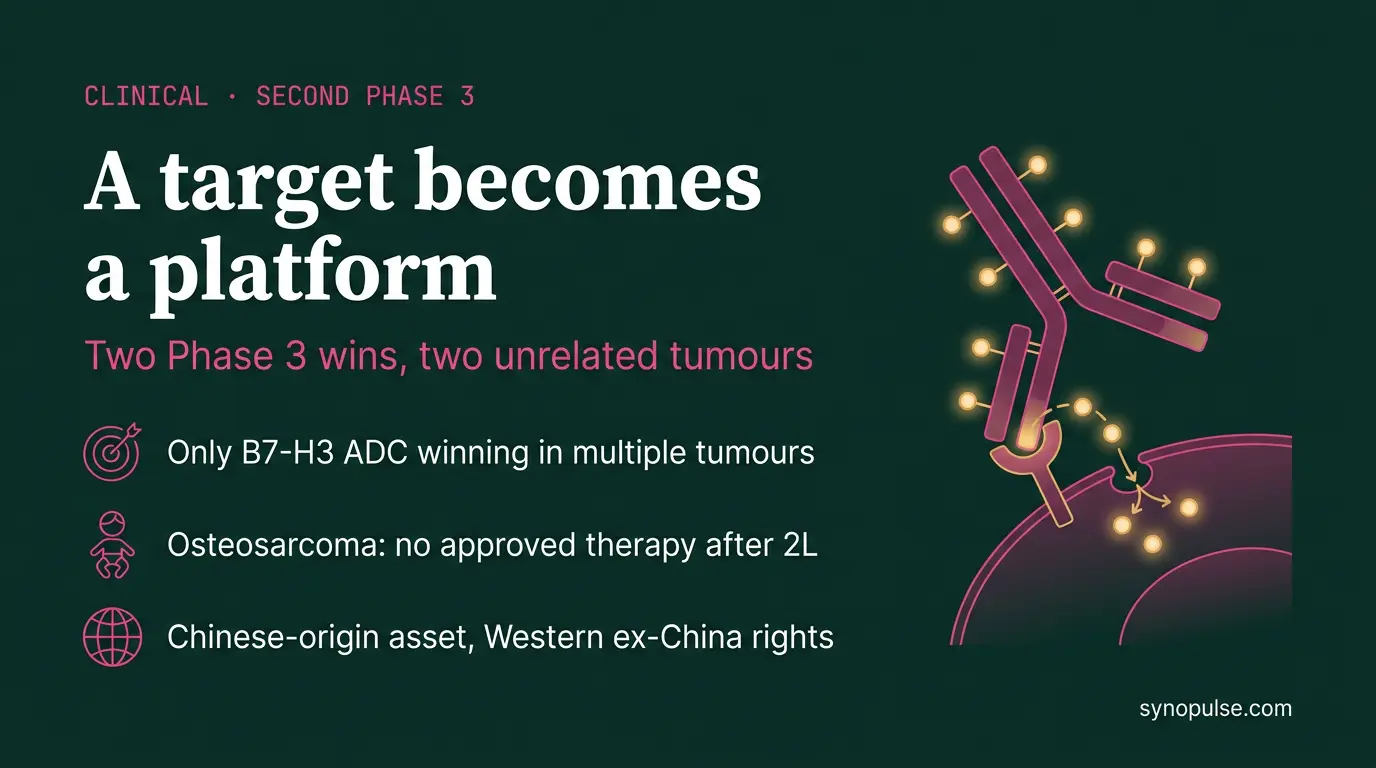
- It follows recent pivotal data in advanced or relapsed small-cell lung cancer, making Ris-Rez the only B7-H3-targeted ADC with positive Phase 3 outcomes across multiple tumour types.
- Osteosarcoma mainly affects children and young adults, occurs in roughly 3.4 cases per million people a year, and has no approved therapies after two prior lines. GSK holds exclusive rights outside mainland China, Hong Kong, Macau and Taiwan, and is running the global EMBOLD Sarcoma-202 study.
Clinical read
Two positive Phase 3 results in two unrelated tumours is the point at which a target stops being a hypothesis and becomes a platform. B7-H3 is expressed across a wide range of solid tumours and has attracted several developers precisely for that reason, but breadth of expression is a promise rather than a result until a molecule converts it in more than one disease. Ris-Rez has now done that in small-cell lung cancer and osteosarcoma, which are about as far apart as solid tumours get, and GSK is running programmes in lung, prostate and other solid tumours behind it. The second thing worth logging is where the asset came from. This is a Chinese-originated molecule, validated in Chinese Phase 3 trials, on which a large Western pharma holds ex-China rights and is building a multi-tumour franchise. That is now a primary pipeline route rather than an opportunistic one, and it is the same asymmetry our H1 data described, with China selling $92.6 billion of assets westward across 45 deals while buying $13.3 billion. Note also the indication chosen for the first win: a paediatric and young-adult bone cancer with nothing approved after second line, which is where a Breakthrough designation and an orphan pathway do the most work.