
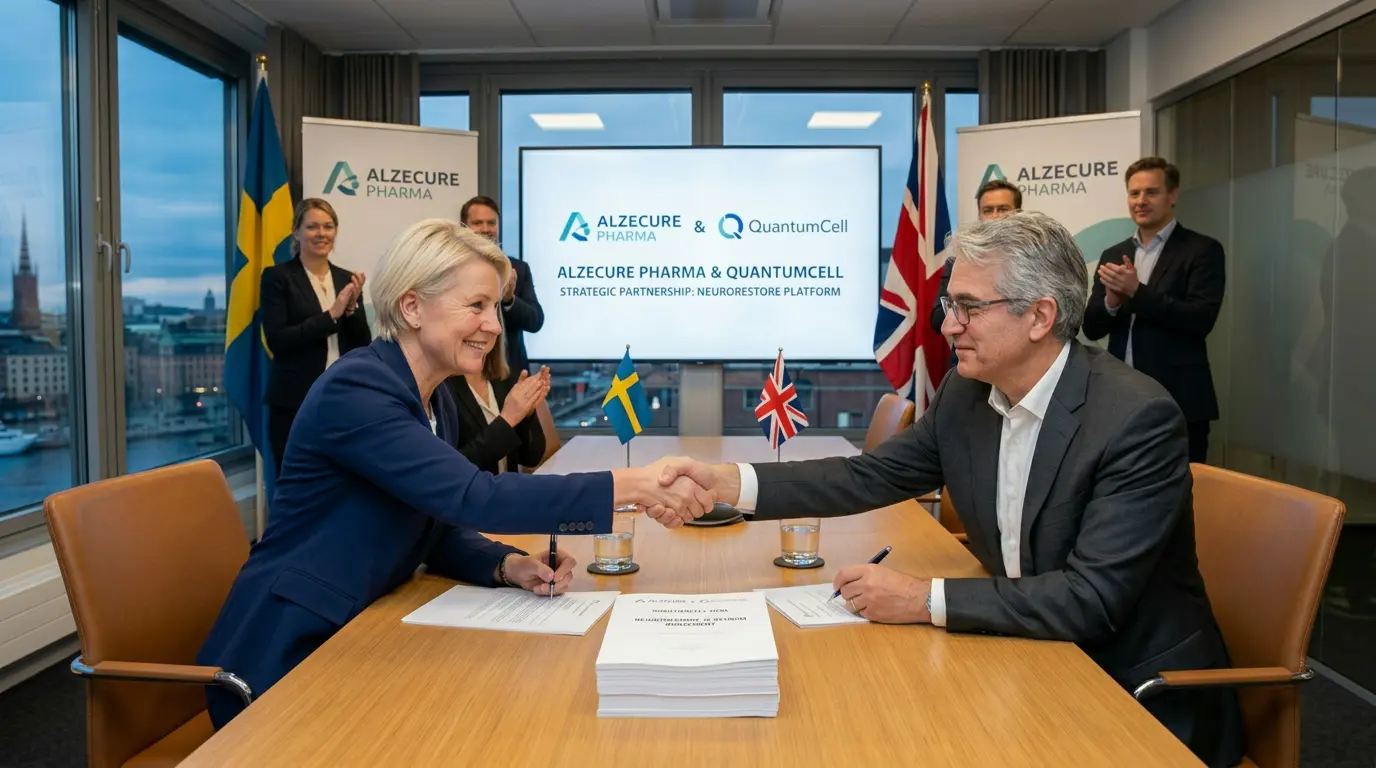
AlzeCure Pharma has found a partner for its Alzheimer’s program, and the numbers attached to the deal are eye-catching, though not all of them in the way the headline suggests.
The Swedish biotech said on July 1 that it has signed an out-licensing and collaboration agreement with QuantumCell, a Danish “tech-enabled” biotech, handing over global rights to its NeuroRestore platform and the lead candidate associated with it, ACD856. On paper, the agreement is worth more than $2.2 billion once you tally up the development and commercial milestones, and that figure doesn’t even include royalties. AlzeCure stands to collect tiered royalties on any eventual sales, running from single digits into the low double digits.
Strip away the milestone math, though, and the money changing hands right now is far more modest. AlzeCure gets $12 million upfront. Of that, $5 million isn’t really a licensing fee at all; it’s a direct equity investment in AlzeCure, priced at a 30% premium to the stock’s average over the previous 10 trading days, which sat at SEK 3.78. For a small-cap company, a cash injection at a premium is its own kind of vote of confidence, separate from the headline biobucks number.
That shapes a small upfront against a large contingent total is standard for platform licensing deals, and it tells you where the risk sits. QuantumCell only pays the big money if ACD856 actually clears the development and commercial hurdles in its path.
So what is QuantumCell buying? NeuroRestore’s lead asset, ACD856, is a small molecule that AlzeCure classifies as a Trk-PAM, a positive modulator of the signaling driven by NGF/TrkA and BDNF/TrkB. In plainer terms, it’s built to dial up the neurotrophin signaling that helps neurons communicate. In preclinical work, AlzeCure has reported that the compound improves cognitive functions like learning and memory, and that it carries neuroprotective, anti-inflammatory, and disease-modifying effects across several models. The candidate has already moved into clinical testing.
The broader idea of tapping BDNF and NGF signaling has circled the Alzheimer’s field for years. These growth factors help keep neurons alive and wired to one another, so boosting them is an appealing target on paper. The trouble has always been the execution: the proteins themselves make poor drugs, which is part of what makes a small-molecule modulator like ACD856 worth a closer look.
Because that mechanism touches core brain signaling rather than a single disease pathway, AlzeCure frames it as a multi-indication play. The company points to Alzheimer’s and Parkinson’s disease as obvious targets, but also to depression, an unusually wide range for a single molecule.
Johan Sandin, AlzeCure’s chief scientific officer, leaned into that breadth, describing ACD856 as an innovative and promising candidate on the strength of positive clinical data and preclinical signals spanning cognition, neuroprotection and antidepressant activity. CEO Martin Jönsson framed the agreement as another milestone for the company and made a point of noting that the first-in-class program had been taken “from idea to clinical phase in-house.”
That in-house detail matters for how AlzeCure wants to be seen. This is the company’s second platform to attract an outside partner in short order — it recently struck a collaboration and out-licensing agreement with Eli Lilly around its Alzstatin platform. Two of AlzeCure’s three research platforms, with the Painless pain program being the third, have now been partnered out. That’s a notable run for a company its size on the Nasdaq First North Premier Growth Market.
A few practical details round out the announcement. QuantumCell is described simply as a Danish company active in pharmaceutical development; AlzeCure didn’t say much more about its new partner. The transaction still has to clear customary closing conditions, including sign-off from Swedish and Danish authorities under foreign direct investment rules — a reminder that cross-border pharma deals now routinely pass through national security screens. On the advisory side, ABG Sundal Collier handled the financials for AlzeCure, while Cirio Law and Synch Law covered the legal work.
For AlzeCure, the appeal is easy to read even without the two-billion-dollar banner: cash on hand, a premium-priced equity top-up, and a partner ready to carry NeuroRestore while the Swedish team keeps its name on the science it built.