
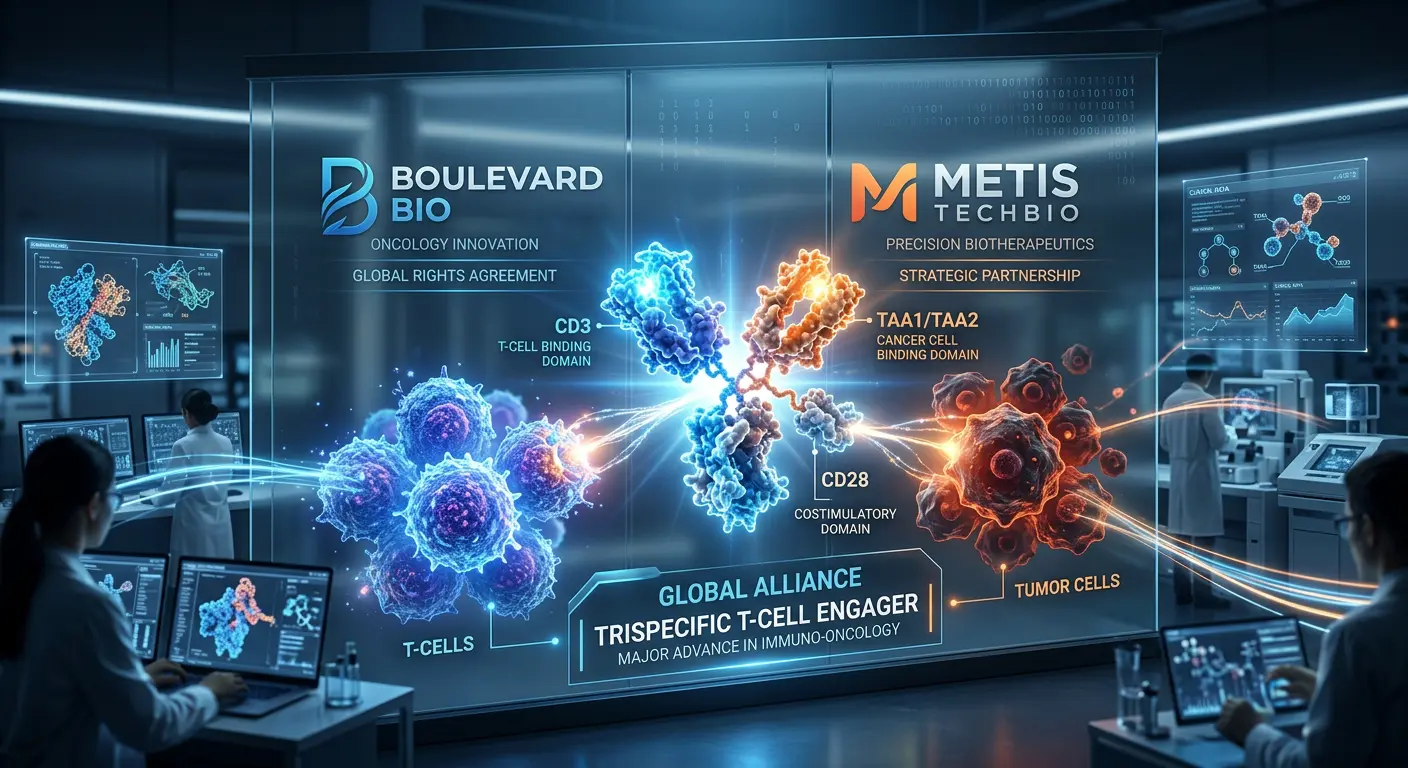
Boulevard Bio has put real money behind a bet on the next wave of T-cell engagers, and it’s sourcing that bet from China.
The U.S. biotech, founded with backing from healthcare investment firm Deerfield Management, has agreed to pay $20 million upfront to Metis TechBio for the worldwide rights to a trispecific T-cell engager built to treat autoimmune disease. The bigger number sits on the back end: up to $1.6 billion in milestone payments tied to development, regulatory and commercial progress, plus tiered royalties if the drug ever reaches the market. Metis spelled out the terms in a June 30 filing with the Hong Kong stock exchange.
At the center of the deal is MTS-128, an early-stage candidate that hasn’t yet entered the clinic. Metis built it on its NanoForge platform, which the company describes as the first AI-driven nano-delivery system of its kind.
The “tri” in trispecific is what sets MTS-128 apart. Most T-cell engagers on the market or in trials are bispecific; they latch onto two targets, one on a T cell and one on the cell the drug is meant to destroy, dragging the two together so the immune system does the killing. MTS-128 reaches for three targets at once. Metis hasn’t said publicly what those three are; its June filing left them out, and the company’s website only notes that the drug is pointed at an autoimmune indication it likewise declined to name.
Metis makes the case that the extra arm earns its keep. In the filing, the company said a trispecific design can work on more biological mechanisms at the same time, which it believes could sharpen how efficiently target cells are destroyed, widen the therapeutic window, and improve both selectivity and safety. Metis also framed the agreement as proof that its method works, pointing to MTS-128 as evidence it can fuse artificial intelligence with protein drug design and keep its NanoForge engine churning out fresh candidates.
That pitch arrives at a moment when the whole field is leaning hard into T-cell engagers. The format has been one of the busier corners of biopharma dealmaking this year. Astellas signed a collaboration worth up to $1.7 billion with Vir Biotechnology around a prostate cancer T-cell engager, and Boehringer Ingelheim has openly placed the modality near the top of its dealmaking wish list.
The autoimmune angle is the fresher twist. For years, T-cell engagers were almost entirely a cancer story. The logic behind the shift is straightforward enough, if a T-cell engager can marshal the immune system to clear cancer cells, it might do the same to the misbehaving immune cells that drive autoimmune conditions. That idea picked up steam earlier this month, when Cullinan Therapeutics shared a first look at clinical data for its own engager in systemic lupus erythematosus. A deal of this size suggests investors are increasingly willing to treat the approach as more than a hunch.
A word on the two companies involved, because neither is exactly a household name.
Metis began life as Metis Therapeutics in 2020. Co-founder Hongming Chen previously served as chief scientific officer at Kala Pharmaceuticals, an eye-disease specialist, and he started the company alongside two MIT scientists: Tsai-Ta Lai, who runs it as CEO, and Wenshou Wang, the chief operating officer. The company keeps Chinese offices in Hangzhou, Beijing and Shanghai, plus a foothold in Cambridge, Massachusetts. It went public last month, and it doesn’t undersell its technology. Metis claims the biggest proprietary library of LNP lipids in the world, north of 10 million of them.
MTS-128 is far from Metis’ only project. The company runs a spread of preclinical and clinical programs across immunology, cancer, metabolic disease and the central nervous system. Its furthest-along candidate is MTS-004, a reworked version of Otsuka’s Nuedexta for pseudobulbar affect, a neurological condition that triggers uncontrollable bouts of laughing or crying.
Related news
Pfizer and Innovent Strike $10.5B Oncology Collaboration
Boulevard, meanwhile, has said almost nothing. The filing describes it as a company focused on developing innovative immunotherapies and confirms its Deerfield roots, but the investment firm hasn’t even added Boulevard to the portfolio list on its own website yet. For a company that just committed to a deal worth as much as $1.6 billion, that’s a remarkably low profile.