
Rare Disease Produced Two First-Ever Approvals in Two Days, and Both of Them Are Neurology
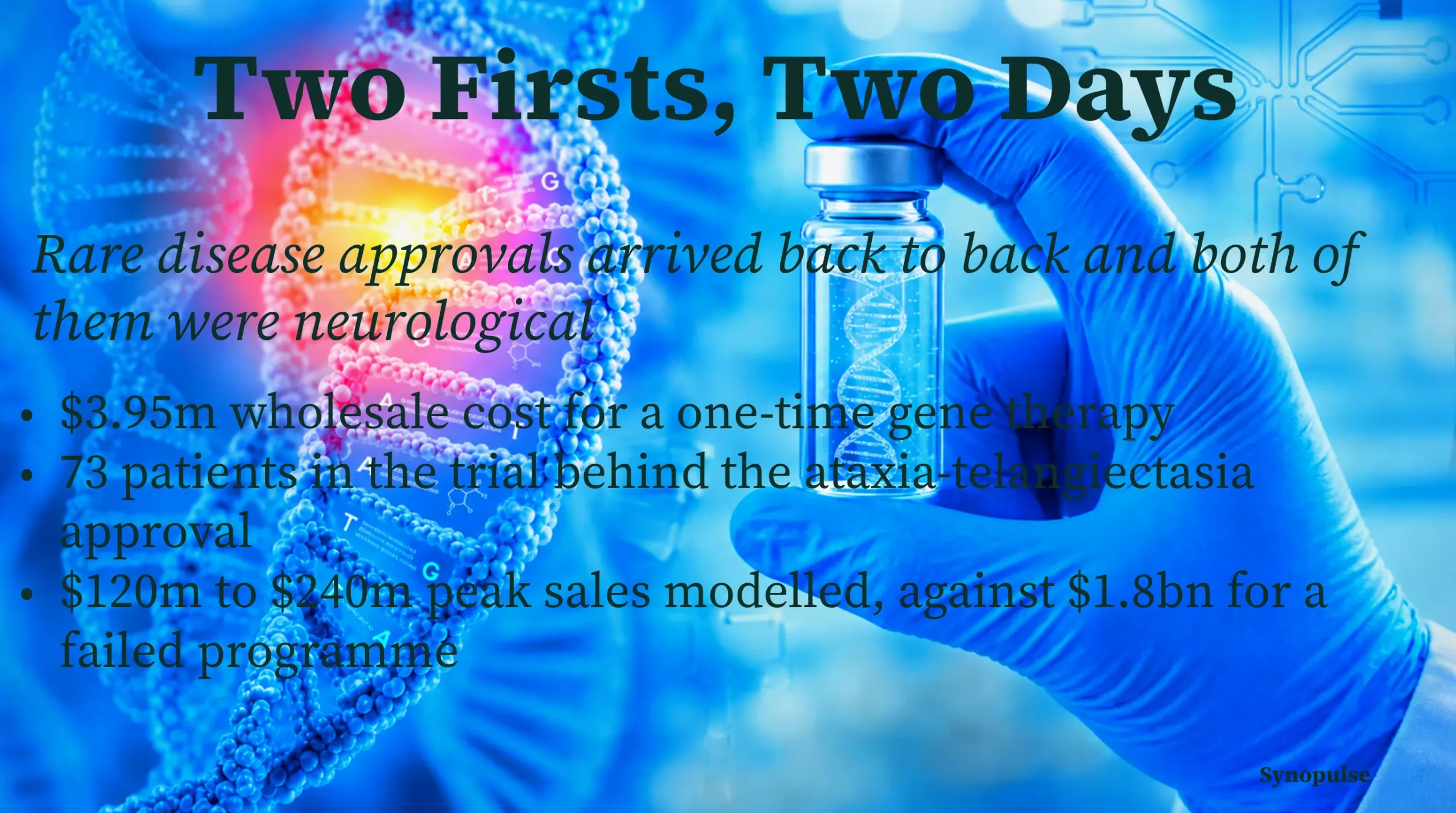
On 17 September the FDA approved the first treatment for Sanfilippo syndrome type A. On 18 September it approved the first treatment for ataxia in ataxia-telangiectasia. Both diseases destroy the nervous system in children, both had nothing before, and the two approvals used opposite commercial models: a one-time gene therapy priced at $3.95 million, and an oral suspension already selling in a different rare neurological disease.
Two diseases with no approved treatment got one, a day apart
Fayuvi (rebisufligene etisparvovec), also known as UX111, received standard full approval for paediatric patients with mucopolysaccharidosis type IIIA. It is an AAV9 gene therapy, supported by the Transpher A programme and its long-term follow-up, using reductions in cerebrospinal fluid heparan sulfate and neurodevelopmental outcomes measured against natural history. The FDA had rejected it in July 2025 over manufacturing.
Aqneursa (levacetylleucine) was approved the next day for ataxia in adults and children with ataxia-telangiectasia weighing at least 15 kg. The evidence is a randomised, double-blind, placebo-controlled crossover study in 73 patients, 26 adults and 47 children, with a median age at treatment initiation of 13 years and two 12-week periods.
Neither disease is usually filed under neurology in a commercial database. Sanfilippo is a metabolic storage disorder and ataxia-telangiectasia is a DNA repair disorder with immune and cancer components. Both kill through the nervous system, and both approvals are neurological approvals in everything except how the market classifies them.
One molecule is walking across three rare neurological diseases
Levacetylleucine was approved in 2024 for the neurological manifestations of Niemann-Pick disease type C. It now has a second rare neurological indication. IntraBio is running a Phase 3 study, IB1001-304, in CACNA1A-related disorders, with enrolment expected to complete in October 2026.
The company puts the CACNA1A population at roughly 30,000 people in the United States and 690,000 worldwide, none of whom have an approved therapy. That is the pattern worth naming, because it is now the dominant one in the segment: a single molecule, a series of small trials, and a label that grows one orphan neurological indication at a time.
Indication stacking beats platform betting, on this month’s evidence
Put the two approaches side by side. IntraBio has taken one oral compound through two approvals and into a third pivotal study, each on a trial in the low hundreds or smaller. Ultragenyx has two approved gene therapies in five weeks, Genglycos in glycogen storage disease type Ia on 19 August and Fayuvi on 17 September, and lost roughly half its market value on 2 September when the antisense programme that carried its valuation failed in Angelman syndrome.
The difference is not scientific merit. It is that a 73-patient crossover trial in a disease with no treatment is a cheaper shot on goal than a Phase 3 in a neurodevelopmental disorder with a cognitive primary endpoint, and it can be repeated. Anyone modelling a rare neurology portfolio should be counting how many indications a molecule can reach, not how large the first one is.
The gene therapy arithmetic did not improve because the approval arrived
Fayuvi is priced at $3.95 million for a population Ultragenyx puts at 3,000 to 5,000 patients across commercially accessible geographies. The company says payer engagement before approval established that lifetime cost of care in MPS IIIA can exceed $8 million, which is the argument the price rests on. Product is expected to ship to qualified treatment centres within 30 to 60 days.
Analysts model peak sales of $120 million to $240 million. Against that, the company received a priority review voucher on approval, an asset that has traded around $200 million. In other words, the voucher issued alongside the approval may be worth as much as the first several years of the product it came with.
That is the structural problem with ultra-rare gene therapy and it did not change this week. One-time treatment, a prevalent pool that empties as it is treated, and an incidence-based run rate afterwards that is measured in dozens of patients a year. The approval is a genuine first for the families involved. It is not a business on its own, which is why Ultragenyx is now describing itself through expense reductions and a 2027 profitability target.
What the rest of September decides
Published rare disease decision calendars put eight FDA actions between 19 and 30 September, including Ionis’s zilganersen in Alexander disease and Egetis’s tiratricol in MCT8 deficiency. Both are neurological, both would be firsts, and both would extend the run.
Watch what happens to the reimbursement conversation if three or four first-ever treatments for childhood neurodegeneration arrive inside a fortnight. Medicaid programmes carry most of this population in the United States, and they will be asked to fund several million-dollar decisions in the same budget cycle rather than one at a time.
And watch whether anyone else copies the IntraBio route. A molecule with an established safety profile, moved across rare neurological indications on small controlled trials, is the lowest-capital path to a first-in-disease label currently available, and this month it worked twice.