
Canada Moved Two Cancer Drugs Forward in One Week. Neither Went the Normal Route.
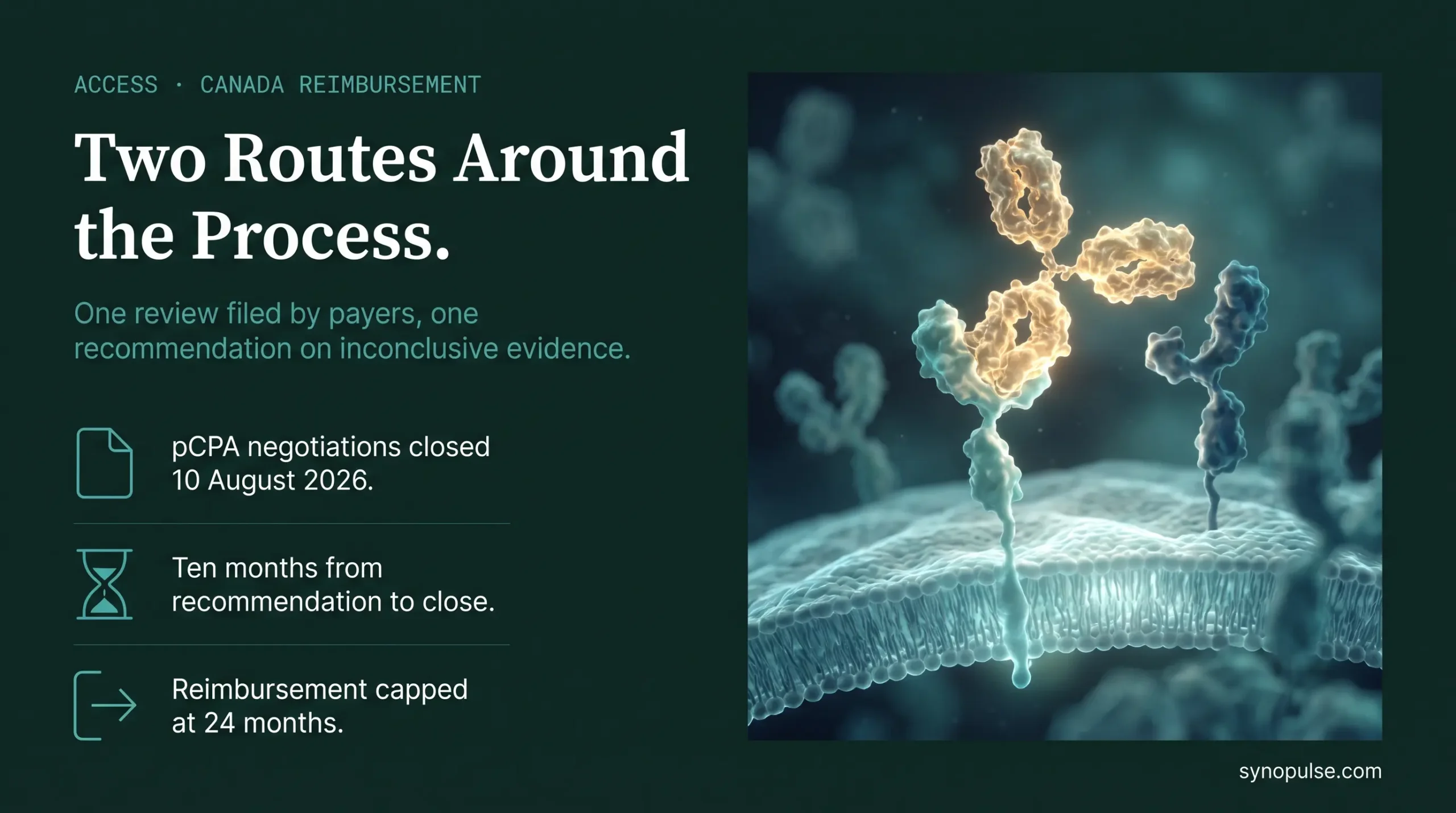
- Roche Canada completed pCPA negotiations on 10 August 2026 for Perjeta (pertuzumab) with trastuzumab and chemotherapy as neoadjuvant treatment in HER2-positive locally advanced, inflammatory or early breast cancer. The review that made it possible was a Non-Sponsored Reimbursement Review, brought forward by public drug programs rather than by the manufacturer.
- That file took its time. CDA-AMC issued a positive recommendation on 6 October 2025, negotiations opened in February 2026 and closed roughly six months later. Provincial and territorial listing decisions are still outstanding, so the drug is not yet funded. Roche calls the regimen the established global standard of care.
- Separately, CDA-AMC published a positive recommendation on 17 August 2026 for Xospata (gilteritinib) as post-transplant maintenance in measurable residual disease positive, FLT3-ITD mutated AML. The evidence is a post hoc subgroup analysis that pERC itself called highly uncertain, hypothesis-generating and inconclusive on the statistics.
- pERC recommended it anyway, citing severity, the absence of funded options after allogeneic transplant, and the biological plausibility that MRD positivity predicts relapse. Reimbursement is capped at 24 months, limited to adults 18 and over prescribed by transplant-experienced clinicians, and conditional on a price reduction.
Access read
Read as two access wins, which they are. Read again and both are workarounds. One drug reached review only because payers filed for a manufacturer that had not. The other was recommended on evidence the committee described as inconclusive.
- The Perjeta review proceeded without the sponsor. Public drug programs used the non-sponsored route to assess a regimen available in many countries for years, and it still took until 10 August to clear pCPA. That mechanism exists because manufacturer non-submission otherwise ends the process, as it did for Vanrafia this month.
- pERC recommended Xospata while calling its own evidence inconclusive. The recommendation, published 17 August, rests on a post hoc subgroup analysis with no quality-of-life data for MRD-positive patients. Unmet need and biological plausibility carried it, not the statistics. Expect that reasoning to be cited in future oncology submissions.
- Both decisions push the residual risk back onto price and time. Xospata is capped at 24 months and conditional on a cost reduction. Perjeta cleared pCPA roughly 10 months after its positive recommendation and still awaits every province. Track listing dates, not negotiation completions.
Read the original source (Roche Canada) → | Xospata recommendation (CDA-AMC) →
GeographyCanada