
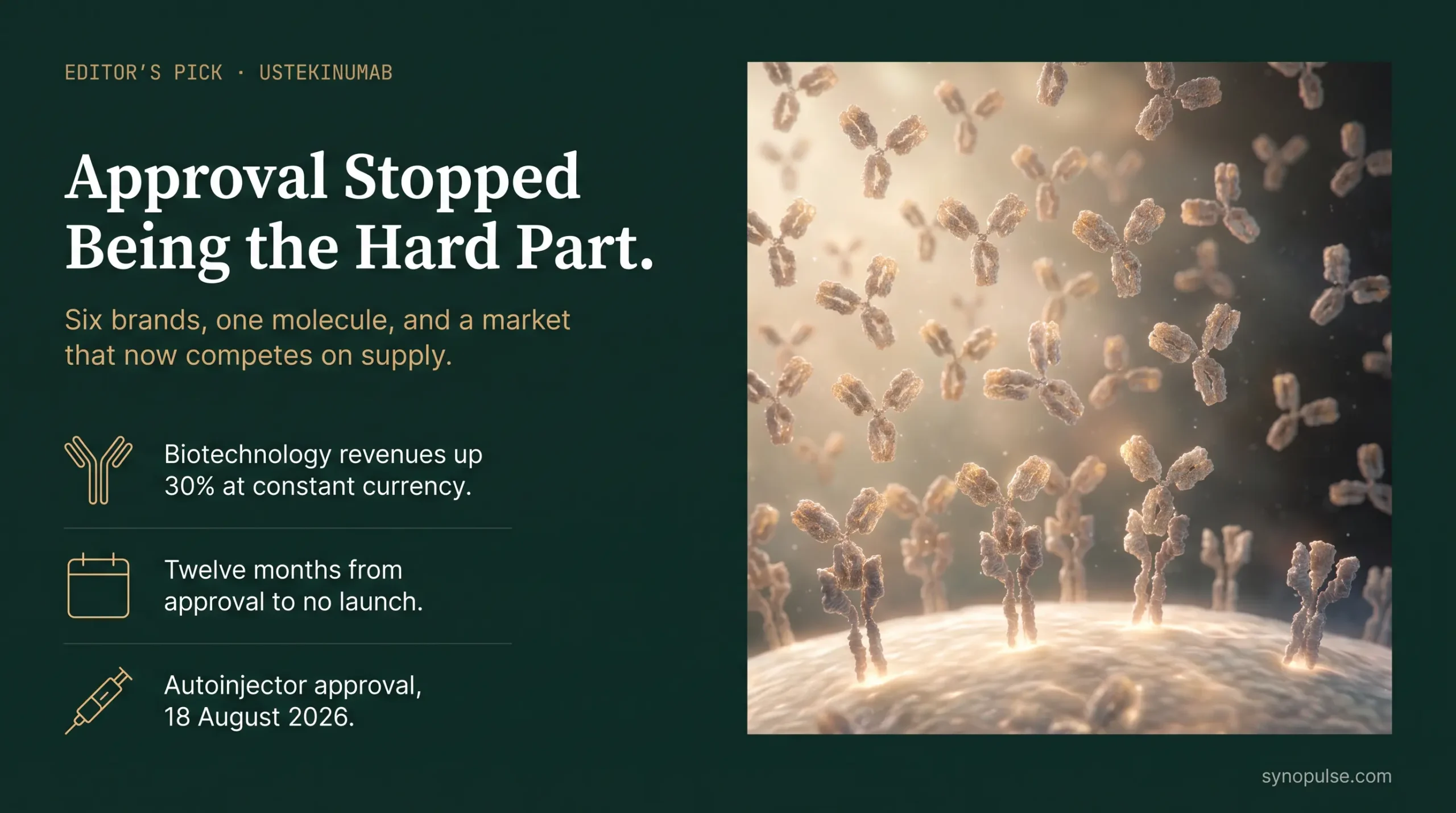
In Ustekinumab Biosimilars, Approval Stopped Being the Hard Part
One molecule, two continents, and a field crowded enough that a marketing authorisation now buys very little on its own. Two events this month show where the competition has actually moved: to supply reliability, and to the device in the patient’s hand.
The licence stopped being the moat
Stelara’s European and American patent cliffs produced exactly what they were meant to produce. In the EU, STADA and Alvotech’s Uzpruvo and Sandoz’s Pyzchiva reached patients in July 2024, with Celltrion’s Steqeyma following in November. In the US, Bio-Thera Solutions’ BAT2206 cleared the FDA in May 2025 and launched that November as Starjemza through Hikma. Biocon’s Yesintek is on the market there too. The same Bio-Thera molecule carries a second brand in Europe, Usymro, licensed to Gedeon Richter for the EU, the UK and Switzerland under an October 2024 agreement, and approved by the European Commission on 26 August 2025.
Set out like that, the interesting thing is not how many companies got through. It is how little getting through now settles. A biosimilar licence used to be the scarce asset. In ustekinumab it has become the entry ticket, and the returns accrue to whoever solves the two problems that come after it.
A year after approval, one brand has still not reached patients
Richter published its Q2 and H1 2026 results on 7 August 2026. The release is a good one. Constant-currency pharma revenues rose 8.7%, clean EBIT guidance was upgraded to double-digit growth, and the Biotechnology segment grew 30% at constant currency, which the company attributes to biosimilar revenues, very strong teriparatide sales and new product launches. The chief executive’s quote names Tuyory, Richter’s tocilizumab biosimilar, as now being commercialised.
Usymro is not mentioned anywhere in that release. Twelve months after European approval, the product that was supposed to extend Richter’s biosimilar franchise into the largest immunology molecule available to copy does not appear in the company’s own account of its half year. Trade coverage has reported that the launch is on hold over manufacturing compliance, and that the period carried a one-off impairment tied to a licensed product whose partner hit production problems. Richter’s results release says neither of those things, and Synopulse has not been able to confirm them against a company document.
What can be confirmed is the structure, and the structure is the point. Under the October 2024 agreement, Bio-Thera develops and manufactures. Richter commercialises. Richter operates eight manufacturing sites and makes its own denosumab biosimilars in house, so this is not a company that cannot run a plant. It is a company that, on this particular product, does not run the plant. Whatever is happening in Guangzhou lands on a Hungarian income statement, and Richter’s remedies are contractual rather than operational.
Competition has moved to the device
The second event is smaller and easier to miss. On 18 August 2026 Biocon announced supplemental FDA approval for Yesintek in two single-dose prefilled autoinjector presentations, 45 mg/0.5 ml and 90 mg/ml. No new molecule, no new indication, no new clinical package worth the name. A new way to give a drug that half a dozen companies already sell.
That is what competition looks like once price has done its work. When several suppliers hold the same licence for the same molecule and discounting has run its course, the remaining levers are the ones that touch the patient and the pharmacist: presentation, device ergonomics, cold-chain simplicity, and the plain question of whether the boxes arrive. Autoinjectors are the visible half of that. Supply reliability is the invisible half, and it is worth more.
What to watch
Three things. Whether Richter names Usymro in its Q3 results, and in what terms, which will settle what the August silence meant. Whether Bio-Thera’s American partner sees any disruption to Starjemza, since the same manufacturer supplies both brands and a compliance problem does not respect a licensing boundary. And whether the next wave of ustekinumab entrants leads with device presentation rather than price, which is the tell that the discounting phase is over.
The wider lesson generalises past this molecule. In-licensing a biosimilar buys speed and avoids capital expenditure, and it moves a manufacturing risk onto a balance sheet that has no way to manage it. That trade is worth making when the licence is scarce. When the licence is not scarce, and six companies hold one, the only durable advantage left is control of the thing your partner controls instead.