
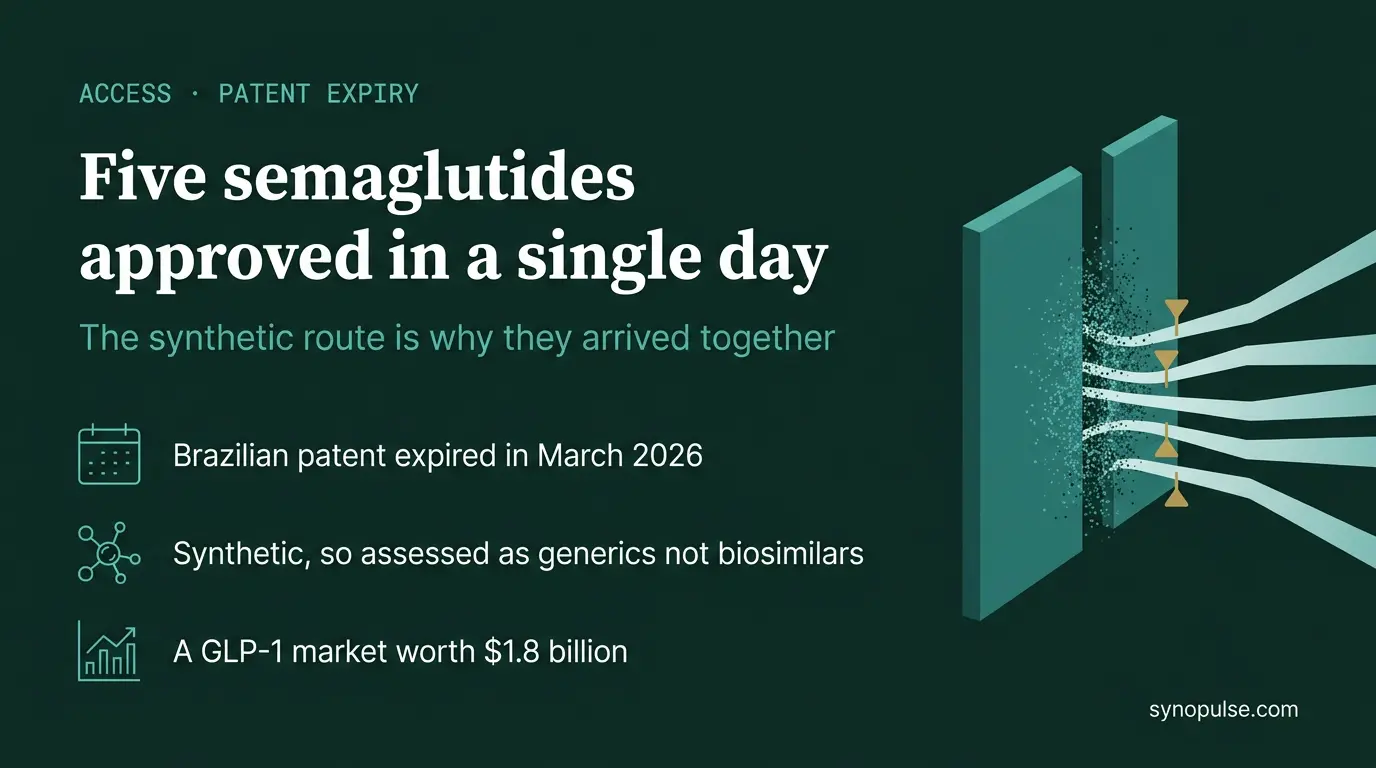
Brazil Approved Five Semaglutides in a Day. Sandoz Announced One of Them.
- ANVISA granted marketing authorisation for Owozy (semaglutide) for type 2 diabetes, developed by Adalvo and commercialised in Brazil by Sandoz, in a pre-filled multi-dose disposable pen. Launch is expected in the second half of 2026.
- Sandoz issued it as an ad hoc announcement under SIX Swiss Exchange listing rules, the disclosure category reserved for price-sensitive information, while stating the approval has no impact on its 2026 financial guidance.
- On the same day ANVISA approved five new injectable semaglutide products in total: Owozy, Seemasun, Zempneo, Semavy and Orsema. All use synthetically manufactured semaglutide rather than the biologically produced molecule.
- Ozempic’s Brazilian patent expired on 20 March 2026. More than 16.5 million people in Brazil live with diabetes, in a GLP-1 market estimated at $1.8 billion.
Access read
Sandoz announced one approval. The regulator granted five the same day, and that is the story. The mechanism behind it is the synthetic route: because these products are chemically manufactured rather than biologically produced, they can be assessed as generics rather than as biosimilars, which is a materially lower evidentiary bar and a far cheaper development path. That is why five arrived together rather than one at a time, and it is why the price competition in Brazil is likely to be sharper and faster than the biosimilar entries Europe has seen. Note also what Sandoz actually did here. It did not develop the product, Adalvo did; Sandoz took commercial rights in a defined market. That is the standard structure for reaching a first wave quickly without carrying development cost, and the company’s own guidance statement confirms the near-term revenue is immaterial. This is a position being taken, not a business being booked. The wider picture is the one worth holding. Semaglutide protection has now lapsed in Brazil and lapses in Canada after a missed maintenance payment, while US exclusivity is expected to hold into the next decade. The largest pharmaceutical franchise in the world is going generic almost everywhere except the market where it earns most, at precisely the moment Washington is trying to peg American prices to the lowest paid abroad.
Read the original source (Sandoz) →