
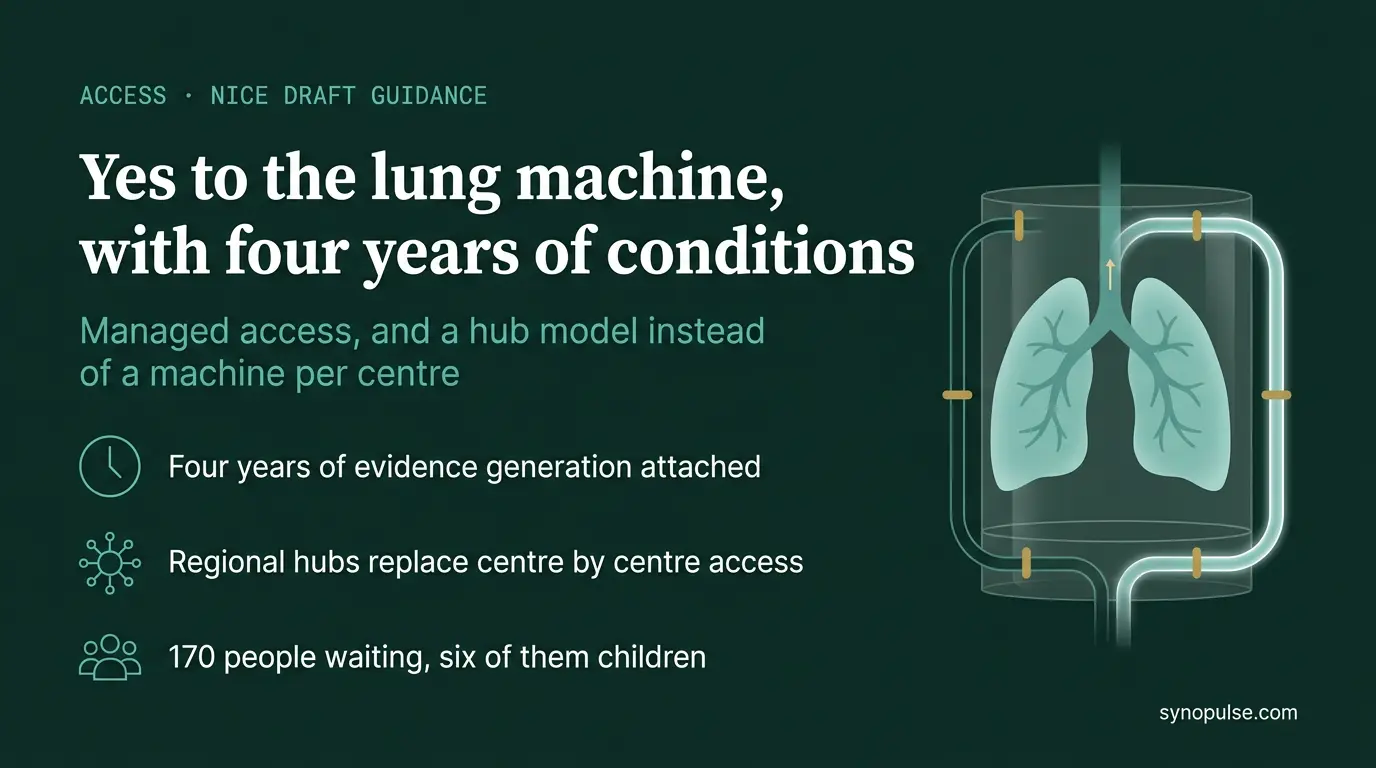
NICE Said Yes to the Lung Machine, and Then Attached Four Years of Conditions
- NICE issued draft guidance conditionally recommending the XVIVO Perfusion System for NHS use in England, to assess and recondition marginal adult donor lungs that would otherwise be declined for transplant.
- The recommendation runs with evidence generation over four years. The technology can be used only while data on its benefits and costs are collected, after which NICE decides whether to recommend it outright.
- The system currently operates in three of England’s five specialist adult lung transplant centres, so access has depended on where a patient is treated. NICE proposes routing donated lungs through regional hubs for assessment and reconditioning before returning them to the recipient’s local centre.
- NHS Blood and Transplant data cited alongside the guidance record 170 people waiting for a lung transplant in the UK, six of them children. Most adults wait well over a year, some close to two.
Access read
Two things in this decision are worth more than the technology. The first is the mechanism. This is a conditional recommendation with managed access, meaning NICE has said yes and no simultaneously: the NHS may use the system, but only while generating the evidence that will decide whether it keeps using it. That structure is spreading across European HTA, and it is worth watching with clear eyes. Italy ran a conditional innovativeness category for eight years and abolished it this month, because almost nothing ever graduated from conditional to full status. A provisional yes is only meaningful if there is a real route to a permanent one, and four years is long enough for the answer to matter and long enough for the question to be forgotten. The second is the delivery model, which is the more elegant part. NICE has not tried to put a machine in every centre. It proposes hubs that receive donor lungs, assess and recondition them, then send them on. That is an infrastructure answer to an equity problem, and it accepts that some capabilities should be centralised rather than distributed, which is an unusual thing for a health system to say out loud. Note where this sits in a wider pattern: this is the third organ-supply story this month, after the first single-port robotic liver transplant and an FDA premarket approval for a lung perfusion system. The bottleneck in transplantation has never been surgical skill. It is supply, and three different systems are now attacking it at once.
Read the original source (NICE) →
CompaniesXVIVO
GeographyUnited Kingdom