
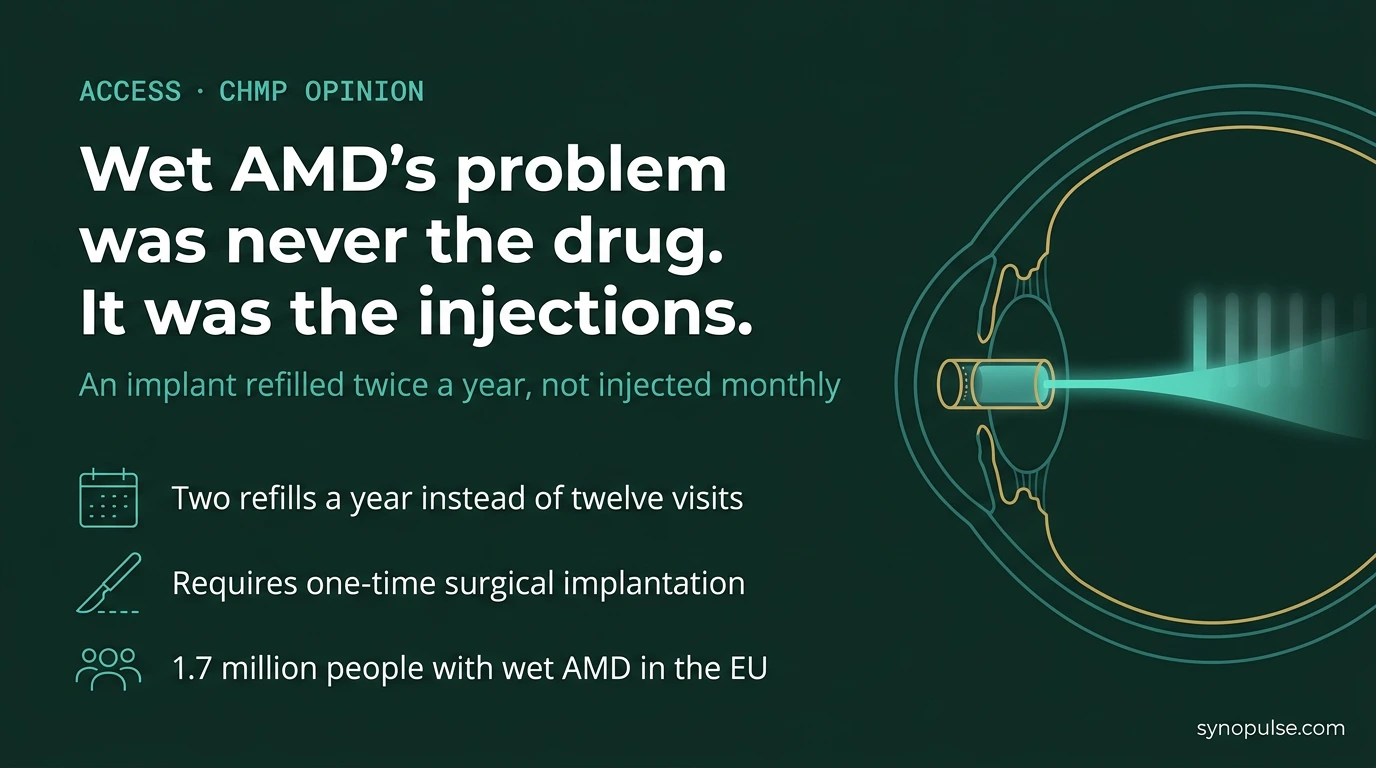
Wet AMD’s Problem Was Never the Drug. It Was the Injections.
- The CHMP recommended approval on 24 July of Susvimo (ranibizumab 100mg/mL) for neovascular age-related macular degeneration, delivered continuously into the vitreous through the Contivue refillable ocular implant. It would be the first continuous-delivery treatment for nAMD in Europe.
- The implant is placed in a one-time outpatient surgical procedure and refilled twice a year, against the monthly or near-monthly injections that define standard care. Roche cites vision maintenance data extending to seven years.
- The opinion rests on the LADDER, Archway and Portal studies, which showed vision maintained equivalent to monthly intravitreal ranibizumab. nAMD affects roughly 1.7 million people in the EU and is a leading cause of blindness over 60.
- The device has a history. The FDA approved Susvimo in 2021; Roche voluntarily recalled the implant, insertion tool and fill kit in 2022 after testing showed some implants fell short of performance standards, re-engineered them, and reintroduced the product in the US in July 2024. Contivue received its EU CE mark in September 2025.
Access read
Wet AMD has not had an efficacy problem for two decades. Anti-VEGF drugs work; what defeats patients is receiving them, an injection into the eye every four to eight weeks, indefinitely, in a population averaging well over 70, each dose requiring a clinic visit, a carer and a slot in a retina service that is already full. Real-world outcomes fall short of trial outcomes largely because people stop attending. So note what the two European wet AMD decisions of this week actually attack. Neither is a new mechanism. Both are twenty-year-old anti-VEGF molecules, and each targets a different failure of delivery: one makes the cheapest option a regulated product, this one cuts twelve visits a year to two. The field has moved from discovering drugs to distributing them. The caveat is the one Roche cannot solve with a label. Susvimo requires surgical implantation, which means an operating list, a trained surgeon and a reimbursement code for a procedure rather than an injection, and a retina clinic geared to inject is not automatically geared to implant. Approval settles whether the treatment exists. Surgical capacity and procedure reimbursement will settle whether patients get it, and the recall history means both hospital procurement and clinicians will look harder at the device than at the drug inside it.