
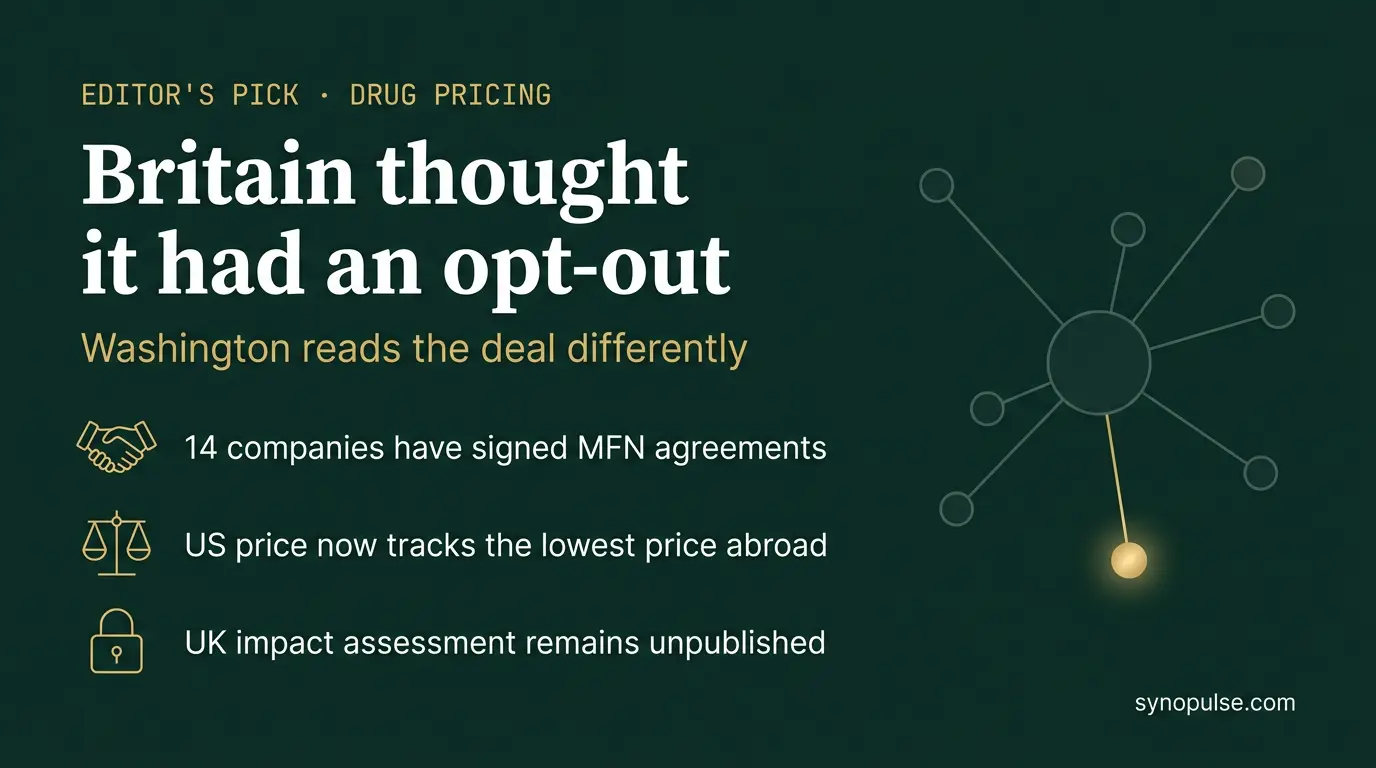
Britain Thought It Had an Opt-Out. Washington Reads the Deal Differently.
Most-favored-nation pricing is described as a policy that lowers American drug prices. Structurally it does something else, and the difference is only now becoming visible. By pegging US prices to the lowest price paid in comparable developed countries, MFN turns every foreign price negotiation into an American one. The countries that spent decades negotiating hard have just discovered their own success is now a liability.
What has actually been built
Since the executive order in May 2025, more than a dozen manufacturers have signed agreements with the administration. Pfizer went first at the end of September, AstraZeneca followed on 10 October, and the list now runs to fourteen or more, including Novo Nordisk, Lilly, Amgen, Boehringer Ingelheim, Bristol Myers Squibb, Genentech, Gilead, GSK, Merck, Novartis and Sanofi.
The terms follow a pattern. AstraZeneca committed to direct-to-consumer sales at 80 percent off list, gave every state Medicaid programme access to international benchmark prices, pledged $50 billion to US R&D and manufacturing including a Virginia facility, and secured exemption from tariffs (AstraZeneca). Lilly and Novo Nordisk brought GLP-1 pricing down to roughly $350 a month through the forthcoming TrumpRx platform (White House). CMS then moved to institutionalise the principle through the GENEROUS Medicaid model, which we covered when it launched (CMS).
Read as a set, these are not price cuts extracted from a reluctant industry. They are trades. Lower US prices in exchange for tariff protection and a manufacturing-investment narrative, negotiated company by company rather than legislated.
The mechanism nobody negotiated for
Here is the part that changes everything downstream. MFN does not set an American price. It sets a rule that the American price will track the lowest price paid elsewhere. That makes every foreign price a direct input into the manufacturer’s largest market.
Follow the incentive. If a low German reference price, a hard-won French agreement or an aggressive Italian payback arrangement now pulls down US revenue on the same molecule, the rational manufacturer response is not to accept it. It is to raise ex-US prices, delay launches in tough-pricing markets, or decline to file where the reference price would do more damage in Washington than the local market is worth.
European health systems built their leverage on a simple asymmetry: they could negotiate hard because the US market absorbed the difference. MFN removes the asymmetry. The countries that were best at extracting low prices are the ones with most to lose, because their prices are now the benchmark being applied against the manufacturer everywhere else.
Britain is where this is being fought out first. The UK agreed a pricing arrangement with the US administration that the government has said will cost around £1 billion over the current spending review period. Independent analysts have put the figure considerably higher, and the impact assessment behind it has not been published.
The substantive dispute is not the number. It is whether the UK sits inside the MFN reference basket at all. London has proceeded on the understanding that it secured an exemption. Washington appears to read the arrangement differently, and implementation remains under active negotiation. That single disagreement determines whether every future NICE decision is also, implicitly, a US pricing decision.
It also explains the secrecy. A government that publishes a full impact assessment mid-negotiation loses the ability to argue for the exemption it thought it already had. Whether that justifies withholding the numbers from the public, and from the devolved administrations whose health systems the outcome will bind, is a separate question and a fair one.
Four systems, one direction
Set this beside what else has happened in the last few weeks. Spain approved a draft law writing automatic price erosion into statute as generics gain share. China admitted patented molecules into its procurement rounds by transferring the patent risk to bidders. Washington threatened tariffs of 100 percent from August 2028 on foreign-made generics, aimed at the products with the least margin to absorb them.
Each is a national decision. Together they describe a global system in which every route to price has been narrowed at once, and MFN is the piece that links them, because it converts a concession made in one market into a cost incurred in another.
The question worth holding is not whether American patients pay less. Some will. It is what happens to the price, and the availability, of medicines everywhere the benchmark is drawn from.