
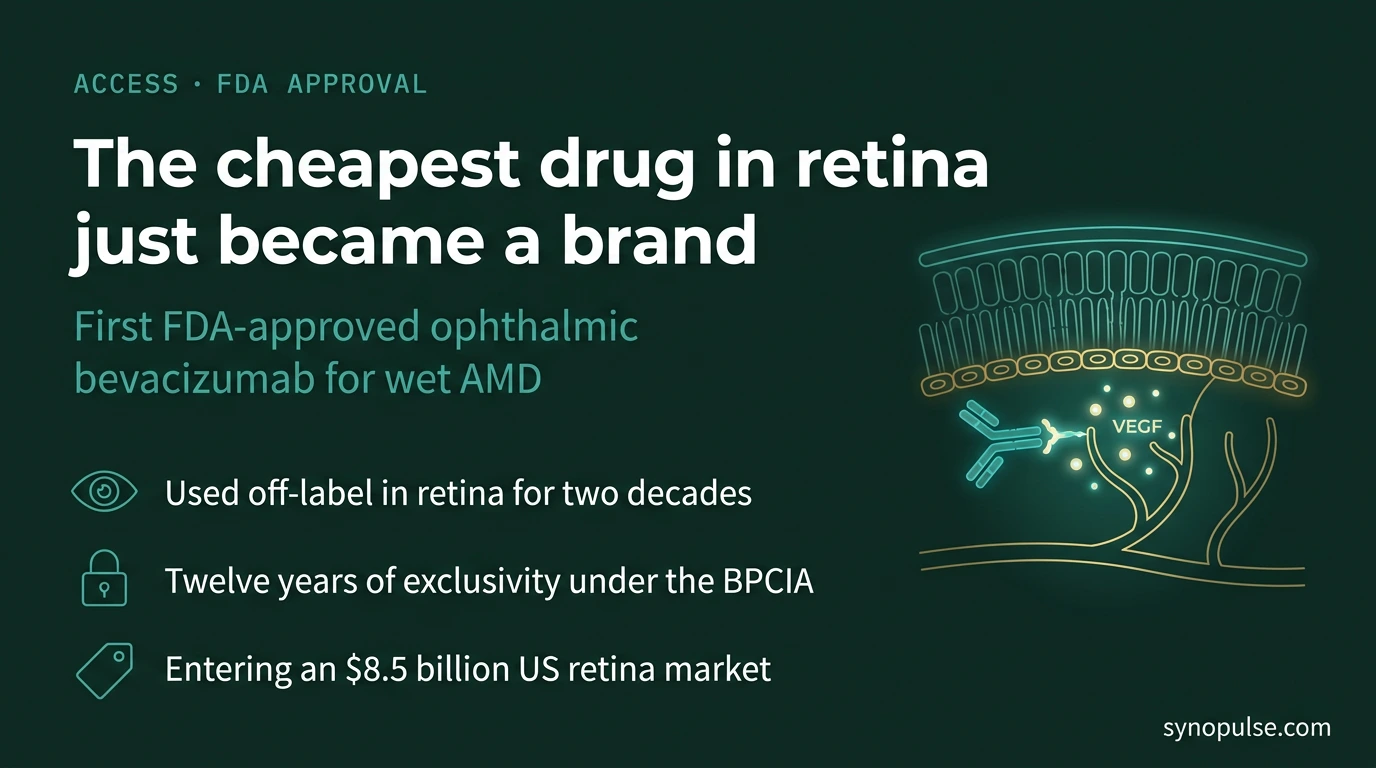
The Cheapest Drug in Retina Just Became a Branded Product
- The FDA approved Outlook Therapeutics’ LYTENAVA (bevacizumab-vikg) for neovascular age-related macular degeneration, the first and only FDA-approved ophthalmic formulation of bevacizumab in the United States.
- Bevacizumab already accounts for the majority of first-line anti-VEGF treatment in wet AMD, used for more than two decades as repackaged intravenous product prepared by compounding pharmacies, without an approved ophthalmic formulation or FDA oversight of that preparation.
- Outlook anticipates 12 years of reference product exclusivity under the BPCIA, and frames the opportunity as the roughly $8.5 billion annual US retina market. Product availability is expected before year-end.
- The regulatory turnaround was unusually fast: the BLA was resubmitted on 1 June, accepted on 16 June, and approved on 24 July. LYTENAVA already holds EU and UK marketing authorisations and has launched in Germany, Austria and the UK.
Access read
The cheapest option in retina medicine has just become a branded product, and the number that decides whether this works has not been disclosed. Compounded bevacizumab is used in most first-line wet AMD treatment for one reason: it costs a small fraction of the branded anti-VEGF agents, which is why an entire treatment paradigm was built on an off-label workaround. Outlook now has to price a regulated version of that same molecule, and the framing in its own release, an $8.5 billion market and a new standard of care, is not how a company describes a product it intends to sell at compounding prices. Note also what the exclusivity does and does not do. Twelve years under the BPCIA blocks biosimilar applications referencing LYTENAVA; it does not stop compounding pharmacies continuing to repackage intravenous bevacizumab as they have since 2005. So this is not a product replacing a cheaper rival, it is a regulated product asking physicians and payers to pay a premium for manufacturing consistency, approved labelling and FDA oversight on a molecule they have used cheaply for twenty years. That is a genuine value proposition and an unproven willingness to pay. Watch the launch price and the first payer coverage decisions, because they will settle whether this expands access or quietly raises the cost of the one affordable option in the field.
Read the original source (Outlook Therapeutics via GlobeNewswire) →