
China Stopped Excluding Patented Drugs From Its Price Cuts. Now the Bidder Signs for the Risk.
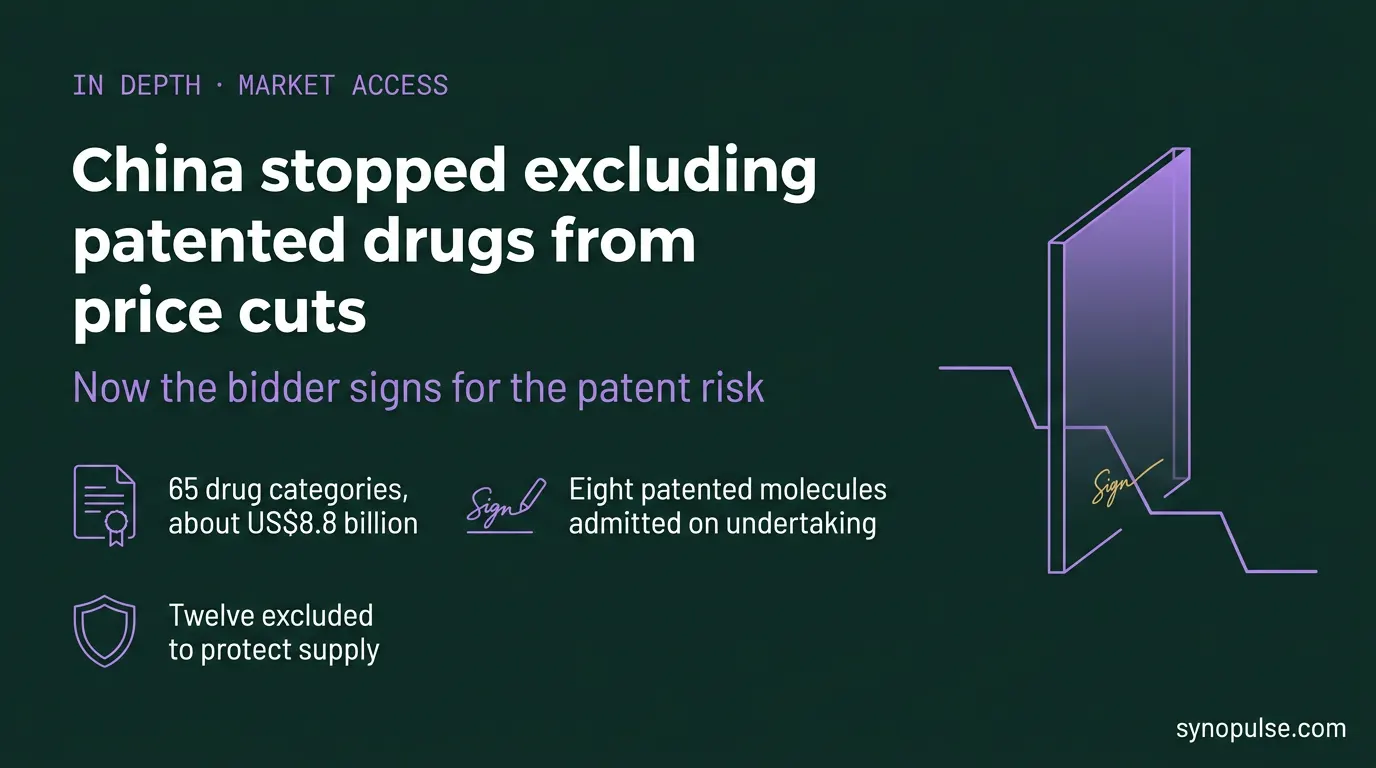
China has stopped treating a patent as a reason to keep a drug out of its price-cutting rounds. In the 12th round of national volume-based procurement, eight patent-sensitive molecules were invited in on one condition: the bidder signs an intellectual property undertaking and a non-infringement declaration, and carries the legal consequences alone. The state gets its price competition without adjudicating a single patent.
- The 12th VBP round covers 65 drug categories worth an estimated RMB60 billion, about US$8.8 billion. Eight of them are patent-sensitive and were admitted anyway, marked with a star, provided each applicant files an IP undertaking and a non-infringement declaration.
- The clearest case is sacubitril/valsartan. On 1 June 2026 China’s patent office granted Novartis a five-year term extension to 8 November 2031 on the crystal-form patent behind Entresto. Three weeks later the procurement office put the molecule in the catalogue and opened it to bidding.
- Twelve products that met the volume thresholds were excluded anyway, on grounds of patent uncertainty, clinical non-comparability or supply security. Authorities gave up savings on methotrexate, cytarabine and nitroglycerin to protect supply of drugs already in shortage.
Read together, the inclusions and the exclusions describe a procurement system that has stopped optimising for price alone. It now trades savings against legal defensibility and supply continuity, and where it cannot resolve a patent question itself, it transfers that risk to whoever wants the volume. A reader can stop here with the full picture. The sections below are the detail.
What actually changed: from exclusion to indemnity
On 23 June 2026 the National Joint Drug Procurement Office released Announcement No. 1 opening the 12th round of national centralised volume-based procurement, administered by the Shanghai Municipal Institute for Pharmaceutical Centralized Tendering and Procurement. The catalogue runs to 65 drug categories across cardiovascular disease, oncology, anti-infectives, endocrinology, neurology, gastroenterology, anaesthesia and critical care, an estimated RMB60 billion of annual spend. Submission and registration have closed; the round is now in qualification review and bid evaluation, and no winners have been named (Cisema).
The mechanism that matters sits in the treatment of patents. Previous rounds handled patent-sensitive molecules by leaving them out. This round splits the difference: eight products were admitted on condition that each applicant submits an intellectual property undertaking and a declaration of non-infringement. They are baricitinib oral solution, alogliptin, dapagliflozin/metformin modified-release, vonoprazan, sacubitril/valsartan, azilsartan, edoxaban and indobufen. Companies that fail to file the documentation risk removal from provincial procurement platforms, or restrictions on new provincial listings for the duration of the agreement period.
That is not a softening. It is a transfer. The procurement office no longer has to decide whether a generic entrant infringes; the entrant asserts that it does not, and owns the consequences if a court later disagrees.
Two arms of the same state, pointing opposite ways
Sacubitril/valsartan is where the tension becomes visible. On 1 June 2026, the China National Intellectual Property Administration granted Novartis a five-year patent term extension on the core crystal-form patent covering Entresto, running protection to 8 November 2031. Twenty-two days later, the procurement office listed the same molecule in a catalogue designed to drive its price down through competitive bidding.
Both decisions are internally coherent. CNIPA assessed a patent application on its merits. The procurement office assessed whether lawful competition could exist and concluded it could, provided bidders certified their own position. But the combined effect on a patent holder is that an extension granted by one agency does not translate into commercial protection from another, and the burden of enforcing it shifts from the administrative process into litigation the holder must initiate.
For multinationals, that reframes what a Chinese patent extension is worth. It remains a legal right. It is no longer a procurement shield.
The exclusions are the more revealing half
Twelve products cleared the preliminary competition and scale thresholds and were left out anyway, for four distinct reasons. Two, ibrutinib and crisaborole, were excluded because asserted patent disputes meant only companies willing to undertake non-infringement could compete, which the office judged insufficient competition. Three injectables were excluded after expert review found clinical use differed enough that grouping them into one procurement bucket would not produce meaningful comparison. One product was excluded because no competitive procurement channel had yet opened.
The fourth category is the one worth dwelling on. Ganirelix, cetrorelix and triptorelin were excluded as key medicines in assisted reproduction. Methotrexate, cytarabine and nitroglycerin were excluded as nationally recognised shortage medicines and clinically essential drugs. In each case the authorities chose supply continuity over price competition, which is a direct admission that aggressive procurement can drive suppliers out of a market and that the state now prices that risk explicitly.
This is the same structural problem that runs through every cost-containment system, arriving at the same answer from a different direction. Spain has just written automatic price erosion into law as generics gain share. Washington has threatened tariffs that would land on drugs with no margin to absorb them. Beijing has been running the most aggressive version of this experiment for eight years, and the 12th round shows what it looks like once the consequences have been felt: a carve-out list for the medicines the system cannot afford to lose. Every system that pushes prices down eventually discovers which products will simply leave, and then builds an exception for them. China has reached that stage sooner than most, because it moved faster and harder.
The tighter gate, and what it means for importers
Qualification requirements are stricter again this round. A bidder must hold a Chinese marketing authorisation issued on or before 23 June 2026, qualify through a recognised quality pathway such as Reference Listed Drug designation or Generic Consistency Evaluation, demonstrate at least two years of manufacturing experience in the same dosage form between June 2021 and June 2026, and maintain a clean GMP and inspection record from June 2024. Imported generics carry an additional condition: evidence of GMP inspection by Chinese regulators, on top of overseas certification.
Read that last requirement as industrial policy rather than quality policy. It does not exclude importers, but it prices in a Chinese inspection cycle that domestic manufacturers already satisfy by default, and it rewards production located where the inspectors are. The announcement did make participation procedurally clearer for overseas marketing authorisation holders, who may bid directly or through a China Domestic Responsible Person, and clarified that pending MAH transfers require both parties to apply jointly and qualify independently.
The pressure this creates, and where it goes
One detail from the run-up to the announcement says more about the stakes than any rule change. Reports surfaced that a foreign drugmaker had submitted a fabricated petition from doctors in an apparent attempt to resist VBP pricing pressure. Novartis, Bayer, Takeda and Eisai have all denied involvement. Whatever the outcome, an episode of that kind indicates how much margin is at stake and how few levers are left to defend it.
Which points at the thing our own H1 data already showed. Across the first half of 2026, China bought $13.3 billion of assets and sold $92.6 billion westward across 45 deals, roughly a quarter of all global deal value. VBP is a substantial part of the explanation. When the domestic market systematically removes margin from anything that faces competition, the return on Chinese innovation has to be earned somewhere else, and it is being earned in licensing deals with Western partners. The 12th round is a procurement announcement. It is also, read at the right distance, one of the forces pushing Chinese assets onto the global market.