
Trump Wants Generics Made in America by 2028. The Economics Say They Can’t.
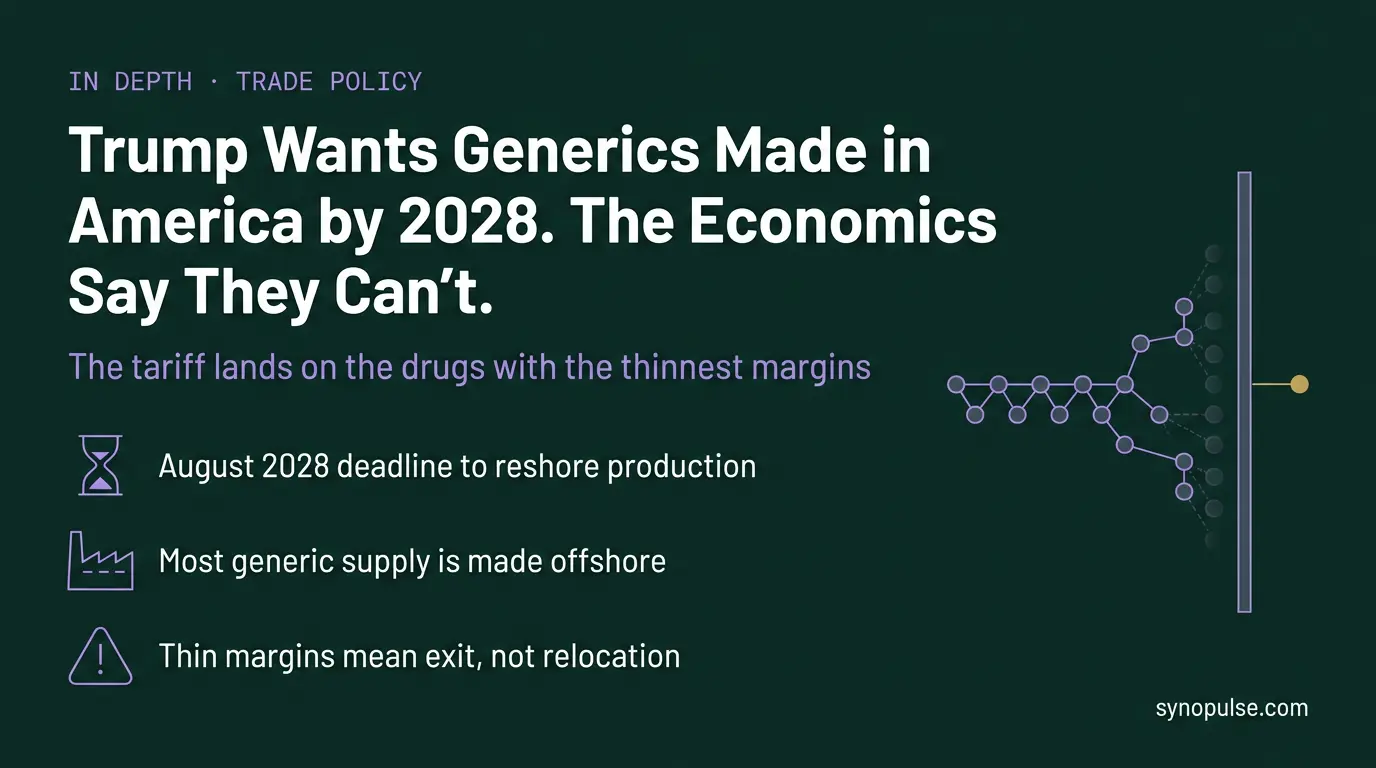
Generic medicines are the cheapest thing in American healthcare and the most fragile. Trump has now aimed a tariff at them with a two-year countdown attached, and the economics of the sector suggest it will not produce the factories he wants. What follows is the arithmetic, and what it says about who actually pays.
- The policy is a countdown, not a switch. Imported generics stay at zero for two years from 1 August 2026, rise to 100 percent in August 2028, then to 200 percent in August 2029. The runway is the instrument: it exists to force capital commitments now.
- It lands where there is no margin to absorb it. Generics are roughly 90 percent of US prescriptions but a small share of drug spending, and for a product earning cents a unit, a 100 percent import tariff exceeds the entire margin. The rational response is often not a US plant, it is discontinuation.
- Nothing has been implemented. This is a social media post, not a rule, and it follows a Supreme Court ruling that struck down a swathe of earlier tariffs and forced $81 billion in repayments. Treat it as a negotiating position with a real deadline attached.
The branded-drug tariffs were survivable because branded drugs carry the margin to absorb them. Generics do not, and that single difference is why this announcement matters more than its predecessors and why the stated goal, reshoring, is the least likely outcome. A reader can stop here with the full picture. The sections below are the detail.
The runway is the policy
The structure announced on 21 July is phased. Imported generics keep their zero rate for a two-year transition beginning 1 August 2026, move to 100 percent from August 2028, then double to 200 percent a year later (AJMC). Read that shape carefully, because the phasing is not a concession, it is the mechanism.
A pharmaceutical plant takes years to build, qualify and clear FDA inspection. Two years is close to the minimum credible timeline, which means the deadline is calibrated to force decisions in 2026 and 2027 rather than to collect duty in 2028. The tariff is a forcing function aimed at capital allocation, not a revenue measure. The question is whether the arithmetic it assumes actually holds.
The tariff lands where there is no margin to take it
Generic medicines account for about 90 percent of prescriptions filled in the United States while representing a fraction of what the country spends on drugs, and India alone supplies more than half of them (CBS News). That ratio is the whole problem. These are products competing on price in tenders and PBM contracts, often earning cents per unit.
For a manufacturer in that position, a 100 percent import tariff is not a cost to pass through, it exceeds the margin entirely, and the contracts that set the price offer no route to raise it. So the choice is not the one the policy imagines, build a plant or pay the tariff. It is build a plant or leave the product. Sandoz’s chief executive said as much publicly a year ago: without the ability to raise prices through PBMs or customers, the company would not supply the product.
Exposure is uneven, and the most exposed can least afford to move
The burden is not evenly distributed. Sandoz, one of the largest generic manufacturers in the world, has no US manufacturing at all. Teva draws roughly 15 percent of revenue from US generics, most of them made in Europe. Viatris takes about 25 percent of revenue from the US with half its generics imported. Canada’s Apotex is the most exposed of all, with no US plants and 40 to 50 percent of its revenue from generics (Fierce Pharma).
The pattern is uncomfortable: the companies with the least US footprint have the most to lose, and thin-margin businesses are precisely the ones without the balance sheet to build their way out. A policy designed to reward reshoring asks for capital investment from the segment least able to fund it.
The contradiction sits at the centre of the administration’s own drug agenda. Lowering prices has been the signature objective, and generics are the mechanism already delivering it. Tariffing them either raises prices or removes products, and the products most likely to go are the oldest and cheapest, low-margin injectables including certain cancer drugs, which are already the most shortage-prone category in American medicine. The plausible result is not more American manufacturing. It is fewer suppliers for the drugs that already have too few.
How firm is any of this
Not very, and that deserves saying plainly. No implementing rule has been issued, the announcement came by social media post, and it arrives after the Supreme Court invalidated a range of earlier tariffs and forced roughly $81 billion in repayments. A bill has been introduced in the Senate to limit unilateral tariff authority (The Hill). The head of the Association for Accessible Medicines called it a catalyst and expects negotiation before anything takes effect.
That leaves companies in an awkward position, which is probably the point. The deadline is distant enough that the policy may never take the announced form, and close enough that anyone planning US capacity has to act as though it will. Uncertainty of that shape is not a side effect of the announcement. It is the leverage.