
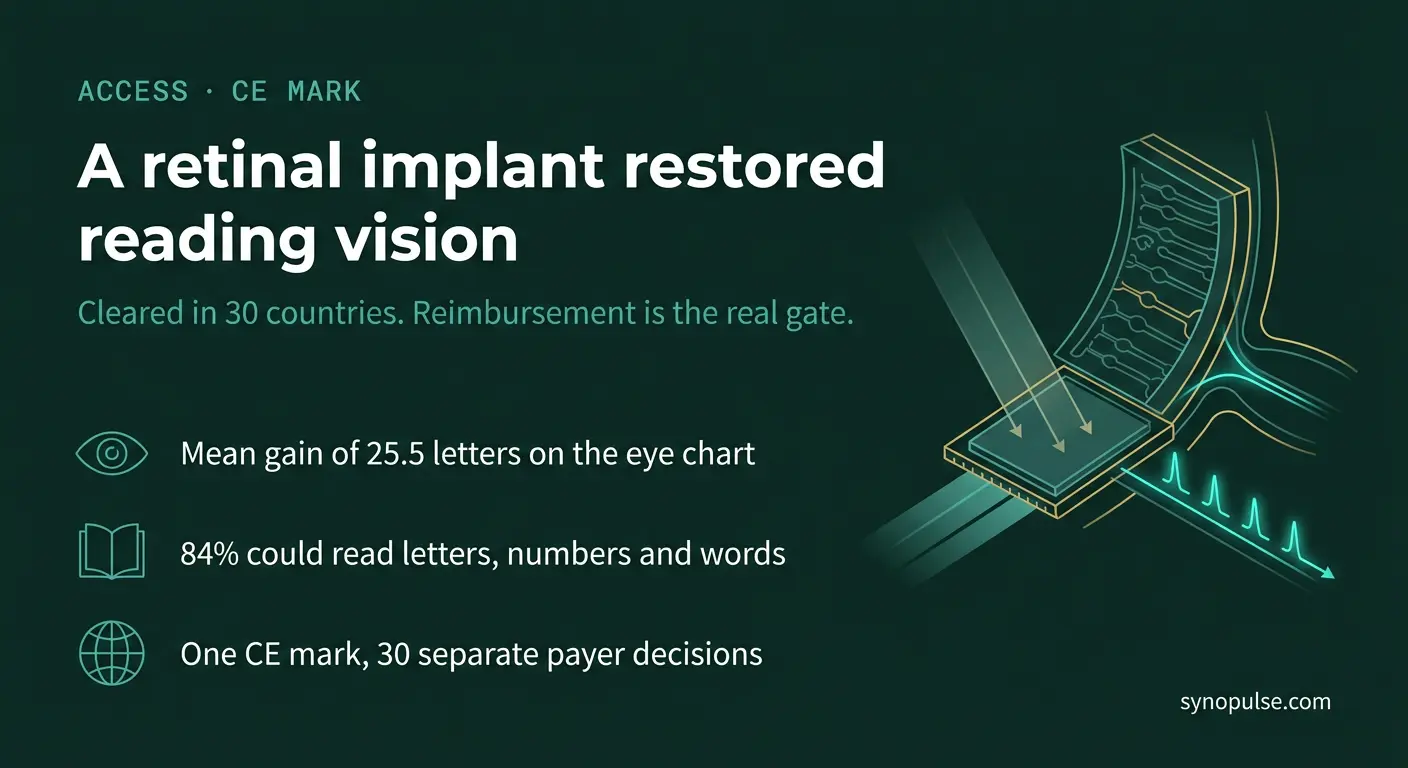
PRIMA Can Be Sold in 30 Countries Tomorrow. Reimbursement Is the Real Timeline.
- Science Corporation’s PRIMA retinal implant received a CE mark under the EU Medical Device Regulation from notified body DEKRA, clearing commercial sale across 30 European countries. It is the first brain-computer interface device CE-marked for form vision restoration, meaning reading letters, numbers and words.
- PRIMA is a subretinal photovoltaic implant placed under the atrophic macula, paired with glasses carrying a camera and infrared projector. It acts as artificial photoreceptors for patients with geographic atrophy from age-related macular degeneration, which affects more than 5 million people globally.
- In the trial behind it (38 patients, 17 sites, 5 countries, published in the New England Journal of Medicine): mean improvement of 25.5 letters, more than five lines on the ETDRS chart; 84% could read letters, numbers and words; 80% hit a meaningful acuity gain at 12 months (p<0.001).
- Science says country-specific reimbursement applications and clinical site activations are underway. The first commercial implant is expected in Germany. The US FDA review is ongoing.
Access read
The CE mark is the easy part, and the company’s own release quietly says so: reimbursement applications are underway, country by country. One conformity assessment opens 30 markets for sale, but each of those 30 decides separately whether to pay, and a first-in-category implant arrives with no existing reimbursement code, no comparator price and no precedent for who is eligible. That, not the regulatory file, is the real timeline, and Germany going first is the tell, it has the fastest route to funded innovative devices in Europe. The second thing worth noting is how this company got here. Science is a brain-computer interface company founded by a Neuralink co-founder, and it has just become the first BCI company with a product on the market, by going around the brain rather than into it. A subretinal implant carries lower surgical risk, a lower regulatory burden and an endpoint anyone can verify, can the patient read the letters. Read alongside the first-in-human cortical recording out of Geneva this week, the pattern is clear enough: the neural interface reaching patients first is the one that avoided the cortex.
Read the original source (Science Corporation via Business Wire) →