
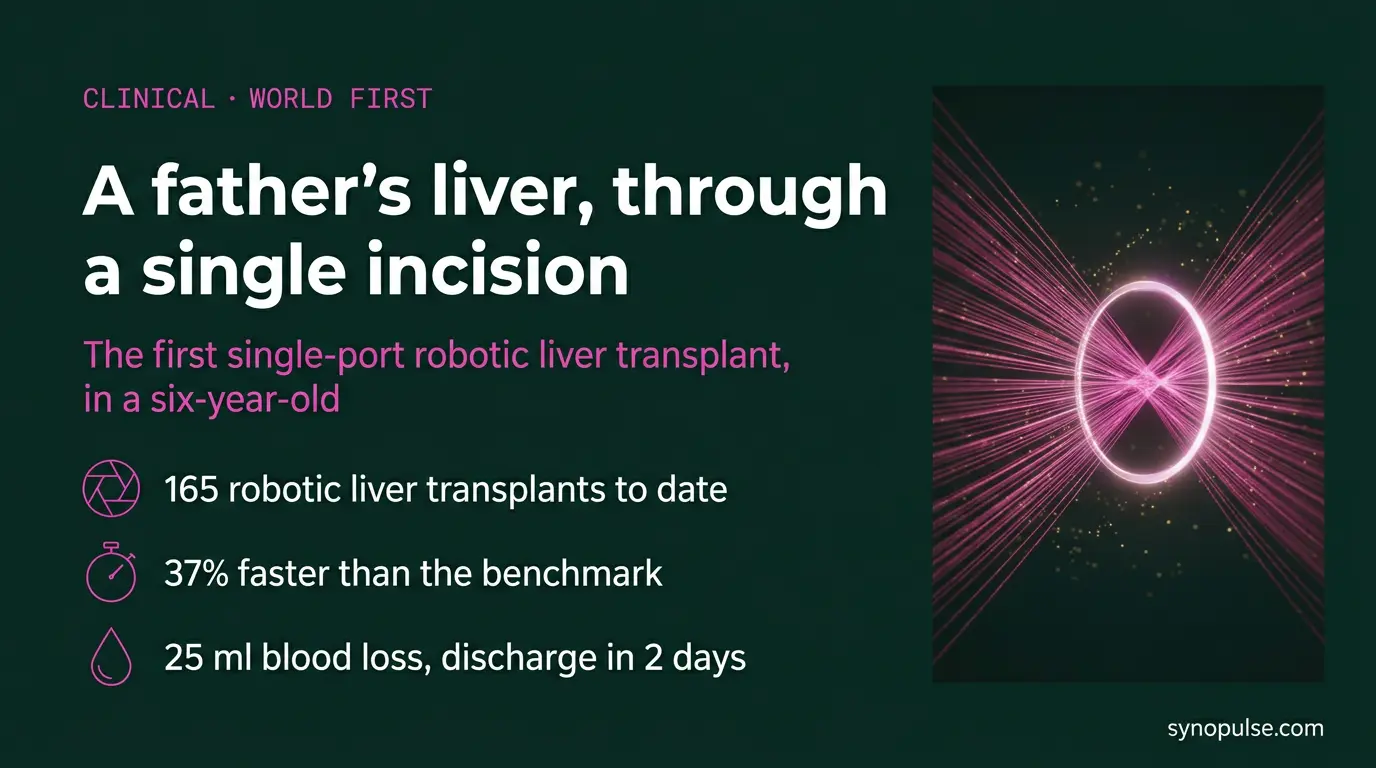
A Father’s Liver, One Incision: the First Single-Port Robotic Liver Transplant Lands in a Six-Year-Old
- King Faisal Specialist Hospital and Research Centre in Riyadh performed the world’s first liver transplant using a single-port robotic system. The recipient was a six-year-old boy with Wolcott-Rallison syndrome, a rare inherited disorder causing early-onset diabetes and recurrent acute liver failure.
- The donor was the child’s father, who gave the left lobe of his liver. The procedure completed successfully, with the graft functioning and no complications reported.
- It builds on a programme, not a one-off: KFSH performed the world’s first fully robotic liver transplant in 2023 and has since done 165 robotic liver transplants, backed by more than 1,700 robotic living-donor liver resections.
- In its first three single-port robotic donor hepatectomies in January and February 2026, procedures averaged 272 minutes against a 430-minute benchmark, roughly 37 percent faster, with 25 ml blood loss and donors discharged in two to three days.
Clinical read
The recipient makes the headline; the donor makes the difference. Living-donor liver transplant is rationed less by surgical skill than by donor willingness, and every deterrent, a long incision, weeks away from work, a permanent scar, shrinks the pool of parents who say yes. Twenty-five millilitres of blood loss and a two-day discharge changes what a parent is being asked to accept, and that is the variable that actually governs how many children get transplanted. The medtech read sits underneath it: single-port platforms have just proven themselves in one of the most technically demanding operations in surgery, which widens the addressable case mix well beyond the routine procedures they were sold into.