
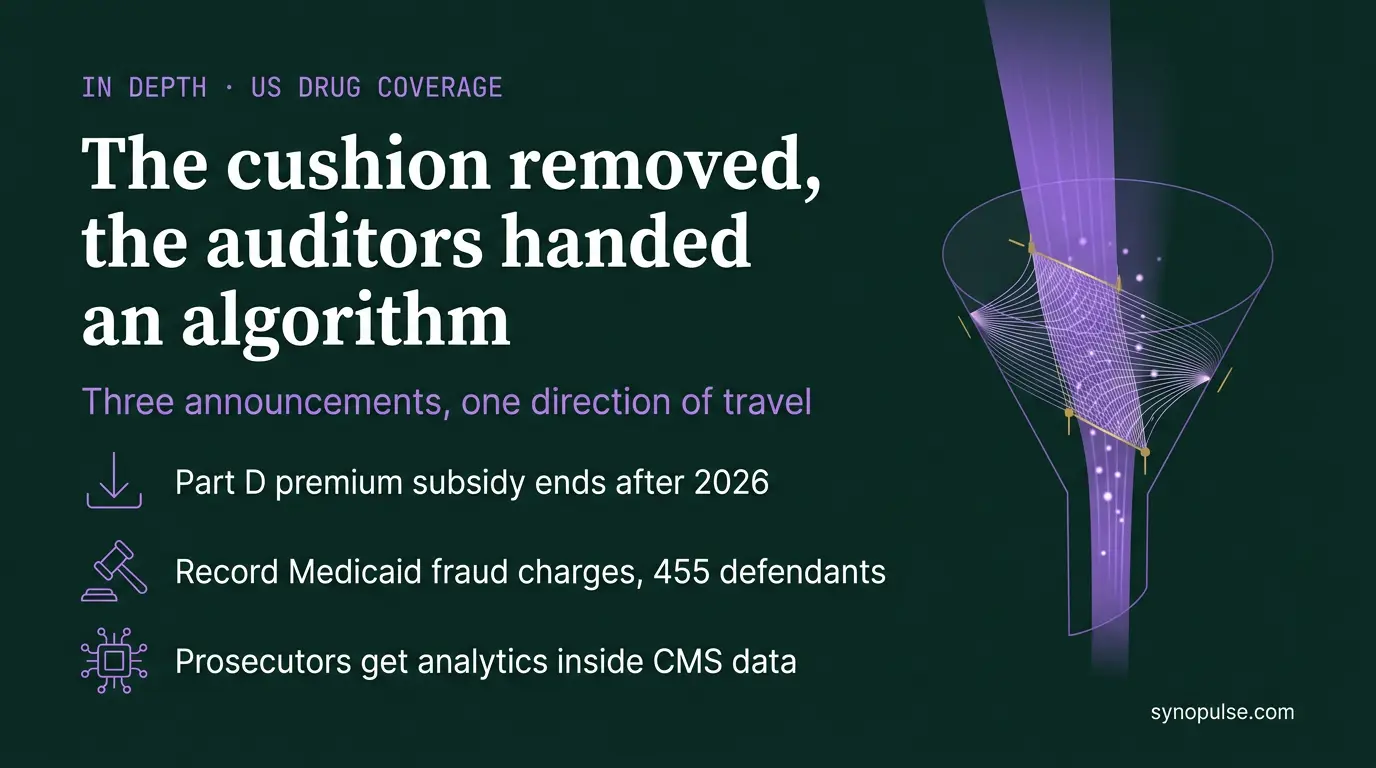
Washington Removed the Cushion Under Part D, and Handed the Auditors an Algorithm
Three announcements, treated as three separate stories, describe one direction of travel. Washington has ended the subsidy holding Medicare drug premiums down, charged a record number of Medicaid fraud defendants, and installed federal prosecutors’ analytics inside the payment system itself. Taken singly, a benefits story, a law enforcement story and an IT story. Taken together, the federal government paying less for medicines and tightening the conditions under which it pays at all.
- CMS is ending the Part D Premium Stabilization Demonstration after 2026, withdrawing roughly $3.6 billion a year that held premiums down for about 25 million people in standalone drug plans. Reporting suggests around three quarters will see some increase; CMS says most will pay under $10 more.
- The 2026 National Health Care Fraud Takedown charged 455 defendants over $6.5 billion in alleged fraud, including the largest Medicaid case in the department’s history at 295 defendants and $518 million. CMS suspended 1,079 providers and revoked 1,403 billing privileges, against roughly 205 in the run-up to the previous year’s action.
- Alongside it, the Justice Department’s fraud division was given cloud computing space inside CMS’s own Integrated Data Repository to run analytics and AI tools, with new data-sharing agreements across other federal agencies.
The administration’s position is internally coherent: cut list prices through most-favoured-nation deals, cut waste through enforcement, and stop paying insurers to hold premiums artificially low. Each step is defensible on its own terms. What the three have in common is that the saving lands somewhere, and it is worth being precise about where. A reader can stop here with the full picture. The sections below are the detail.
What the subsidy was actually holding up
The Part D Premium Stabilization Demonstration was not a general giveaway. It was created to cushion a specific shock: the Inflation Reduction Act’s redesign of the drug benefit, including the $2,000 annual cap on beneficiary out-of-pocket spending, shifted cost onto the plans, and premiums would have moved sharply without something absorbing it. The demonstration ran for 2025 and 2026 and absorbed it.
Removing it does not reverse the redesign. The cap stays, negotiated prices stay, and the cost those create still sits with the plans. What changes is that the plans now price it into premiums rather than receiving federal money not to. The cushion is being taken away while the thing it cushioned remains in place, which is why the arithmetic falls on beneficiaries in 2027 rather than on the policy that caused it.
Note the second-order effect flagged by health policy analysts: if standalone Part D becomes less affordable relative to Medicare Advantage plans that bundle drug coverage, enrolment shifts toward Medicare Advantage. That is a structural migration, not a premium adjustment, and it changes who administers the drug benefit for millions of people.
Enforcement stopped being an audit and became a system
The takedown numbers are large but the mechanism is what has changed. The Justice Department reported charges against 455 defendants across 56 federal districts, with all 50 state Medicaid Fraud Control Units participating for the first time, and the largest Medicaid fraud loss it has ever charged (DOJ). CMS suspended 1,079 providers and revoked 1,403 billing privileges, against roughly 205 in the equivalent period a year earlier (HHS-OIG).
The durable change is the plumbing. Prosecutors now have compute space inside CMS’s own claims data environment to run analytics and AI tools, with new agreements to share data across other federal agencies, and CMS is building identity verification and attestation into claims submission. Detection has moved from retrospective audit to continuous monitoring of the payment system by the people who prosecute it.
The wound-care allograft cases show what that produces. Analytics flagged an abnormal payment spike, prosecutions followed, and CMS separately cut the reimbursement rate to $127 per square centimetre from January. Detection, prosecution and price-setting operating as one loop.
Here is the part that should concern anyone working in reimbursement rather than compliance. Payment integrity increasingly runs on a standard of credible allegation, which permits suspension before adjudication. Combine that with algorithmic outlier detection and the practical consequence is that a provider can stop being paid on the basis of a statistical pattern, with the argument happening afterwards.
For genuine fraud that is exactly the point, and the wound-care schemes are a reminder of what is being caught. But outlier detection does not distinguish between fraud and unusual practice, and specialist prescribers, rare disease centres and small practices serving atypical populations are outliers by definition. When the same infrastructure that catches theft can also interrupt payment to a legitimate clinic treating an uncommon disease, the line between enforcement and access control has moved, and it has moved without anyone deciding that it should.
The same week, the same government, the other direction
None of this is happening in isolation from the pricing agenda. The CMS administrator, defending the subsidy decision, pointed to further most-favoured-nation agreements and a policy giving seniors access to GLP-1 medicines at $50 a month. That is the administration’s coherence argument: prices are being pushed down elsewhere, so a premium subsidy is no longer needed.
Whether that holds depends on timing more than principle. MFN agreements are commitments about future list and direct-to-consumer prices. The Part D change takes effect in 2027, with beneficiaries learning their new premiums in September. One is a promise with a long horizon; the other is a bill arriving in the autumn. Both may be right, and a beneficiary can still be worse off in the interval between them.
The wider pattern is one this beat has now seen four times in a month. Spain writing automatic price erosion into law, China transferring patent risk to bidders, Canada counting the cost of forty years of containment, and now Washington withdrawing a cushion while automating the machinery that decides what gets paid. Every developed system is asking how to spend less on medicines. The differences are in who absorbs it, and how visible that is when it happens.