
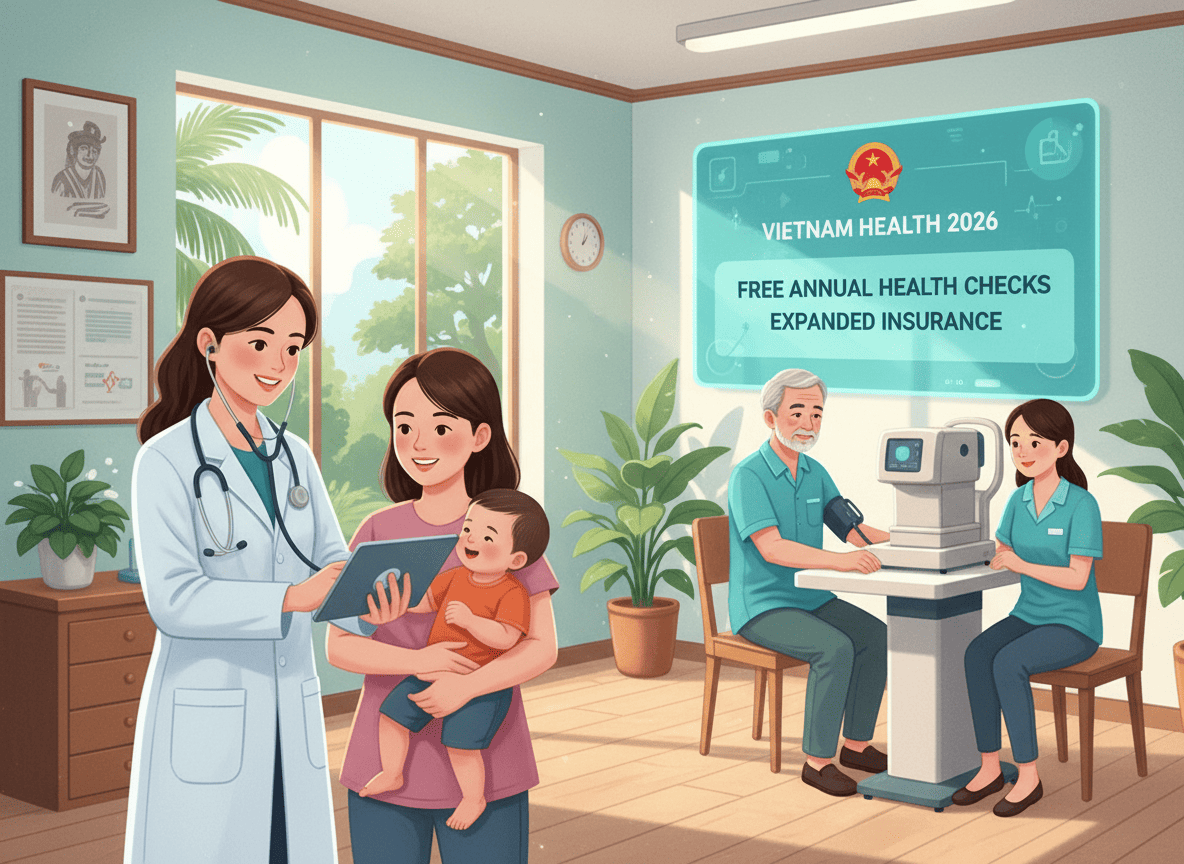
Doctors providing check-ups with a sign announcing free annual health checks and expanded insurance.
Vietnam Sets Ambitious 2026 Plan for Free Annual Health Checks, Expanded Coverage, and System-Wide Reform
Vietnam is preparing to deliver one of its most far-reaching public-health reforms in decades, a nationwide guarantee of one free annual health check or screening for every citizen starting in 2026. The proposal submitted to the National Assembly by Minister of Health Đào Hồng Lan marks a decisive shift toward preventive care as Vietnam works to modernize its health system and extend equitable access across its 100-million-plus population.
The draft resolution forms part of the government’s operational plan to implement Politburo Resolution No. 72, an overarching framework that calls for a strengthened public-health infrastructure, a revitalized preventive-care ecosystem, and improved human-resource capacity across the healthcare workforce. If approved, the policy would stand as a national commitment to earlier detection of chronic diseases, improved management of risk factors, and reduced long-term healthcare burdens.
What You Need To Know
- Vietnam plans to provide every citizen with one free annual health check starting in 2026, backed by Resolution 72’s public-health reform framework.
- The government proposes 100% health-insurance coverage for near-poor households and seniors aged 75+, with an estimated budget impact up to VND 2.74 trillion.
- Workforce reforms include VND 4.48 trillion in annual funding for improved allowances for medical staff in disadvantaged or high-risk areas.
- Additional measures streamline healthcare-infrastructure development, strengthen immunisation financing, and align future reforms with upcoming health legislatio
A Universal Annual Check-Up With a Preventive Focus
Under the proposal, every resident would be entitled to at least one free annual check-up integrated into existing systems such as school health programs, workplace examinations, and services already available under the national health insurance scheme. The initiative will also align with Vietnam’s ongoing rollout of electronic health records, creating a more coherent and trackable preventive-care pathway for individuals and families.
Critically, the Ministry of Health emphasizes that implementation will be phased and prioritised based on funding capacity and target populations. While the policy’s universality is its headline feature, its operational backbone is a hybrid financing model pulling contributions from employers, the national health insurance fund, and the state budget.
The government projects it will require VND 6 trillion (US$227 million) annually from central budget allocations to fully support priority groups. Screening programs themselves will be funded through the national target programme on healthcare, population and development for the 2026–2035 period.
Expanding Insurance Coverage for the Most Vulnerable
In parallel to the preventive-care initiative, the draft proposes a major shift in health-insurance benefits. Vietnam is considering raising coverage to 100% of eligible costs for two high-need groups:
- Near-poor households
- Citizens aged 75 and older receiving social pensions
Depending on uptake, the Ministry estimates the financial impact on the insurance fund could range from VND 455 billion to VND 2.74 trillion (US$17.3–104 million) annually.
The move underscores the government’s intent to cushion financially vulnerable populations, especially the elderly, who often face significant barriers to care and higher disease burdens.
Support for Medical Workers in High-Risk Environments
A key dimension of Resolution 72 is rebuilding confidence and resilience within Vietnam’s healthcare workforce. The draft plan proposes piloting supplementary health-insurance packages and adjusting allowances for frontline personnel particularly those working in underserved or high-risk areas.
These salary and benefit adjustments are projected to cost VND 4.48 trillion (US$170 million) annually, with the majority of funding directed to local health facilities. For policymakers, improving remuneration is essential to retaining skilled practitioners and addressing chronic workforce shortages.
One of the more unexpected structural proposals is a new mechanism enabling competent land-management authorities to convert land for medical use without requiring amendments to land-use master plans. If adopted, this could significantly accelerate the development of hospitals, clinics, and vaccination centers, areas where construction delays have historically slowed expansion.
Stronger Immunisation Frameworks and Future Amendments
The government also aims to reinforce Vietnam’s immunisation ecosystem by establishing special financial mechanisms for catch-up vaccination programmes and mass vaccination campaigns under the Expanded Programme on Immunisation (EPI).
Related news
Thailand launches drug access program to slash household medical bills by 32B baht
However, the National Assembly’s Committee for Culture and Society has urged the government to more clearly define the scope of “free basic hospital fees” and to synchronize the proposal with Vietnam’s upcoming Law on Disease Prevention. Lawmakers also recommend that amendments to the Law on Health Insurance be submitted in 2026 to ensure long-term alignment.
If approved, the seven-article resolution will take effect January 1, 2026, marking a new chapter in Vietnam’s public-health strategy one anchored in prevention, equity, and systemic modernization.
