
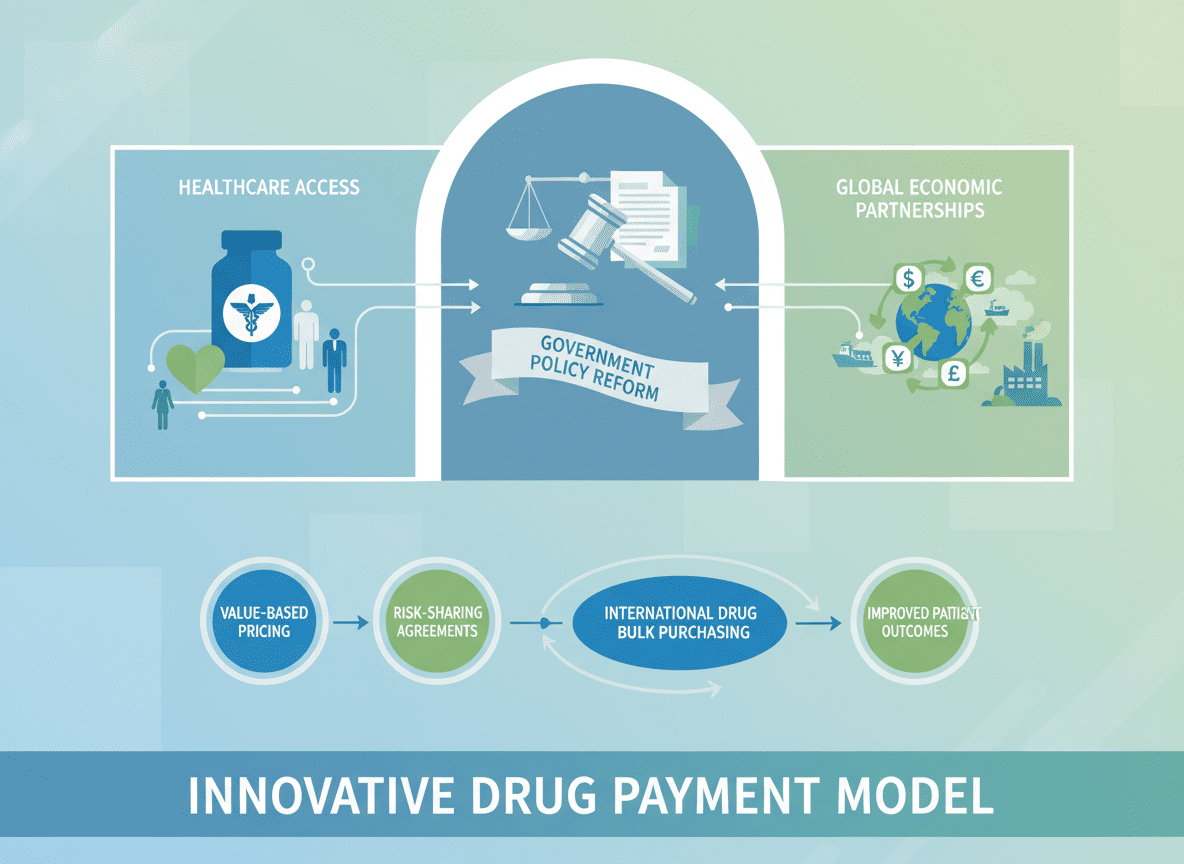
CMS’ Medicaid drug payment model links value-based pricing and international benchmarks to lower costs and improve patient outcomes. (Editorial illustration.)
US government aims to lower Medicaid drug prices and align costs with global rates under new GENEROUS model
The US government has launched a sweeping initiative to reduce prescription drug costs under the Medicaid program, unveiling a new Medicaid drug payment model that ties reimbursement to international benchmarks and measurable clinical value. The Centers for Medicare & Medicaid Services (CMS) announced the plan called the GENErating cost Reductions fOr U.S. Medicaid (GENEROUS) Model as a cornerstone of a broader effort to lower prices, expand access, and strengthen value-based care across federal health programs.
Under the GENEROUS model, participating states will be able to purchase select prescription drugs at prices comparable to those paid in other developed nations, effectively extending Most-Favored-Nation (MFN) pricing into the Medicaid program. The pilot, scheduled to launch in 2026, allows CMS to negotiate directly with drug manufacturers while participating states implement uniform, transparent coverage criteria. By linking payment to both global pricing and therapeutic outcomes, CMS aims to strengthen the Medicaid program’s fiscal sustainability and deliver fairer drug costs to millions of low-income Americans.
Abe Sutton, Director of the CMS Innovation Center, emphasized that the model represents a move toward international parity. “Drug prices in the U.S. remain far too high. GENEROUS aims to ensure Medicaid pricing will be on par with those in other developed nations,”.
The CMS program builds directly on the White House’s Most-Favored-Nation (MFN) pricing strategy announced earlier this year by President Donald J. Trump, which has delivered a series of high-profile deals with major pharmaceutical manufacturers. The MFN framework seeks to ensure that Americans pay no more than patients in peer nations for the same drugs a policy reversal after decades of price disparity.
In the latest phase of the initiative, the administration announced new MFN agreements with Eli Lilly and Novo Nordisk covering the market’s most expensive and widely prescribed GLP-1 therapies: Ozempic, Wegovy, Mounjaro, and Zepbound. Prices for Ozempic and Wegovy will drop from $1,000 and $1,350 per month to $350 when purchased through TrumpRx. Zepbound and Orforglipron, once approved, will be priced around $346 per month. The deals also set guaranteed MFN pricing on all new drugs from both companies, allowing state Medicaid programs nationwide to access these rates.
Related news
Obesity Drug Talks Reach Defining Moment as Lilly and Novo Near Trump Administration Pricing Deal
By reducing prices on the leading obesity and diabetes drugs, the MFN agreements enabled Medicare and Medicaid to begin covering these therapies for adults with obesity and related comorbidities something previously deemed financially untenable. CMS officials confirmed that pricing and utilization data from the MFN contracts will serve as a benchmark for the GENEROUS Medicaid drug payment model, ensuring consistency between negotiated manufacturer agreements and state-level reimbursement policies.
The new framework also complements earlier MFN arrangements with Pfizer and AstraZeneca, both of which introduced globally aligned drug pricing and new domestic manufacturing investments. AstraZeneca’s October 2025 deal gave every state Medicaid program access to international benchmark prices for its portfolio and committed $50 billion to U.S. R&D expansion, including a facility in Virginia creating 3,600 skilled jobs. Eli Lilly has pledged $27 billion in new U.S. manufacturing capacity, while Novo Nordisk committed $10 billion to produce its Wegovy tablet domestically if approved.
“Thanks to President Trump’s leadership and Dr. Oz’s direction at CMS, we’re expanding access to affordable medicines for millions of Americans,” said Health and Human Services Secretary Robert F. Kennedy Jr. “By bringing Most-Favored-Nation pricing to Medicaid, we’re driving down drug costs and protecting the future of care for our most vulnerable citizens.”
Policy analysts say the combination of the MFN agreements and the CMS pilot represents the most aggressive federal intervention in drug pricing in decades, positioning the United States closer to the global standard of value-based, outcome-linked pricing. Together, the reforms aim to align public spending with clinical benefit while curbing excessive markups that have long inflated U.S. prices.
“CMS is effectively institutionalizing Most-Favored-Nation principles within the Medicaid payment system,” said one healthcare economist familiar with the policy design. “The MFN agreements established the template, and GENEROUS will make it permanent by creating a transparent, state-level infrastructure for global pricing.”
Industry groups have expressed caution. Pharmaceutical manufacturers argue that international reference pricing could hinder innovation or limit access to newer drugs in Medicaid formularies. But supporters say the fiscal imbalance is too large to ignore gross Medicaid prescription spending hit $100 billion in 2024, with net spending after rebates still exceeding $60 billion.
CMS will soon issue a Request for Applications (RFA) for manufacturers interested in participating in the GENEROUS model, as well as a call for letters of intent from state Medicaid agencies. Selected companies will negotiate international benchmark-based rates with CMS, while states that opt in will implement the model’s standardized coverage framework.
The broader strategy underscores a new phase in U.S. healthcare policy one that links value-based care, international pricing parity, and fiscal discipline across public programs. As President Trump said during the MFN announcement, “Our citizens pay massively higher prices than other nations pay for the same exact pill, from the same factory. Those days are ending.”
If successful, the CMS Medicaid drug payment model could serve as the structural backbone for future value-based pricing across Medicare and commercial markets cementing a long-term policy shift toward global alignment, affordability, and sustainability in U.S. healthcare.