
The Alzheimer’s Blood Test Just Moved Into the GP’s Office, Which Is the Whole Point
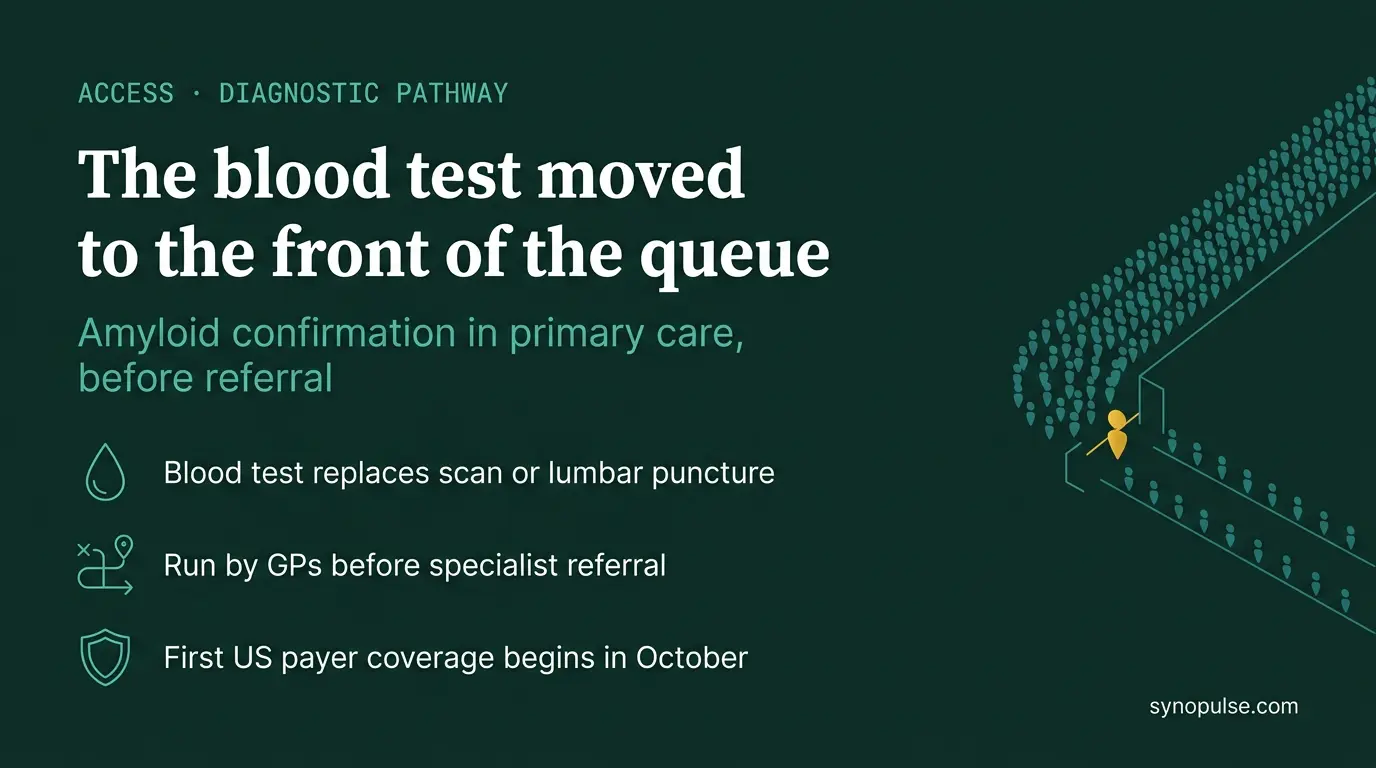
- Imperial College London is using C2N’s PrecivityAD2 blood test in the BEAD-PC study, in which general practitioners in North West London run the test alongside standard cognitive assessment before referring patients to dementia specialists.
- The design is deliberate. The study places the test in primary care research sites rather than hospital or specialist settings, testing whether accurate amyloid detection works at the point where patients first present. Those flagged are referred on to the Imperial Memory Unit at Charing Cross Hospital.
- Imperial is the only UK centre in the Davos Alzheimer’s Collaborative Accurate Dx programme, alongside four US health systems, two in the EU and one in Japan. UK recruitment began in May.
- Separately, C2N announced that Anthem will begin covering PrecivityAD2 under a medical policy from 1 October 2026, the first US insurance coverage for the test.
Access read
Alzheimer’s has not had a diagnosis problem for several years. It has had a queue problem. Confirming amyloid pathology, which the new antibody therapies require before treatment, has meant PET imaging or lumbar puncture, both specialist-only, both rationed, both slow. Patients wait to be confirmed, and a proportion progress past the window in which the drugs are worth giving while they wait. That is the real constraint on the anti-amyloid class, and no amount of prescribing enthusiasm fixes it. Which is why the location of this study matters more than the technology. Putting an accurate blood test in front of the referral rather than behind it changes the shape of the funnel: general practitioners can triage before sending anyone on, so specialist clinics see enriched populations instead of everyone, and the queue shortens without anyone building a scanner. One of the Imperial investigators puts the current position plainly, describing general practice as operating in a grey area, responding to patient concerns without precise tools. Note the two-track commercial strategy running underneath. In the UK, C2N is generating the pathway evidence a public system needs before it adopts anything at scale. In the US, it has secured a first payer decision effective October. Two systems, two routes to the same destination, and the diagnostic reaching routine use is the event that finally makes the treatments usable.
Read the original source (C2N Diagnostics via Business Wire) →