
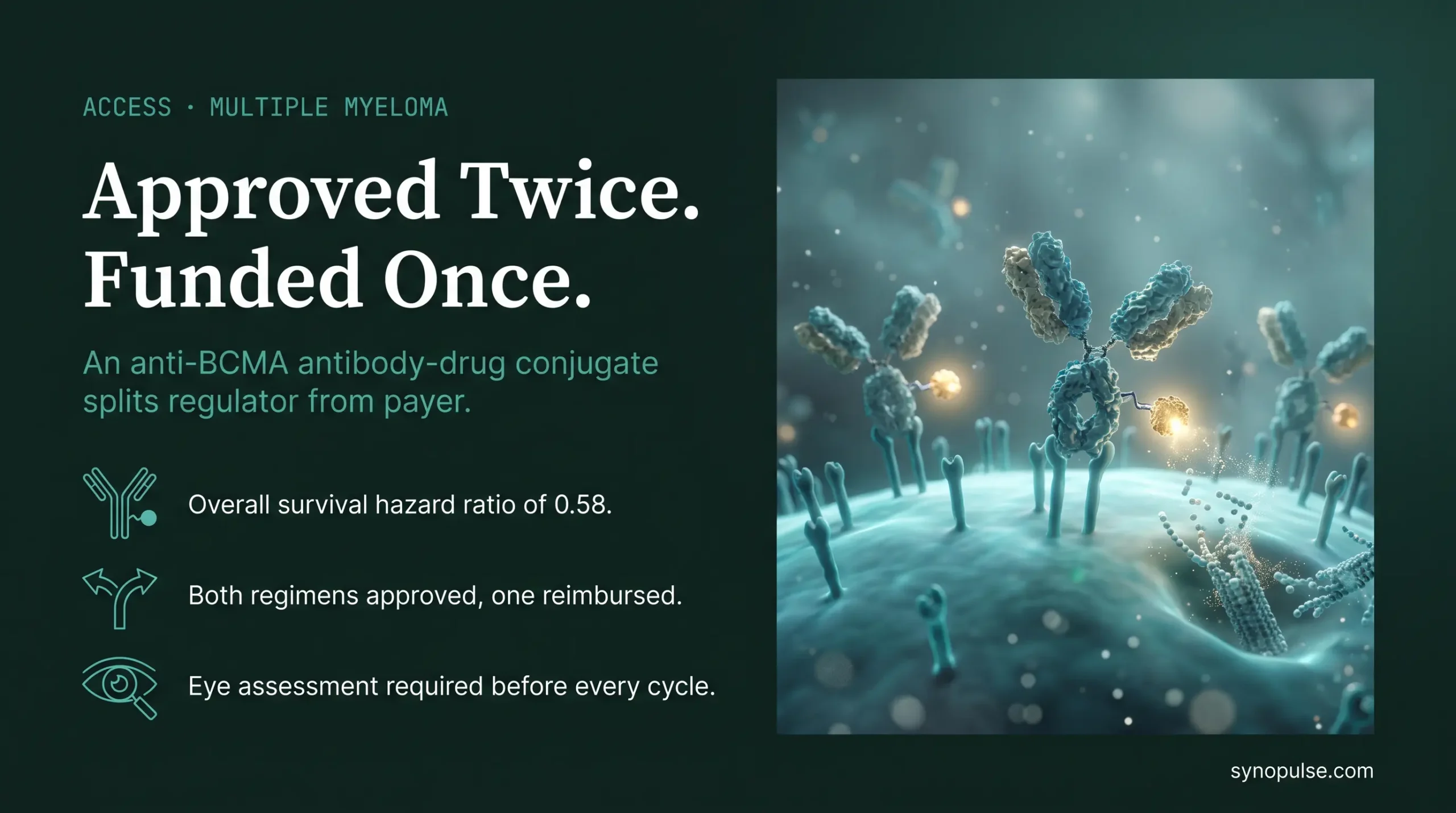
Singapore Approved Both Blenrep Combinations. Korea Reimbursed Only the One With Survival Data.
- Singapore’s Health Sciences Authority approved GSK‘s Blenrep (belantamab mafodotin) in both combinations on 19 August 2026: with bortezomib and dexamethasone (BVd) after at least one prior therapy, and with pomalidomide and dexamethasone (BPd) after at least one prior therapy including lenalidomide.
- The same week, Korea’s HIRA Cancer Disease Review Committee approved national insurance reimbursement criteria for BVd only, covering relapsed or refractory patients after at least one prior therapy. It did not approve criteria for BPd, leaving one of two approved regimens outside coverage.
- The two regimens carry different evidence. DREAMM-7 (n=494) gave median PFS of 36.6 months against 13.4 for the daratumumab triplet (HR 0.41), plus an overall survival benefit at 39.4 months median follow-up (HR 0.58), with three-year OS of 74% against 60%.
- DREAMM-8 (n=302) had not reached median PFS at 21.8 months median follow-up, against 12.7 months for the comparator, and has published no overall survival readout. Its population was harder: 78% refractory to lenalidomide and 25% with prior daratumumab exposure.
Access read
Two Asian markets moved on the same drug in the same week and split. The split has nothing to do with the drug. It is a clean demonstration of which endpoint each kind of body is willing to act on.
- Regulators approve on progression, payers pay on survival. Singapore’s regulator cleared both regimens on PFS. Korea’s payer funded the one carrying an OS hazard ratio of 0.58 and declined the one whose median PFS was still not reached at 21.8 months. Read that as the pricing bar, not a safety judgement.
- The regimen left outside coverage serves the harder patients. DREAMM-8 enrolled 78% lenalidomide-refractory patients and 25% with prior daratumumab. In Korea, the patients with the fewest remaining options are the ones without funding. Expect that gap to be the argument at resubmission.
- Ocular monitoring is a siting constraint, not a footnote. MFDS requires visual acuity and slit-lamp examination by an ophthalmologist before every cycle, at institutions able to coordinate that care. Discontinuation for eye events stayed at or below 9% in both trials, but only where that pathway exists. Model centre eligibility before volume.
Read the original source (GSK Singapore) → | Korea reimbursement decision (Korea Biomedical Review) →
CompaniesGSK