
RiboX’s China Trial Data Bought It an Accelerated Dose Titration and a Subcutaneous Route
- The FDA cleared the IND for RXIM002 on 8 August 2026. It is a targeted lipid nanoparticle carrying circular RNA that encodes a CD19-directed chimeric antigen receptor, generating CAR-T cells inside the patient rather than in a manufacturing facility. RiboX describes it as the world’s first circRNA-based in vivo CAR-T therapy to clear an FDA IND.
- Before submission, RXIM002 was evaluated in investigator-initiated trials in China in autoimmune disease patients, with follow-up ongoing and some patients past six months. RiboX submitted the complete IIT dataset, covering safety and early efficacy in all treated patients, as part of the IND package.
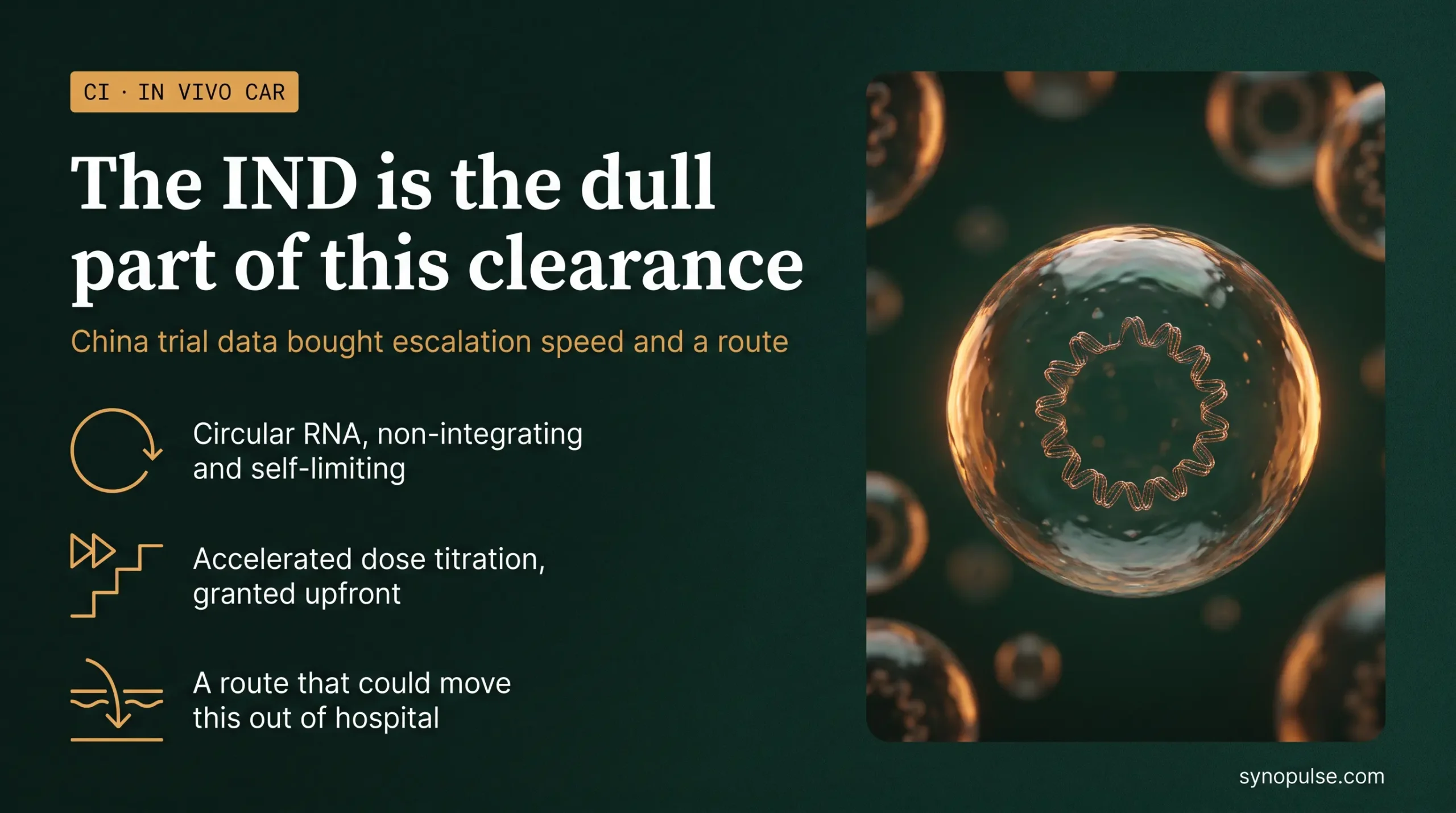
- On the strength of that dataset the agency permitted an accelerated dose-titration scheme and granted subcutaneous formulation as part of clinical development, opening the possibility of outpatient administration.
- POPULUS-1 is the Phase 1, evaluating safety, pharmacokinetics, pharmacodynamics and early efficacy in relapsed or refractory autoimmune cytopenias, enrolling first in relapsed or refractory immune thrombocytopenia. RiboX operates across China, the United States and Israel.
CI read
The IND clearance is the least interesting thing in this release. What matters is the two concessions attached to it. RiboX ran investigator-initiated trials in China, filed the complete dataset alongside the application, and on that basis the FDA permitted faster dose escalation and allowed a subcutaneous formulation into the development plan. A first-in-human application for a modality stack this novel would ordinarily earn the most conservative escalation the agency has. This one did not, because it did not arrive first-in-human.
- Chinese investigator-initiated data is now working as a de-risking instrument at the FDA. IITs are cheap, fast and run outside a sponsor’s registrational programme, and they have generally been treated as supporting colour rather than as grounds for design latitude. Here they bought two things that normally have to be earned inside a US trial across additional quarters: escalation speed and a route of administration. For any developer with China operations that is a strategy. For anyone without them it is a competitive gap. Count how many first-in-class INDs over the next year arrive carrying an IIT package, because this is the template being set.
- The modality stack is the reason to watch, not the indication. Three things converge here that have only been attempted separately: circular RNA for non-integrating durable expression, a targeted lipid nanoparticle for delivery into T cells, and CAR generation in situ. Together they attack the constraint that has actually limited CAR-T in autoimmune disease, which was never response rate but apheresis, ex vivo manufacturing and treatment centre capacity. An off-the-shelf product given subcutaneously changes the cost structure rather than the efficacy, and cost structure is what decides whether this reaches beyond academic centres.
- Hold the caveats firmly, because the release offers nothing to hold. No efficacy figures from the Chinese trials are disclosed at all, and follow-up is characterised only as some patients exceeding six months, which is a short look at a therapy whose entire premise is durable immune reset. Transient RNA-driven CAR expression cuts both ways: non-integrating and self-limiting is the safety argument, and it is also precisely why durability is the open question. The numbers to demand from POPULUS-1 are depth and duration of B-cell depletion alongside platelet response in ITP, not the safety readout a Phase 1 is nominally built to produce.