
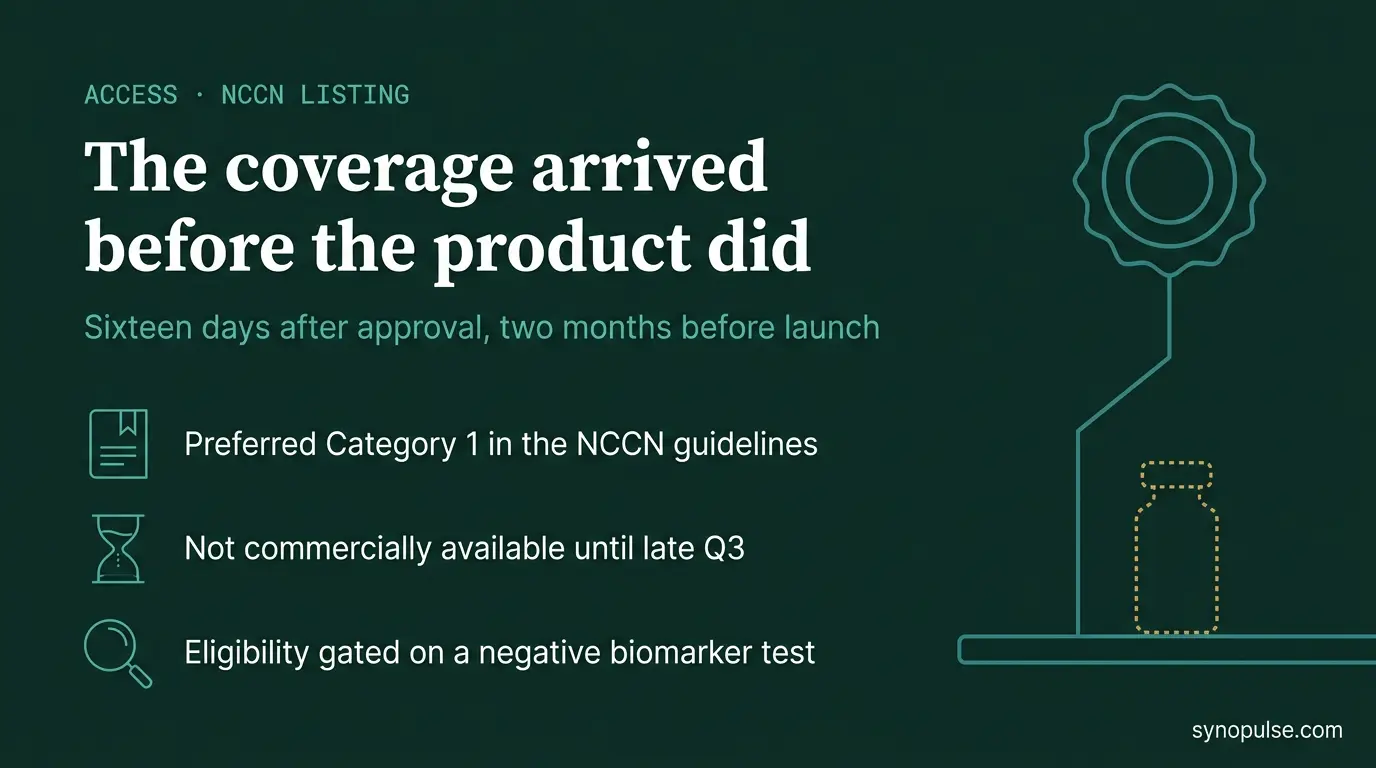
Revtorpyk Got Its NCCN Category 1 Listing Two Months Before Celcuity Can Sell a Single Vial
- The NCCN Clinical Practice Guidelines in Oncology now recommend Revtorpyk (gedatolisib) with fulvestrant, with or without palbociclib, as a preferred Category 1 second-line and subsequent-line therapy for HR+/HER2- disease after progression on at least one line of endocrine therapy.
- The FDA approved Revtorpyk on 14 July 2026. The guideline listing came 16 days later, and Celcuity expects commercial availability only in late Q3 2026, so the recommendation precedes the product by roughly two months. An expanded access programme covers the gap.
- Approval rests on the PIK3CA wild-type cohort of Phase 3 VIKTORIA-1. The triplet delivered median PFS of 9.3 months against 2.0 on fulvestrant (HR 0.24, p<0.0001) with an ORR of 32% versus 1%. The doublet delivered 7.4 months against 2.0 (HR 0.33) with an ORR of 28%.
- The label is defined by a negative biomarker, “without a PIK3CA mutation detected,” which covers roughly 60% of HR+/HER2- disease. Stomatitis occurred in 72% of triplet patients, Grade 3 in 22%.
Access read
Guideline inclusion is not a clinical formality in the United States, it is where coverage gets decided. Commercial plans write NCCN into oncology medical policy, practices build treatment pathways off it, and the compendia route carries coverage for uses that run past the label. Celcuity’s own release names payers among the guideline’s audience, which tells you what the announcement is for. What makes it worth logging is the order. The listing lands sixteen days after approval and roughly two months before there is a product to sell, so the reimbursement case is being built during the supply delay rather than after it. That inverts the usual launch failure, where the vials arrive and the payer policies do not. Two gates remain, and a guideline solves neither. The label turns on a negative biomarker, so patients qualify by what their tumour does not have, which means uptake tracks PIK3CA testing rates rather than coverage, and an untested patient is not eligible on paper. And Category 1 gets you onto the policy, not past utilisation management. At 72% stomatitis on the triplet with 22% Grade 3, discontinuation is the variable payers will model, because cost per completed course is what they actually price. Celcuity has not disclosed a price. Watch that number and the prior authorisation criteria that follow it, because the guideline was the easy part.
Read the original source (Celcuity) →
CompaniesCelcuity
GeographyUnited States