
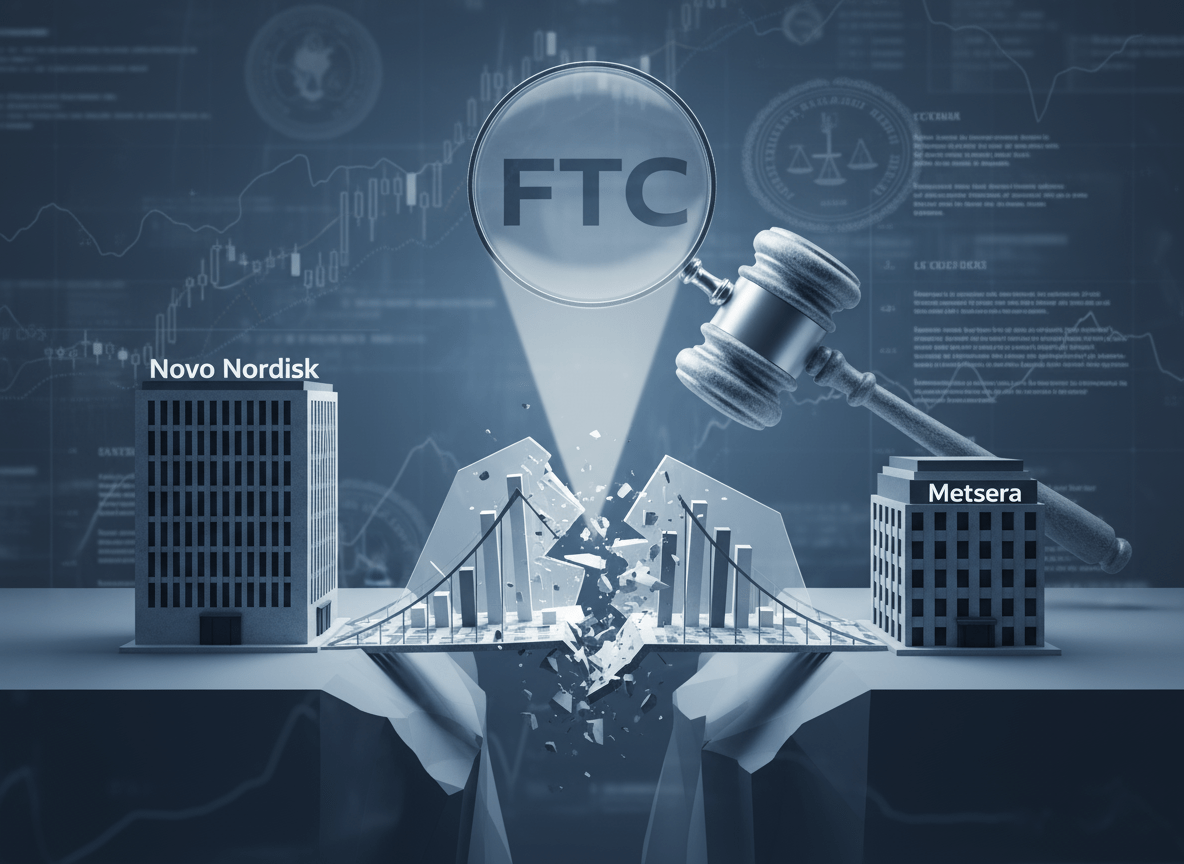
Concept illustration showing regulatory scrutiny of Novo Nordisk’s $10 billion Metsera takeover as the FTC reviews potential market impact. (Image: Created for editorial use)
Court rejects Pfizer’s injunction; FTC opens probe into Novo’s $10B Metsera takeover
Novo Nordisk’s $10 billion takeover of metabolic biotech Metsera has cleared a major legal hurdle after a Delaware court denied Pfizer’s request to block the deal, but the Danish drugmaker’s path to completion remains under regulatory watch as the U.S. Federal Trade Commission (FTC) launches an antitrust review.
The ruling caps, months of corporate and legal Maneuvering between two of the sector’s biggest players, both eager to secure Metsera’s pipeline of next-generation obesity and cardiometabolic candidates. Novo Nordisk first announced its intent to acquire Metsera earlier this year in an unsolicited takeover, bid valued at roughly $2B billion, board rejects owing to FTC hurdle and undervaluing the company.
What You Need To Know
- Novo Nordisk’s $10B acquisition of Metsera moves forward after a Delaware court rejects Pfizer’s attempt to block the deal.
- The FTC opens an antitrust review into the transaction amid concerns over market dominance in metabolic drugs.
- Metsera’s dual- and tri-agonist pipeline strengthens Novo’s long-term GLP-1 and cardiometabolic strategy.
- After losing its legal challenge, Pfizer faces renewed investor pressure to rebuild its obesity portfolio or pursue alternative M&A targets.
Pfizer makes first move in Metsera takeover race
Pfizer was the first major contender to move on metabolic biotech Metsera, seeking to expand its footprint in the fast-rising obesity drug space. The company opened takeover discussions in mid-2025, valuing Metsera on a potential $7.3 billion and framing the bid as a cornerstone for rebuilding its metabolic portfolio.
With GLP-1 development setbacks weighing on its pipeline, Pfizer viewed Metsera’s early-stage peptide agonist programs as a shortcut to regain competitive positioning against Novo Nordisk and Eli Lilly. Sources close to the deal said Pfizer’s initial term sheet included milestone-based earnouts and a mix of cash and stock, underscoring its need to preserve balance sheet flexibility after multiple cost-restructuring cycles. The company also pushed for exclusivity during due diligence terms that later became central to its legal complaint against Novo.
Novo Nordisk counters with a $9B takeover offer
Novo Nordisk entered the Metsera race shortly after Pfizer’s talks became public, submitting a competing bid that valued the biotech at $9 billion a full billion above Pfizer’s initial proposal. The Danish pharma framed its move as a strategic extension of its metabolic leadership, integrating Metsera’s GLP-1, GIP, and dual-agonist assets into its long-term obesity and cardiometabolic pipeline.
Metsera’s board deemed Novo’s proposal a “superior offer,” citing stronger financial backing and a cleaner close timeline compared with Pfizer’s conditional structure. Novo’s interest was fueled by overlap in peptide-engineering technology and the potential to accelerate its next-generation obesity candidates. By late summer, both companies had entered a bidding deadlock, escalating into formal acquisition filings and triggering legal tensions.
Pfizer and Novo upsize bids as takeover fight escalates
As competition intensified, both companies upsized their takeover bids in an attempt to secure the prize. Pfizer raised its valuation to match Novo’s $10 billion offer, adding revised milestones and enhanced retention packages for Metsera’s R&D leadership. The move was intended to keep the board at the negotiating table and prevent a premature endorsement of Novo’s deal.
Novo responded by tightening its own offer terms, eliminating performance earnouts and committing to full cash consideration moves designed to signal execution certainty. Metsera’s board reaffirmed its support for Novo’s proposal, triggering Pfizer’s Delaware court injunction attempt, which was later denied. With Novo now advancing the acquisition through regulatory review and the FTC launching an antitrust inquiry, the Metsera takeover has evolved from a valuation contest into one of 2025’s defining tests of biotech consolidation strategy.
The court rejected Pfizer’s motion, ruling that the company failed to demonstrate irreparable harm or a contractual breach sufficient to halt the takeover process. The decision effectively removes the final corporate barrier to closing but leaves Novo navigating the next phase, “regulatory review”.
According to filings and sources familiar with the process, the FTC has opened an inquiry into Novo’s acquisition, citing concerns about consolidation in the fast-expanding metabolic disease market. Both Wegovy and Ozempic have redefined the sector’s economics, and regulators have become increasingly cautious about deals that could further entrench dominant players in obesity and diabetes care.
The FTC’s interest centers on whether Novo could use control of Metsera’s assets believed to include proprietary dual- and tri-agonist molecules targeting GLP-1 and GIP pathways to limit competition or delay rival development programs. Similar antitrust reviews have followed other large-scale biopharma mergers, including Amgen’s Horizon Therapeutics acquisition, which faced months of scrutiny before approval.
For Novo, the Delaware ruling represents a clear legal win in its contest with Pfizer, which has struggled to gain ground in the GLP-1 market despite aggressive R&D investment. Analysts say the court’s denial underscores the strength of Novo’s contractual footing and signals limited options for Pfizer to continue contesting the deal outside of antitrust venues.
Pfizer, meanwhile, characterized the ruling as “disappointing” but reiterated its position that Novo’s pursuit of Metsera “undermines fair process and investor transparency.” A company spokesperson confirmed Pfizer is cooperating with FTC investigators but has not indicated whether it will pursue an appeal.
The Metsera acquisition would mark one of Novo Nordisk’s largest recent strategic moves, following a series of manufacturing and pipeline expansions to meet surging global demand for its GLP-1 therapies. Metsera’s platform, focused on peptide-based modulators for metabolic and fibrotic diseases, is viewed as a long-term diversification play that could extend Novo’s dominance beyond semaglutide-class drugs.
Regulatory analysts note that FTC attention does not necessarily imply opposition but could prolong closing timelines. “Novo’s win in Delaware gives them momentum, but FTC review could still stretch several months,” one antitrust attorney told Fierce Biotech. “They’ll need to demonstrate that Metsera’s assets do not meaningfully overlap with existing GLP-1 markets.”
The agency’s action reflects growing scrutiny of consolidation in the biopharma space as obesity and metabolic drugs become a multibillion-dollar market segment. With multiple next-generation candidates targeting similar pathways, regulators are focused on ensuring smaller innovators retain room to compete.
Novo Nordisk declined to comment on the ongoing FTC review but said it remains “fully confident in the strategic and scientific value of the Metsera transaction.”
If approved, the deal would strengthen Novo’s position as the industry’s most dominant force in metabolic medicine, while Pfizer faces renewed pressure to accelerate its own internal programs or seek alternative acquisitions.
For now, Novo’s courtroom victory clears the immediate path ahead but with federal regulators circling and Pfizer unlikely to retreat quietly, the $10 billion Metsera acquisition remains one of the most closely watched deal tests for global pharma in 2025.
For media inquiries or to share perspectives on access and evidence policy, email editor@synopulse.com.
