
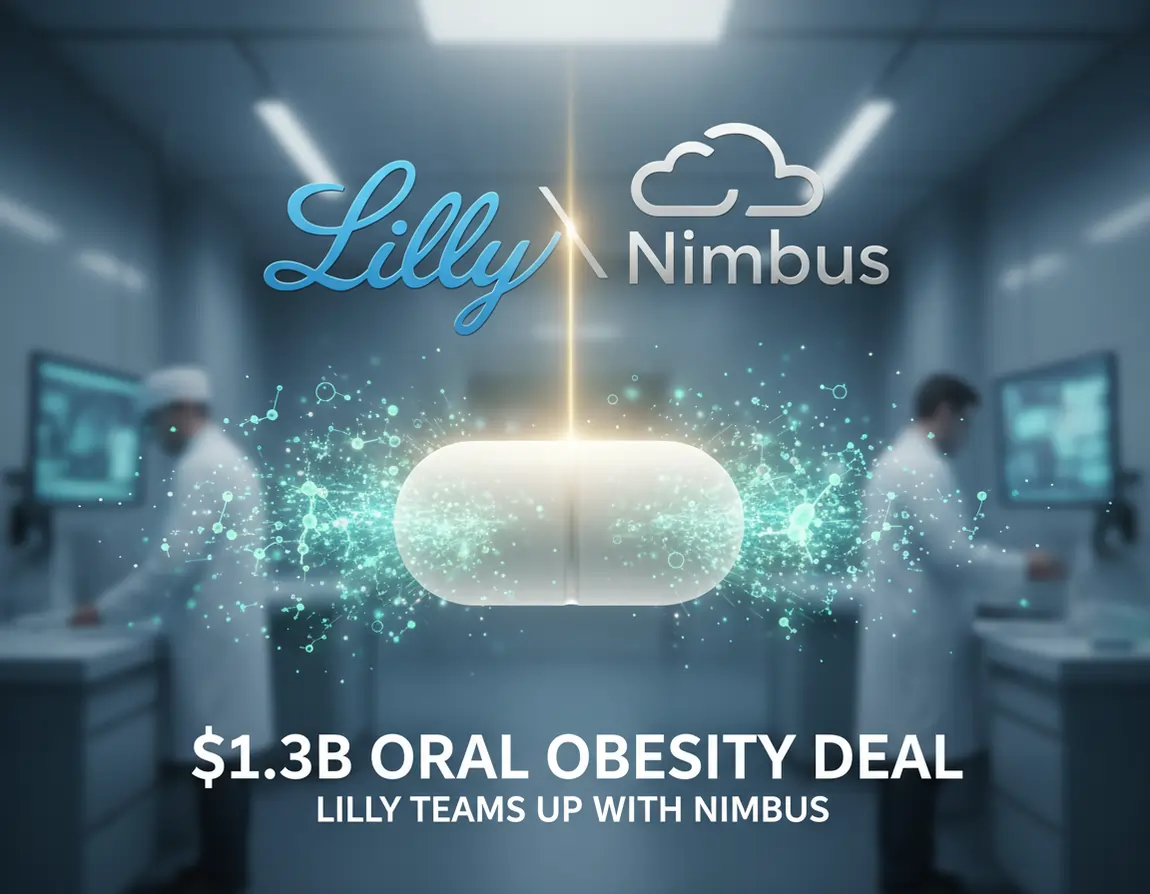
Eli Lilly and Company has renewed its bet on Nimbus Therapeutics, signing a multi-year research collaboration and exclusive worldwide license agreement to develop a novel oral therapy for obesity and other metabolic diseases, one of the most competitive battlegrounds in biopharma R&D.
Under the deal, Nimbus is eligible to receive $55 million in upfront and near-term milestone payments, with the total package reaching up to $1.3 billion in development, regulatory, and commercial milestones, plus tiered royalties on global net sales. Lilly will lead later-stage development and commercialization.
The agreement builds on the companies’ 2022 collaboration targeting AMPK in cardiometabolic disease, a deal then valued at up to $496 million. This time, the focus shifts squarely to obesity, as large pharmas race to secure oral alternatives to injectable GLP-1 therapies.
Lilly will tap Nimbus’ AI-enhanced computational chemistry and structure-based drug design engine to advance an early-stage small-molecule discovery program aimed at a still-undisclosed obesity target. The structure reflects Lilly’s strategy of externalizing early discovery risk while maintaining downstream control in high-value metabolic indications.
“We are pleased to deepen our collaboration with Nimbus,” said Ruth Gimeno, Lilly’s group vice president of diabetes and metabolic R&D, framing the program as a meaningful addition to Lilly’s obesity pipeline.
Oral obesity drugs have become one of the hottest and most crowded areas in drug development, following Novo Nordisk’s launch of an oral formulation of Wegovy and Lilly’s own push to secure approval for orforglipron. While injectable therapies continue to dominate in efficacy, oral agents are viewed as critical for long-term scalability, payer acceptance, and primary-care uptake.
Nimbus positions itself as a specialist in “difficult-to-drug” targets, combining computational scientists, medicinal chemists, and translational biologists to optimize small molecules before they reach the clinic. Lilly’s return signals confidence that the biotech’s platform can deliver differentiated candidates in a field where incremental improvements are no longer enough.
The deal reinforces a capital-efficient partnering model. Rather than building late-stage infrastructure, the company continues to monetize its discovery engine through milestone-heavy collaborations, an approach validated by Takeda’s $4 billion acquisition of Nimbus’ TYK2 program in 2022, now known as zasocitinib.
Related news
Sanofi, Earendil Lab ink $2.5B deal for bispecific antibody
The collaboration underscores how central external innovation has become to sustaining leadership in metabolic disease. With competition intensifying and payer scrutiny rising, securing multiple shots on goal, across injectables and orals, peptides and small molecules, has become a strategic necessity.
As obesity drug development heads deeper into 2026, the Lilly–Nimbus reunion highlights a broader industry pattern.
