
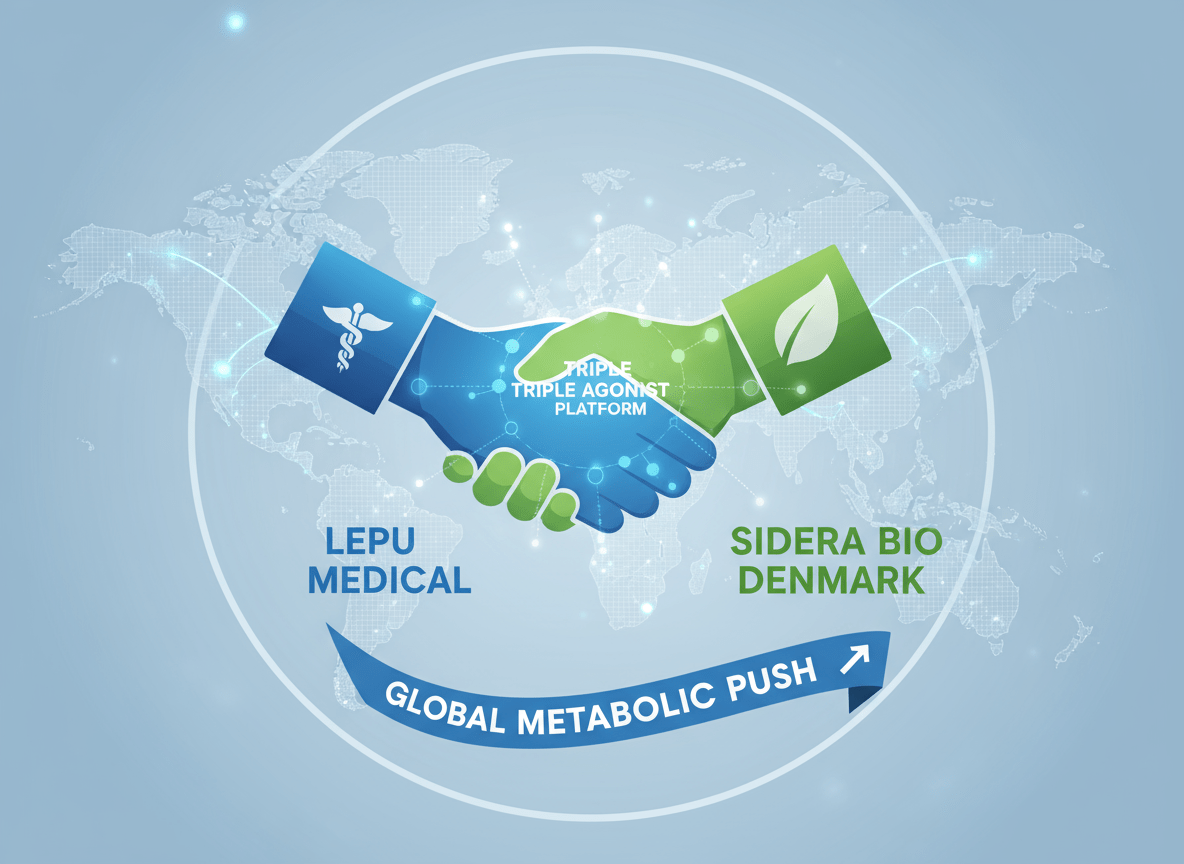
Triple Agonist Partnership Signals Lepu’s Ambition Beyond China
Beijing-based Lepu Medical Technology is making a decisive move into global biopharmaceuticals with a new licensing deal that links its research pipeline to a Danish biotech player. The company’s wholly owned subsidiary has signed an agreement with Sidera Bio Aps, granting the Danish firm exclusive rights outside Greater China to develop and commercialize MWN105, Lepu’s investigational GLP-1/GIP/FGF21 triple agonist targeting obesity and metabolic diseases.
What You Need To Know
- Lepu’s Beijing subsidiary grants global (ex-Greater China) development and commercialization rights to Sidera Bio for MWN105, a GLP-1/GIP/FGF21 triple agonist.
- The deal includes a 9.99% equity stake in Sidera and up to $1.01 billion in milestone payments, plus future royalties.
- The partnership positions Sidera in the fast-growing metabolic and obesity therapeutics market, competing against next-generation incretin players.
- For Lepu, the transaction reflects a strategic pivot toward global biotech collaboration while monetizing R&D outside China.
The teams are striking for a cross-border partnership: Lepu will receive a 9.99% equity stake in Sidera Bio and is eligible for up to $1.01 billion in development, regulatory, and commercial milestone payments, along with tiered royalties on future global sales. The structure positions Lepu both as an early-stage investor and a beneficiary of long-term revenue from Sidera’s success.
Lepu, best known for its cardiovascular devices and diagnostic systems, the deal represents a clear signal of its intent to expand beyond medical technology into global drug innovation. Over the past three years, Lepu has invested heavily in metabolic and oncology R&D MWN105 being among its flagship projects. The compound, a triple agonist that activates GLP-1, GIP, and FGF21 receptors, is designed to regulate appetite, glucose metabolism, and lipid balance simultaneously a profile expected to deliver stronger efficacy than single- or dual-agonist drugs.
Such molecules are drawing significant attention as the next frontier in obesity and diabetes treatment. With Novo Nordisk and Eli Lilly dominating the GLP-1 class, emerging triple-agonists could reshape competitive dynamics. “The biology behind these drugs is powerful combining incretin and metabolic pathways for broader systemic benefit,” said one European metabolic researcher.
For Sidera Bio, acquiring global rights to MWN105 is a strategic leap forward. The Copenhagen-based biotech gains access to an advanced asset that aligns with its focus on endocrine and metabolic diseases, potentially accelerating its entry into late-stage development and partnerships with global pharma companies. The company said in a statement that the agreement would “enable rapid global expansion and clinical acceleration in obesity and metabolic disorders.”
The transaction also reinforces an evolving trend in the Asian biotech landscape, Chinese firms increasingly out-licensing innovative compounds to Western partners while retaining domestic rights. This model allows them to monetize early R&D assets and share risk while leveraging Western regulatory and commercialization networks.
Related news
Novo’s unsolicited bid for Metsera challenges Pfizer pact
Lepu’s move as pragmatic and well-timed. The global obesity-therapy market, projected to surpass $100 billion by 2030, is attracting intense competition and investor capital. By licensing out its triple agonist, MWN105, Lepu gains exposure to global markets and potential royalty streams without carrying the full burden of late-stage development costs.
“The transaction fits a hybrid innovation model capitalizing on R&D strengths in China while securing global validation,” said one Asia-Pacific biotech analyst. “It’s both a financial hedge and a brand-building move.”
The deal is equally transformative for Sidera. With Lepu’s asset and financial alignment, the Danish biotech strengthens its pipeline ahead of a potential Series B round or strategic partnership. Analysts suggest that MWN105 could enter first-in-human studies in Europe in 2026, setting up a timeline competitive with other multi-agonists in early clinical testing.
The two companies have not disclosed specific upfront payment figures, but the combined package of equity, milestones, and royalties gives the collaboration both immediate and long-term incentive alignment.
As obesity and metabolic disease become central therapeutic battlegrounds, partnerships like Lepu-Sidera illustrate the increasingly interconnected nature of global biotech. Chinese R&D capacity, European development expertise, and Western market infrastructure are converging to speed up innovation.
Related news
Metsera responds to Pfizer lawsuit, defends board process in Novo bid dispute
In a statement accompanying the announcement, Lepu’s management described the collaboration as “a milestone in expanding our global innovation network.” For the company, the deal delivers financial upside and a foothold in the next wave of metabolic therapies while Sidera Bio gains a cutting-edge asset to propel its clinical and commercial ambitions.
Together, the two companies may have just positioned themselves for a front-row seat in the post-GLP-1 era of metabolic medicine.