
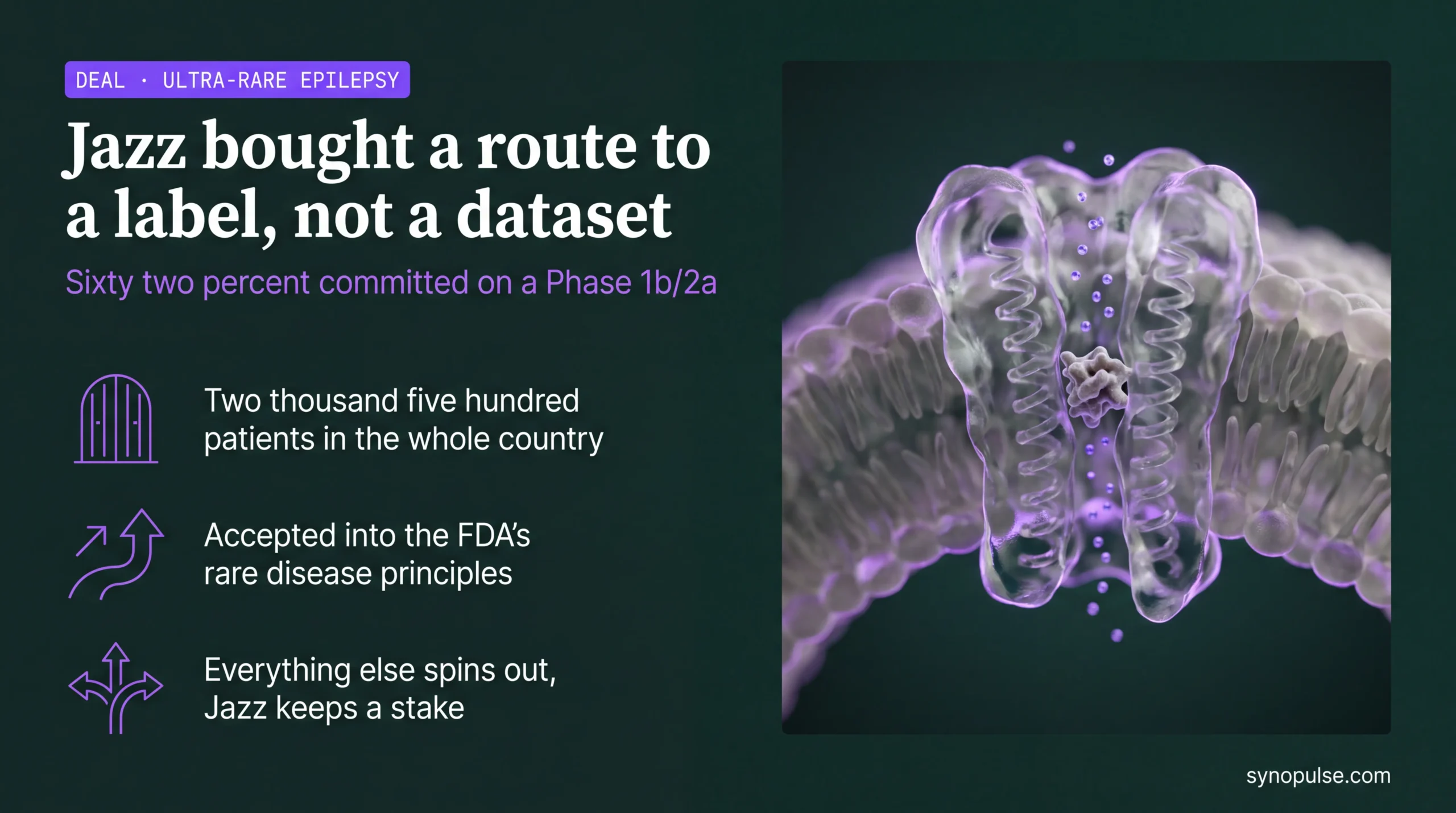
Jazz Paid $820 Million Upfront for a Phase 1b/2a Because the FDA Pathway Came With It
- Jazz Pharmaceuticals will acquire privately held Actio Biosciences for $820 million upfront plus up to $500 million in approval and sales milestones, a maximum of $1.32 billion. That puts roughly 62% of consideration on the table at signing. Both boards approved unanimously and closing is expected by Q4 2026, funded from cash on hand and existing facilities.
- The asset is ABS-1230, a first-in-class oral small molecule KCNT1 ion channel inhibitor. KCNT1-related epilepsy affects roughly 2,500 people in the United States, with about 80% of onset in infancy, most patients enduring dozens to hundreds of seizures a day, many never walking or speaking, and some not surviving into adulthood. No therapies are approved.
- ABS-1230 holds Fast Track, Rare Pediatric Disease and Orphan Drug designations, and has been accepted into the FDA’s new Rare Disease Evidence Principles programme. The ongoing Phase 1b/2a KYRON trial is designed to serve as the registrational study supporting a US filing. Disclosed efficacy is described only as meaningful seizure reductions in an early proof-of-concept trial in children.
- At closing, Actio will spin out a new private company holding certain management, employees and other assets, including ABS-0871, a TRPV4 inhibitor for Charcot-Marie-Tooth type 2C. Existing investors fund it and Jazz takes a minority stake with certain related rights. ABS-1230 remains with Actio and transfers to Jazz.
Deal read
Eight hundred and twenty million dollars certain, for an asset in roughly 2,500 American patients, whose registrational study is a Phase 1b/2a still running, and whose disclosed efficacy amounts to meaningful seizure reductions in an early proof-of-concept. On the data alone that price does not compute. On the pathway it does. ABS-1230 has been accepted into the FDA’s Rare Disease Evidence Principles programme, which is the thing that makes a Phase 1b/2a registrational at all. Jazz did not buy the dataset. It bought a route to a label.
- Acceptance into that programme is now a priceable asset, and this transaction puts the first number on it. The principles exist to let ultra-rare therapies reach approval on evidence packages that would be inadequate anywhere else, and the practical effect is to collapse the development timeline and the enrolment problem at the same moment. In a disease of 2,500 people, enrolment is the binding constraint rather than biology. Anyone holding an ultra-rare asset should treat acceptance as a value inflection on the order of a Phase 2 readout, and anyone valuing one should ask about it before asking about the data.
- The spin-out is the structure worth copying. ABS-1230 transfers to Jazz. Everything else, including the Charcot-Marie-Tooth programme and much of the team, moves into a newly funded private company in which Jazz holds a minority stake and certain rights. Jazz has bought the molecule it wanted plus an option on whatever that group of geneticists produces next, without paying for the pipeline or carrying the payroll. Sellers keep the upside, the buyer keeps a look. Expect this repeatedly in rare disease, where the durable asset is the team rather than any single compound.
- Where it sits on the conviction curve. Three transactions in two weeks now bracket the range. argenx committed 100% upfront against 42 patients. Alphamab took roughly 6% upfront on an asset already in Phase III. Jazz commits 62% on a Phase 1b/2a. The gradient tracks who carries the residual risk and who has the fewest alternatives, not development stage. Watch the KYRON readout closely, because everything Jazz has paid rests on a single-arm trial in a population small enough that a handful of patients will move the result either way.