
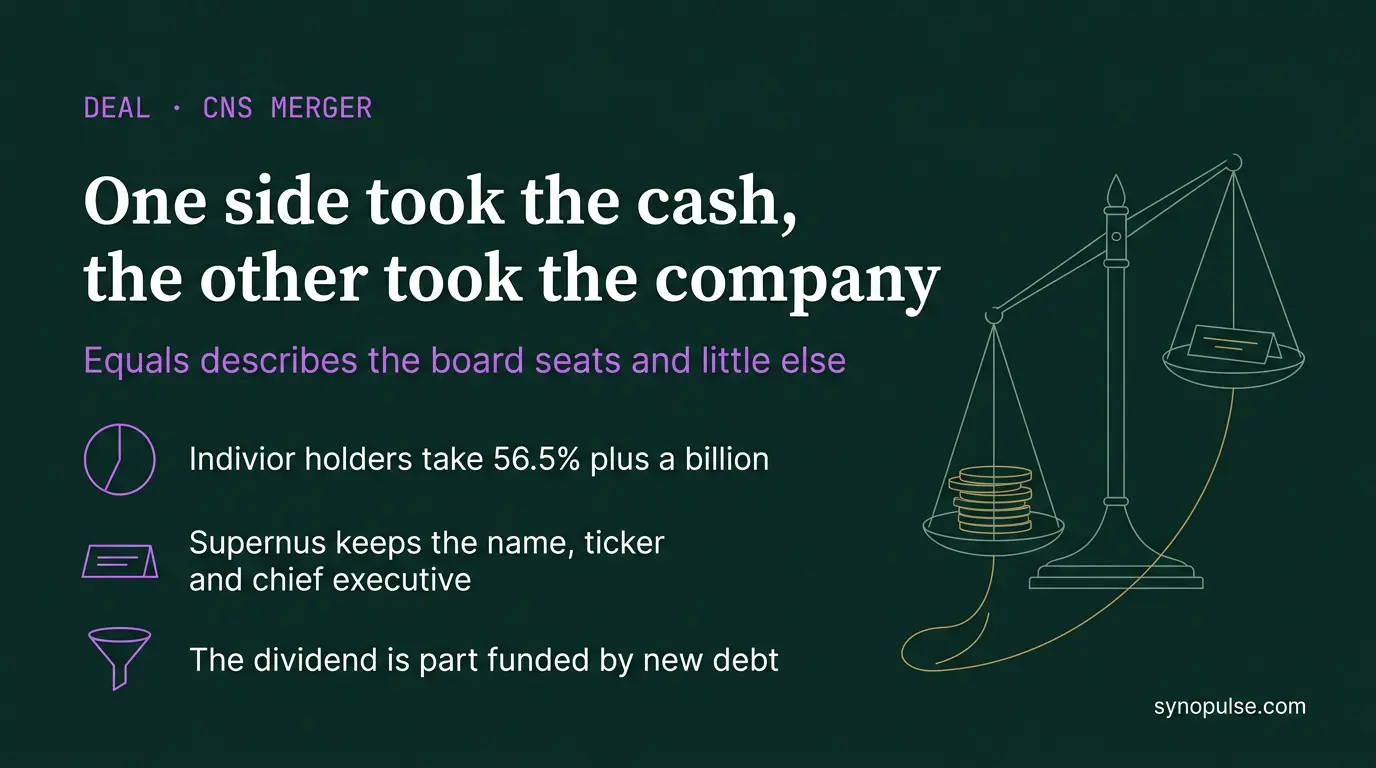
Indivior’s Holders Take 56.5% and $1 Billion, Supernus Takes the Name, the CEO and the Building
- Supernus Pharmaceuticals (Nasdaq: SUPN) and Indivior Pharmaceuticals (Nasdaq: INDV) will combine in a tax-free all-stock merger of equals. Supernus stockholders receive 1.5401 Indivior shares per Supernus share, leaving Indivior holders with roughly 56.5% of the combined company and Supernus holders 43.5% on a fully diluted basis. The entity will be named Supernus, Inc. and trade as SUPN.
- Indivior stockholders also receive a one-time special cash dividend of $1.0 billion immediately before closing, funded by a $650 million Citibank term loan with the balance from cash on hand of the combined company. Pro forma net debt lands near $878 million, a net leverage ratio under 1x.
- The board will hold eight directors, four from each side. Jack Khattar of Supernus becomes President and CEO, Tony Kingsley of Indivior becomes Board Chair, and Supernus’ Rockville headquarters becomes the global headquarters. Indivior files the Form S-4.
- Pro forma net revenue is $2.2 billion with adjusted EBITDA of $888 million, including $125 million of expected annual cost synergies, across 11 medicines spanning psychiatry, neurology and addiction. Closing is expected in Q4 2026, and a joint transaction call replaced both companies’ Q2 earnings calls.
Deal read
Merger of equals describes the board seats and almost nothing else. Indivior shareholders take 56.5% of the equity and $1 billion in cash. Supernus shareholders take 43.5% and no cash. In exchange, Supernus takes everything that is not money: the name, the ticker, the chief executive, the headquarters. Four directors each, with the chair going to Indivior. Strip the language away and this is Supernus management acquiring Indivior’s cash flows, priced in equity and part-funded with borrowed money.
- The special dividend is cash consideration wearing a dividend’s clothes. Read footnote three: the $650 million term loan is drawn against the combined company and the balance comes from combined cash on hand, yet the payment goes exclusively to one side’s holders. Supernus shareholders help fund it, then own 43.5% of the resulting leverage, which is why both parties list the incremental debt as a standalone risk factor. The tidier version of this deal was a lower exchange ratio and no dividend. The dividend exists because Indivior holders wanted certainty, and certainty inside a stock deal has to be paid for in cash.
- Competitive frame: the synergy number tells you how well these portfolios actually fit. $125 million on $2.2 billion is 5.7%, and no revenue synergy is claimed anywhere in the release. CNS is the umbrella that makes ADHD, Parkinson’s and opioid use disorder look adjacent, and they are not. Long-acting injectables for OUD move through opioid treatment programmes, Medicaid channels, justice-adjacent referral and REMS constraints, sharing almost no prescriber base or payer pathway with epilepsy or postpartum depression. Judge this as a financial combination buying scale and free cash flow, not as a commercial one.
- What to watch: Joe Ciaffoni’s own quote is the tell. He describes closing as completing all three phases of the Indivior Action Agenda, and he holds no announced role in the combined company, which is a chief executive calling a turnaround finished by selling it. Then the mechanics: the 1.5401 ratio is fixed with no adjustment for market moves and roughly a quarter to run, so both shareholder bases carry the spread, and the S-4 belongs to Indivior, meaning Indivior is the legal issuer even though the Supernus name survives. The number that settles who needed this more is in the background section of the joint proxy, not the press release.