
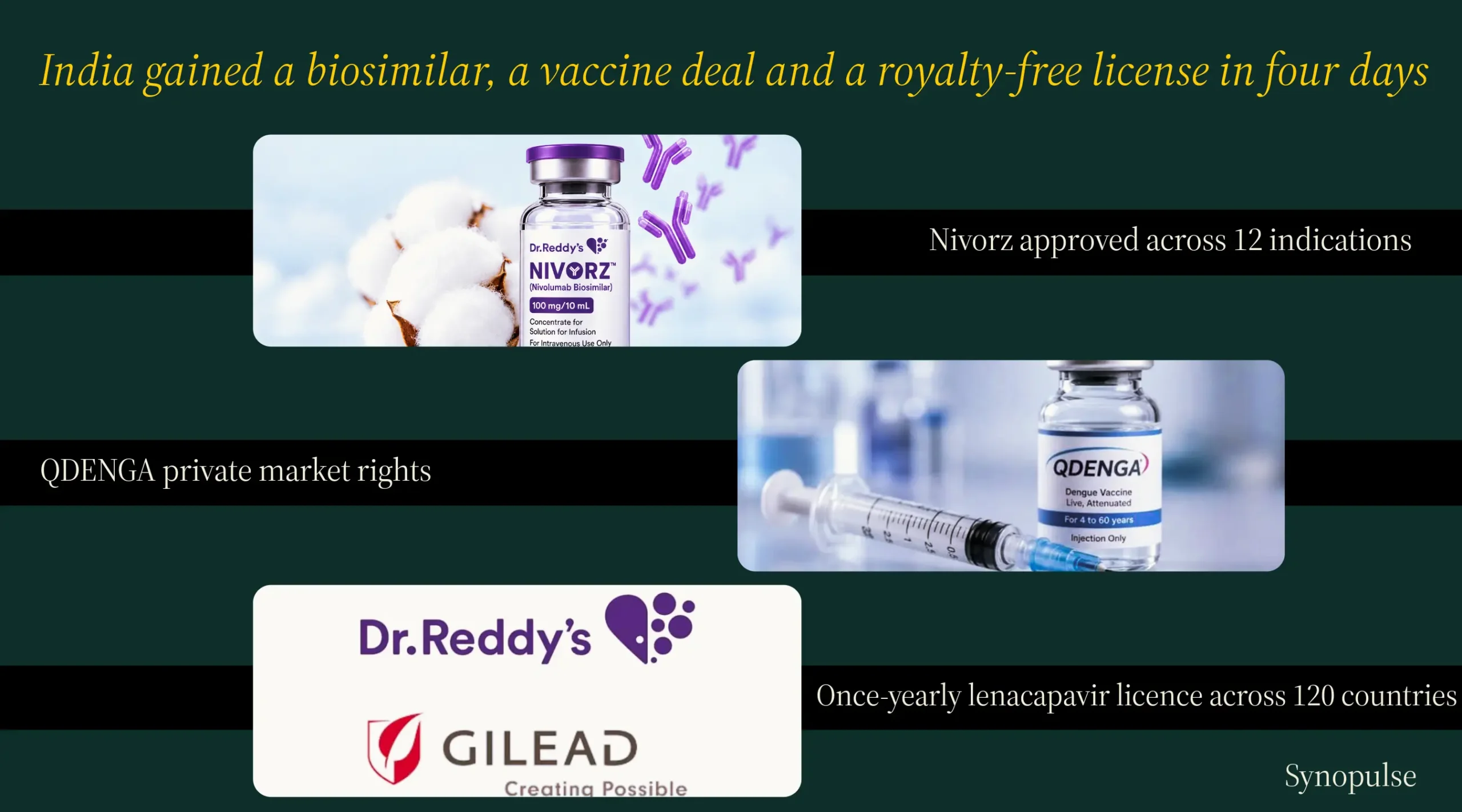
India Got Three Different Access Mechanisms in Four Days
Between 15 and 18 September, Dr Reddy’s launched a nivolumab biosimilar it developed itself, took the private-market rights to India’s first approved dengue vaccine, and extended a royalty-free HIV licence to an investigational once-yearly injection. Three announcements, three different routes to patients, and no figure a patient could use.
Dr Reddy’s Laboratories launched Nivorz, its own nivolumab biosimilar, approved by the Drugs Controller General of India across 12 indications. It was developed and manufactured in-house at Bachupally, Hyderabad, and supported by a 288-patient programme with 252 patients in India and 36 in Russia. It comes in three single-dose vial sizes. No price was announced.
On 18 September Takeda and Dr Reddy’s signed an exclusive agreement covering promotion and distribution of QDENGA in India’s private market for paediatric and adult vaccination. Takeda keeps the public market, manufacturing, importation and brand ownership. There is no upfront and no milestone payment, and other commercial terms were not disclosed.
QDENGA received CDSCO marketing authorisation in July 2026 for individuals aged 4 to 60, making it India’s first approved dengue vaccine. It is given as two doses three months apart without pre-vaccination screening, and the partners expect availability in the first half of 2027.
On 17 September Dr Reddy’s confirmed a royalty-free, non-exclusive voluntary licence from Gilead covering investigational once-yearly lenacapavir for HIV prevention, one of six manufacturers covered, across 120 high-incidence countries. The once-yearly formulation is still in the Phase 3 PURPOSE 365 study.
A biosimilar launched without a price is a distribution announcement
Nivorz is the part of the week that should move access furthest. Checkpoint inhibitor therapy in India is limited by cost and by duration of treatment, and a domestically manufactured biosimilar addresses both in principle. The company says as much, describing the product as a more affordable option.
The launch release does not say what it costs. For a molecule whose access barrier is arithmetic rather than availability, that is the missing number, and it is the one every oncologist and every hospital purchasing committee needs before anything changes for a patient.
The commercial frame is clear enough. Dr Reddy’s puts the Indian immuno-oncology market at roughly 3,900 crore rupees as of 2025, and entering it with an in-house biologic rather than an in-licensed one keeps the margin and the manufacturing inside the company. The clinical programme was run predominantly in India, at 252 of 288 patients, which is a domestic development case as much as a commercial one.
Access follows from price, and the price will emerge through tenders and hospital lists over the coming months rather than through a release. Until it does, the claim on the record is capability, not affordability.
The dengue vaccine was split into two markets before it arrived
The QDENGA agreement divides India in two. Dr Reddy’s gets exclusive promotion and distribution in the private market for children and adults. Takeda retains the public market, along with manufacturing, importation and legal and brand ownership.
That structure decides the sequence in which Indians get the vaccine. Private-market availability is expected in the first half of 2027, while public provision depends on a separate decision. Takeda’s Mahender Nayak points to the Parliamentary Committee on Health’s recommendation that dengue vaccine be considered for the Universal Immunization Programme, which is a recommendation rather than a commitment.
The economics are unusual and worth stating plainly. There is no upfront payment and no milestone payment, so Dr Reddy’s is not buying the rights. It is renting out its commercial network, and Takeda is paying for reach with margin rather than with cash. For a company that has been building a vaccines business, an arrangement with no capital at risk and an established brand to carry is a good trade.
What it means for access is narrower. The first Indians to receive an approved dengue vaccine will be those who can pay for it privately, in a country where a surveillance picture cited by the partners has dengue cases rising roughly elevenfold over two decades. Universal immunisation, if it comes, follows a public procurement decision that neither company controls.
A royalty-free licence is a manufacturing plan, not a supply
The lenacapavir expansion is the furthest from patients and the most structurally interesting. Gilead has extended royalty-free, non-exclusive voluntary licences to six generic manufacturers, including Dr Reddy’s, for an investigational once-yearly formulation, covering 120 high-incidence countries that are mostly low and lower-middle income.
The product is not approved anywhere in that form. PURPOSE 365 is still running. What the licence does is start technology transfer, process validation and regulatory preparation before the data arrive, which is the part of long-acting injectable supply that normally adds years after an approval.
This is the industry doing the one thing that reliably shortens the gap between an approval in a rich country and availability in a poor one, and doing it in advance. It also costs Gilead nothing today. If PURPOSE 365 misses, the licence was free to give.
The access angleThree mechanisms appeared in four days: build it yourself, distribute someone else’s, and prepare to manufacture something that does not exist yet. Each moves a different constraint, and each was announced without the number that determines whether a patient gets the medicine. A biosimilar with no price, a vaccine with a private-market launch and a public ambition, and a licence for an investigational product describe capability rather than access. In India, where a large share of medicine spending is paid out of pocket, capability and access are separated by exactly one figure, and none of the three releases contains it.
What to watch
The Nivorz price, when it appears in hospital tenders and state purchasing lists. The gap against reference nivolumab is the only measure of what this launch does for patients, and it will emerge in procurement rather than in a press release.
Whether QDENGA reaches the Universal Immunization Programme. A private launch in the first half of 2027 sets a reference price that any subsequent public negotiation starts from, which is why the sequence matters as much as the approval did.
PURPOSE 365 data and the first once-yearly regulatory filing. Six licensed manufacturers preparing in parallel is the difference between a launch sequence measured in years and one measured in months, and India carries three of the six.
Four days produced a domestic biologic, a global vaccine and a royalty-free licence covering 120 countries. The week’s honest summary is that India’s capacity to supply medicines advanced on three fronts, and its patients learned nothing about what any of it will cost them.