
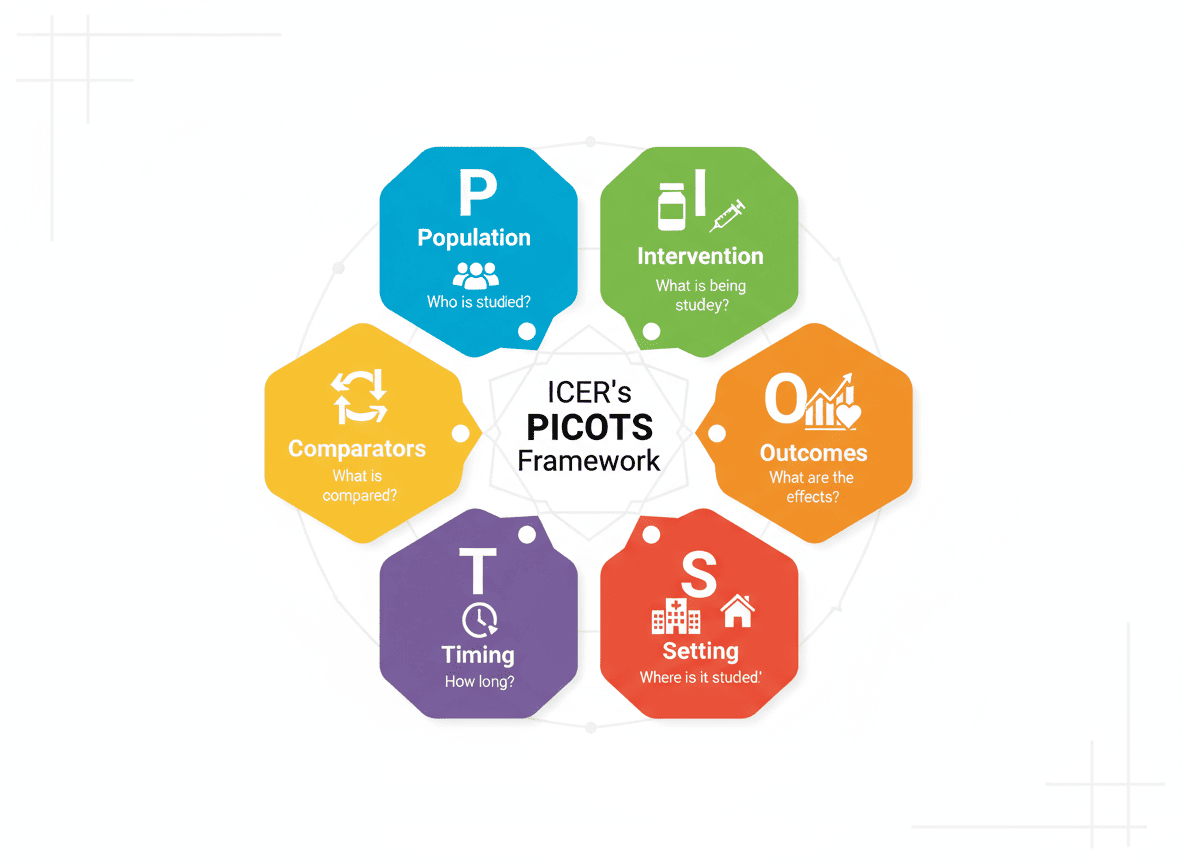
Conceptual illustration of ICER’s PICOTS framework, outlining the six key domains – Population, Intervention, Comparators, Outcomes, Timing, and Setting, used to structure comparative clinical and economic value assessments.
Draft scope evaluates long-term effectiveness, safety, and cost-effectiveness of updated vaccines from Pfizer, Moderna, and Sanofi
The Institute for Clinical and Economic Review (ICER) has launched a new assessment of the comparative clinical effectiveness and value of updated COVID-19 vaccines, marking the first U.S. value review of next-generation immunizations in the post-pandemic landscape.
In a draft scoping document published November 10, 2025, ICER outlined plans to evaluate the efficacy, safety, and cost-effectiveness of the four vaccines currently authorized for use in the United States: Comirnaty (Pfizer/BioNTech), Spikevax and mNEXSPIKE (Moderna), and Nuvaxovid (Sanofi). The report will examine both short- and long-term outcomes of vaccination, including effectiveness against severe disease, hospitalization, mortality, and long COVID.
Public comments on the draft are open through December 2, 2025, after which ICER will release a revised scope on December 12, 2025. The completed assessment will be the focus of the New England Comparative Effectiveness Public Advisory Council (CEPAC) meeting scheduled for June 2026.
“This project will evaluate the health and economic outcomes of vaccines for COVID-19,” ICER wrote. “We will ensure the full range of benefits and harms including public health impact, innovation, and reduction in disparities are reflected in our assessment of value.”
A Post-Pandemic Value Lens
ICER’s COVID-19 vaccine analysis arrives nearly six years after the first emergency use authorizations in late 2020. With over 1.2 million U.S. deaths and 7 million worldwide attributed to COVID-19, the agency says this review aims to contextualize vaccine value in an era when most of the U.S. population has some degree of immunity from prior infection or vaccination.
The evaluation will consider direct clinical outcomes such as serious illness, hospitalization, and death as well as societal outcomes like productivity loss, caregiver impact, and long COVID prevalence. ICER will model cost-effectiveness over both lifetime and five-year time horizons, incorporating quality-adjusted life years (QALYs) and equal value of life years gained (evLYs) to capture patient-cantered benefit.
The scope reflects recent FDA label updates (August 2025), which now authorize these vaccines for individuals 65 and older, as well as younger adults with underlying risk factors such as diabetes, obesity, or cardiopulmonary conditions.
ICER plans to analyze outcomes across multiple subpopulations, including:
- Children and adolescents
- Pregnant women
- Adults under and over age 65
- Patients with chronic comorbidities (e.g., COPD, cardiovascular disease, immunocompromise)
Comparisons will include head-to-head vaccine analyses and evaluation against no updated vaccination to reflect current real-world immunization patterns.
The interventions under review are:
- Comirnaty® (Pfizer, BioNTech) – mRNA vaccine
- Spikevax® (Moderna) – mRNA vaccine
- mNEXSPIKE® (Moderna) – updated mRNA platform
- Nuvaxovid® (Sanofi) – adjuvanted spike protein vaccine
ICER said it will incorporate evidence from randomized controlled trials, systematic reviews, and large-scale cohort studies, with particular attention to the vaccines’ performance against evolving variants and their role in preventing long COVID.
The draft scope also details ICER’s comparative value analysis, combining quantitative modeling with qualitative factors such as public health benefits and ethical priorities. The forthcoming model will estimate incremental cost per QALY and budget impact, reflecting both healthcare system and societal perspectives.
Related news
Brensocatib faces ICER spotlight with strong case for clinical and economic value
ICER noted that productivity losses, caregiver burden, and other indirect costs will be incorporated when data are available, following its 2023 Value Assessment Framework.
As part of its process, ICER has conducted five weeks of stakeholder outreach to patient advocacy groups, manufacturers, clinicians, and researchers. The organization encourages broad public participation, inviting written comments to publiccomments@icer.org through 5 p.m. ET, December 2, 2025.
In line with ICER’s standard evidence framework, the draft scope defines key elements of the review using the PICOTS structure. Population, Interventions, Comparators, Outcomes, Timing, and Setting. This framework ensures a transparent, systematic approach to evaluating the comparative clinical and economic value of COVID-19 vaccines.
| PICOTS Element | Description in ICER Draft Scope |
|---|---|
| Population | Primary Population: People living in the US in 2026, eligible for COVID-19 vaccination. Sociodemographic Subgroups: young children, boys and young adult men, pregnant women, adults under age 65, adults ages 65 and older. Comorbidity Subgroups: Pulmonary conditions such as asthma and COPD, Cardiovascular diseases, Diabetes, Obesity and Immunocompromising conditions. |
| Interventions | Comirnaty®, Spikevax®, mNEXSPIKE®, and Nuvaxovid® |
| Comparators | 1. Each vaccine intervention vs. the others 2. Each vaccine vs. not receiving an updated COVID-19 vaccine |
| Outcomes | Patient-Important Outcomes: Covid-19, Serious illness from Covid-19, Hospitalization, Mortality, Risk of transmitting SARS-CoV-2, Long Covid and permanent harms from Covid-19, Fetal injury from Covid-19, Adverse events ( Short-term minor AE including fever and malaise, Myocarditis and pericarditis, Guillain-Barre syndrome, Fetal injury from Covid-19 immunization) Other Outcomes: Asymptomatic SARS-CoV-2 infection |
| Timing | Any duration |
| Setting | All relevant settings considered, special focus on outpatient settings in the United States |
Table illustrates PICOTS Framework – ICER COVID-19 Vaccine Value Assessment
Following the comment period, ICER will finalize its analytical model and begin evidence synthesis. The economic analysis plan, detailing model assumptions and cost parameters, will be released in February 2026, ahead of the CEPAC meeting in June.
ICER’s COVID-19 vaccine review aims to inform payer coverage decisions and public health policy as vaccination strategies transition from emergency response to long-term sustainability.
