
FastWave’s Pivotal Trial Cannot Measure the Thing FastWave Is Selling
- FastWave Medical received FDA approval of its Investigational Device Exemption on 11 August 2026, clearing it to begin the US pivotal trial of the Artero electric intravascular lithotripsy system in peripheral artery disease. The SPARC trial will enrol up to 125 patients across 30 sites, co-led by Dr Sahil Parikh of Columbia and Dr Venita Chandra of Stanford Health Care.
- Artero delivers circumferential sonic pressure waves at 4 Hz, which FastWave describes as up to four times the speed of legacy IVL devices, through a one-click, hands-free system. Its rupture-resistant design and low crossing profile are intended to shorten procedure times and deliver predictable performance in complex disease.
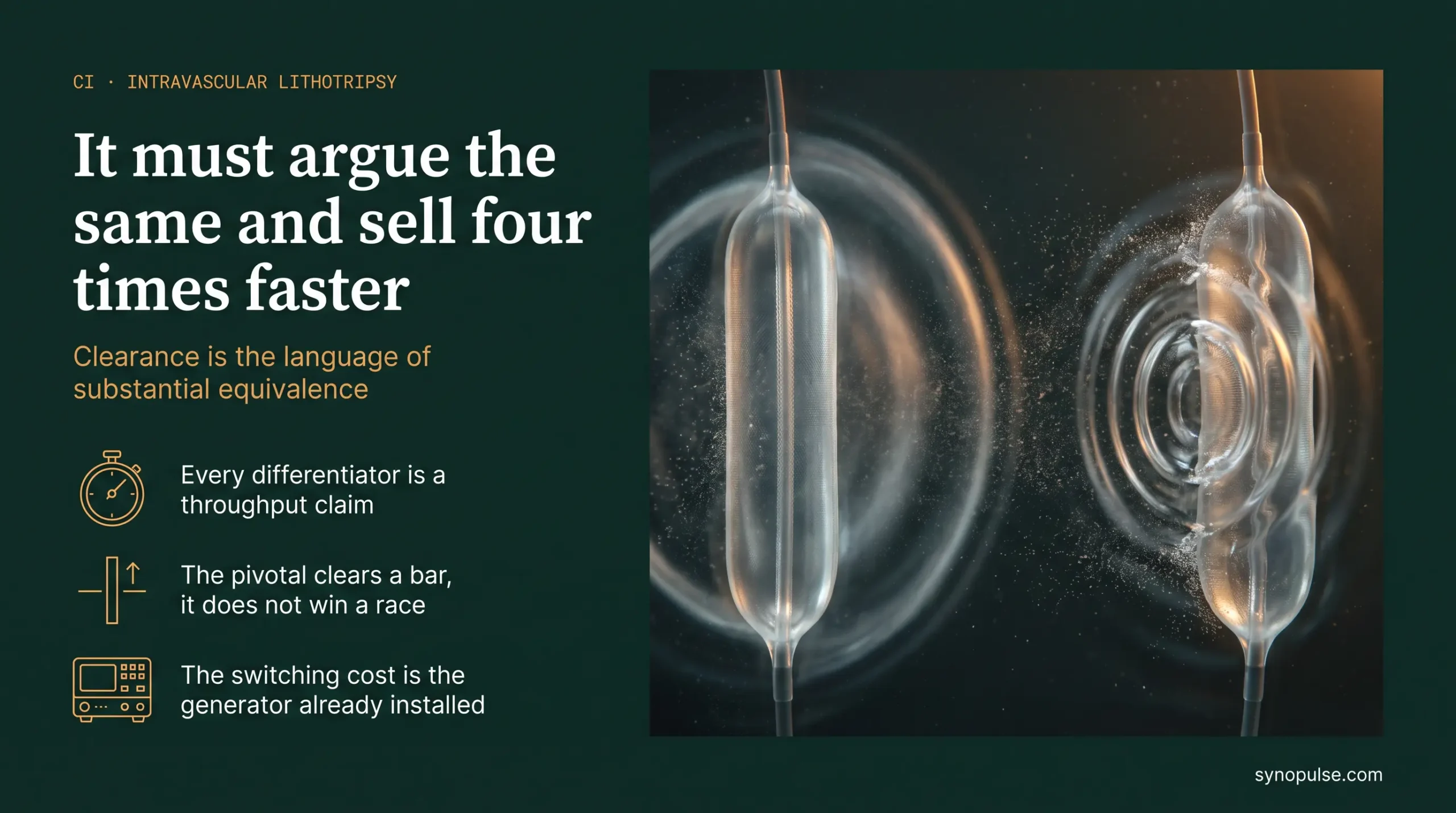
- Chief executive Scott Nelson describes the milestone as bringing FastWave a step closer to FDA clearance, not approval. Clearance is the language of the 510(k) pathway, which turns on substantial equivalence to an existing predicate device rather than on independent demonstration of benefit.
- FastWave was founded in 2021 and has raised over $50 million in venture funding across a dual platform: Artero for peripheral use and Sola, a laser-based coronary IVL system that has completed a 30-patient feasibility study. The incumbent in peripheral IVL is Shockwave Medical, acquired by Johnson & Johnson in 2024.
CI read
Everything FastWave sells is comparative. Four times the pulse rate, shorter procedure times, more predictable performance, better deliverability. Every one of those claims is a statement about another company’s device. Now read the word the chief executive actually used: clearance. That is the 510(k) vocabulary, and 510(k) turns on substantial equivalence to a predicate. So FastWave has to persuade the FDA that Artero is materially the same as what already exists, while persuading operators that it is four times better. Both arguments are legitimate. They simply cannot be made in the same document.
- The trial is built to clear a threshold, not to win a comparison. A pivotal study of this shape asks whether the device modifies calcium adequately and safely, which is exactly what a predicate-based filing requires and exactly what a differentiation story does not. Procedure time, pulse efficiency and deliverability are the reasons an operator would switch, and none of them will be settled by SPARC. Anyone reading this readout when it lands should check whether procedure duration was even collected, because that single variable carries more commercial weight than the effectiveness endpoint the filing depends on.
- Competitive frame: the incumbent is not a competitor, it is Johnson & Johnson. Shockwave defined this category and now sits inside the largest medtech organisation in the world, with an installed generator base, an existing contract at essentially every relevant hospital, and years of real-world evidence. FastWave has raised just over fifty million dollars. In peripheral intervention the switching cost is not clinical, it is the capital equipment already sitting in the lab and the contract already signed, so a superior catheter that needs a new generator starts every conversation behind. Note the hedge in the portfolio: Artero is electric, Sola is laser. A company running two different energy modalities across two vascular beds is not certain which one wins either.
- What to watch: whether FastWave is acquired before SPARC reads out. A dual-platform IVL company with an IDE in hand, thirteen patents, an award shelf and fifty million raised is priced as an asset rather than as a business, and the strategics circling calcium modification have been buying rather than building. The number to demand is not the effectiveness rate. It is the cost per lesion including the generator, because peripheral work is migrating to ambulatory and office-based labs where throughput and consumable cost decide adoption long before any endpoint does.