
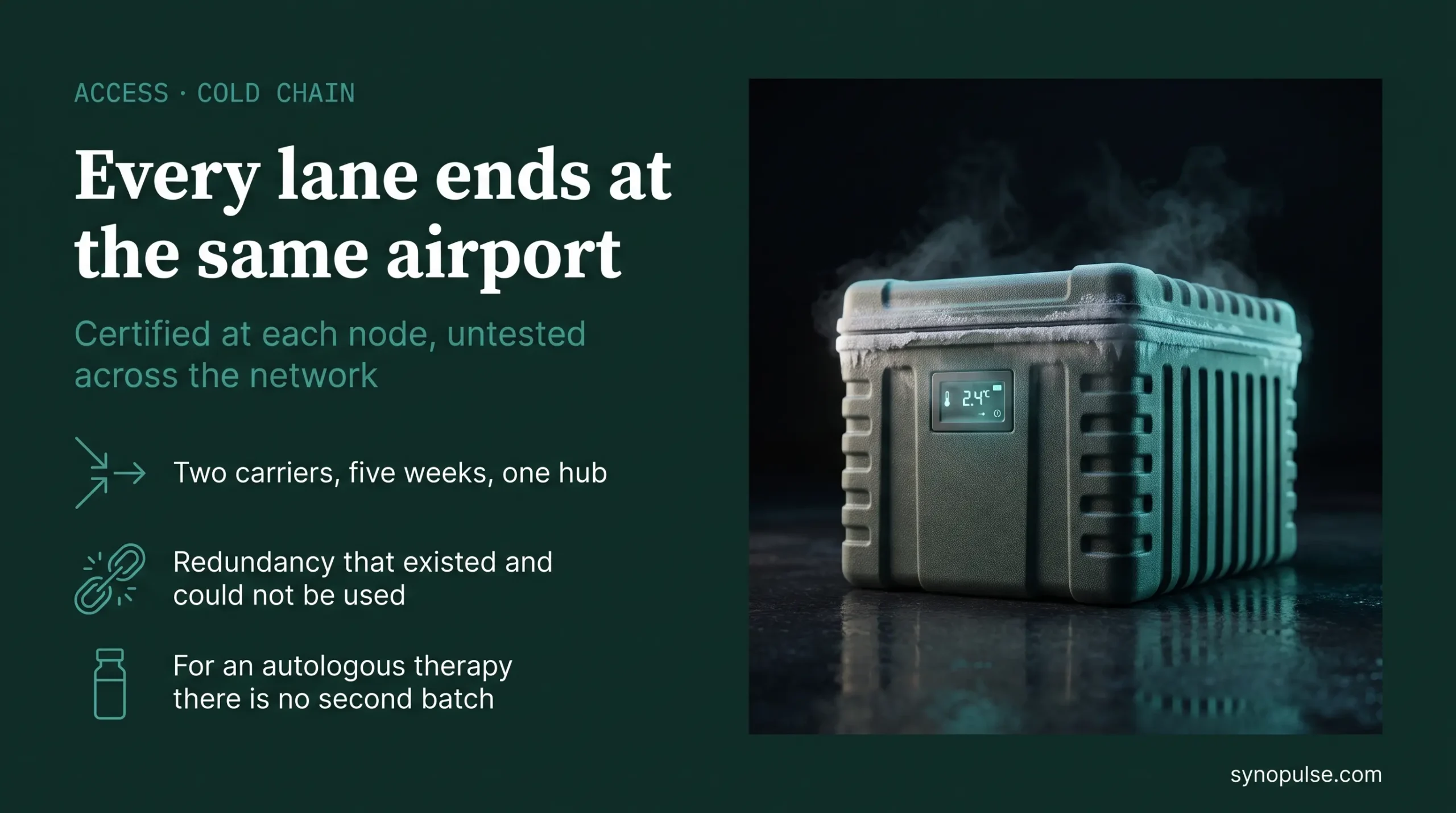
Everyone’s New Pharma Lane Runs Through Heathrow
Two carriers announced new temperature-controlled pharmaceutical lanes in the five weeks to 18 August, and both of them terminate at London Heathrow. American Airlines Cargo trucks from Amsterdam and Brussels to Heathrow, then flies to US pharma hubs. IAG Cargo now runs a daily Kuala Lumpur service into Heathrow, timed so shipments make same-day onward connections. In March 2025 Heathrow closed for around eighteen hours because one transformer caught fire.
- The network is getting denser and narrower at once. IAG Cargo’s roughly 100 approved stations and American’s new corridor both funnel through one hub, so station count measures reach rather than resilience, and the two are reported as though they were the same thing.
- The concentration is deliberate. The joint business between IAG Cargo, Qatar Airways Cargo and MASkargo is explicitly a single network, described by IAG Cargo’s chief executive as more coordinated than traditional interline. Efficiency and single-point exposure are one decision read from opposite ends.
- The freight is becoming less replaceable as the routing becomes less redundant. A delayed pallet of tablets is a write-off. A delayed autologous cell therapy is a treatment window for a named patient, with no second batch to send.
Route concentration has quietly become a clinical variable rather than a logistics one, and it sits outside every certification scheme governing these lanes. A reader can stop here with the full picture. The sections below are the detail.
Two announcements, five weeks apart, one airport
On 15 July American Airlines Cargo confirmed a pharma corridor linking the life sciences clusters at Amsterdam and Brussels with US destinations by way of London Heathrow. GDP-certified trucking, run with FlyUs Aviation Group, has operated daily since 1 May, carrying 2 to 8 degree and 15 to 25 degree shipments into Heathrow, where they transfer to belly capacity on transatlantic flights. American calls Heathrow one of its largest gateways.
On 18 August IAG Cargo added a GDP-certified Constant Climate station at Kuala Lumpur, its thirteenth in Asia Pacific, taking the network to roughly 100. It is served by a daily flight to Heathrow, and IAG Cargo is explicit that the schedule was built around an early morning arrival so shipments make same-day onward connections across the rest of the network. Heathrow is the company’s primary cold chain hub.
Neither decision is odd alone. Together, two carriers with different fleets, customers and geographies have independently concluded that the way to move pharmaceuticals is through the same airport.
The single network is the product, which makes it the exposure
The Kuala Lumpur station did not appear in isolation. IAG Cargo, Qatar Airways Cargo and MASkargo announced their intention to form a Global Cargo Joint Business in April 2025, and were seeking Singapore approval for the metal-neutral partnership in January 2026. MASkargo is Kuala Lumpur based, and IAG Cargo already handles its freight at Heathrow.
So a carrier opened a pharma station at its joint business partner’s home airport, connected by daily service to the hub where it already handles that partner’s freight. The release frames this as regional demand. The likelier reading is that the joint business is being wired together, and pharmaceuticals are the highest-yield thing to wire it with.
IAG Cargo’s chief executive David Shepherd described the partnership as creating a single network, more coordinated than anything available through traditional interline agreements. That is accurate and a good commercial argument. It also describes removing the redundancy interline arrangements happen to provide. Three carriers routing independently produce duplication. They also produce alternatives.
The cargo is getting less replaceable as the route gets less redundant
IAG Cargo’s head of pharmaceutical, Jordan Kohlbeck, named the demand drivers precisely: biologics, cell and gene therapies, and personalised medicines. Those three categories break the assumptions the cold chain was built on.
Good Distribution Practice was designed around pallets of small molecules with shelf lives in years and stock held at multiple points, and almost every mitigation in that world depends on the shipment being one of many. An autologous cell therapy is none of those things. The starting material is the patient, the manufacturing slot is scheduled against that patient’s lymphodepletion, and no warehouse holds a spare.
So the cost of a delay changes shape. A pallet of tablets held eighteen hours is a claim and possibly a write-off. An autologous product held eighteen hours at the wrong point is a treatment window that may not reopen for someone already conditioned for it. The financial exposure is smaller and the clinical exposure is categorical, and that difference appears nowhere in the certification governing these lanes.
Certification measures the node, not the network
The buildout is being done properly at the level it operates. Geodis recertified its Warsaw airfreight operations to IATA CEIV Pharma in July, and Envirotainer opened its sixth Indian station at Navi Mumbai the same month. What that certifies is handling inside a facility: process, equipment, training, documentation, temperature control. It is genuine assurance and worth having.
What none of it scores is what happens when a certified node is unavailable. There is no certification for route redundancy, no audit asking how a Kuala Lumpur shipment reaches Boston if Heathrow is shut, and no standard requiring the alternate be exercised. A hundred certified stations tell you the handling is sound at each. They say nothing about the topology connecting them.
Heathrow has already run this experiment
On the evening of 20 March 2025 a transformer holding around 25,000 litres of cooling oil caught fire at the North Hyde substation in Hayes, west London. Heathrow closed for about eighteen hours the next day. More than 1,300 flights were cancelled or disrupted and around 120 aircraft already airborne diverted or returned to origin.
The National Energy System Operator investigation, published that July, found an elevated moisture reading in oil samples taken at the substation in 2018, with no action taken to replace the bushings in the seven years that followed. The second finding matters more here. Heathrow had underestimated the likelihood of losing one of its three power sources, and its internal electrical distribution network was not configured to take advantage of multiple supply points for quick recovery.
Heathrow had redundancy and could not use it. The alternates existed on the diagram and not in the configuration, which is a more instructive failure than having no alternates at all.
Eighteen hours is survivable for most passive shipments, whose validated hold times run into days, which is why March 2025 was reported as a passenger story rather than a pharma one. The point is not that one closure destroyed cargo. It is that both carriers have since routed more pharmaceutical volume through that node, as the mix shifts toward products with far less tolerance, and neither announcement says what happens if the hub is unavailable.
What generalises
Every network optimises for throughput and finds out about its concentration when something fails. The version specific to this industry is that the shipment is becoming not a copy of the treatment but the treatment itself, while the network consolidates into alliance blocs and single hubs at the same moment.
For anyone running a cell or gene therapy programme, or contracting lanes for a biologic launch, the useful question is not whether the route is certified. It will be. Ask what the alternate routing is, who owns it inside a metal-neutral joint business where the carriers no longer compete on that lane, and when it was last actually run rather than described in a contract.