
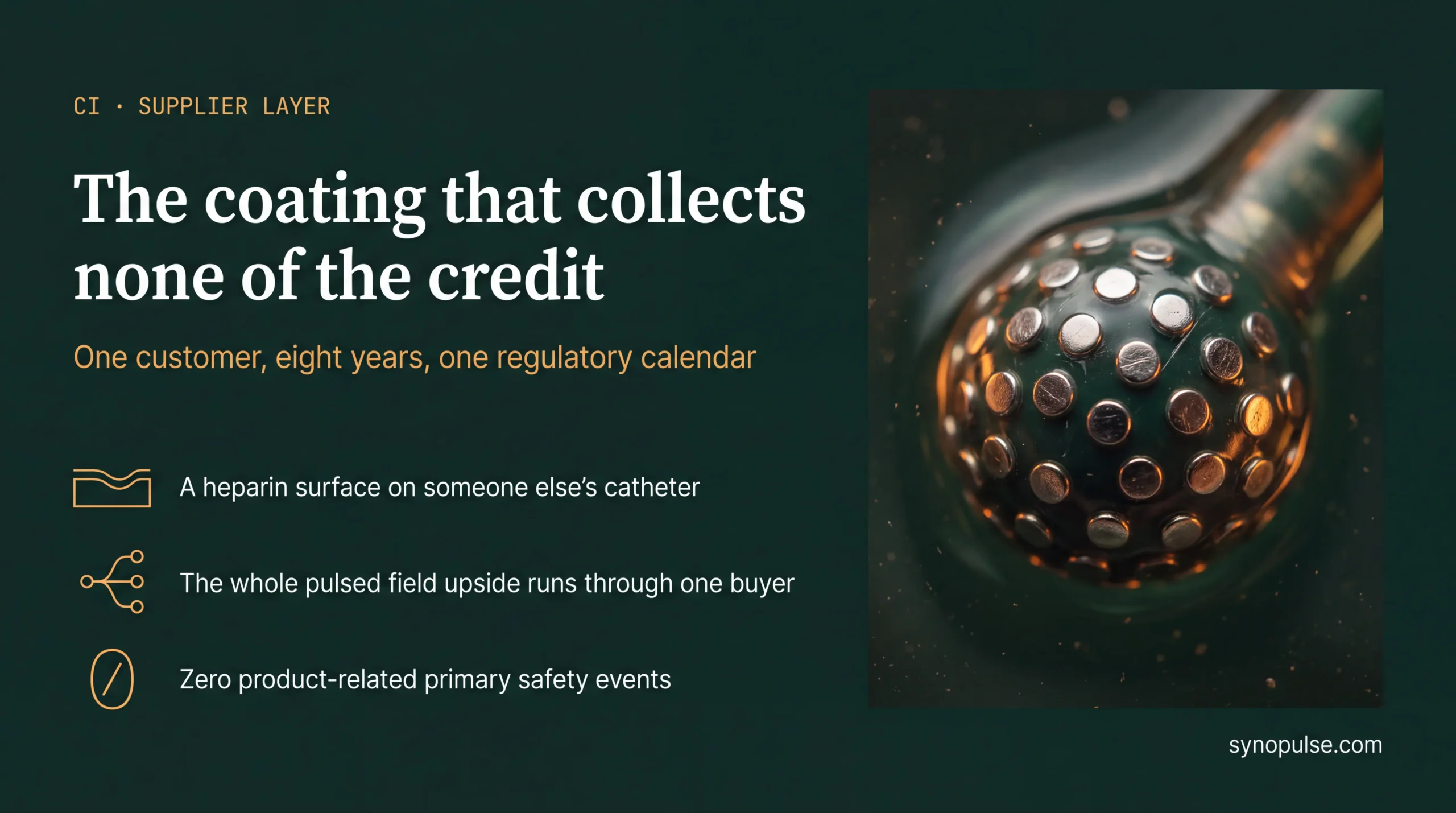
Corline’s Whole Pulsed Field Upside Depends on One Customer’s Regulatory Calendar
- Corline Biomedical disclosed, under EU market abuse rules and at 08:32 on 10 August 2026, that Health Canada has granted a Medical Device Licence for Kardium’s Globe Pulsed Field System, opening the Canadian market. Corline supplies the CHS heparin surface coating applied to the Globe catheter and has been Kardium’s technology partner for more than eight years.
- The licence follows FDA approval in September 2025 and marks a second major market for a CHS-coated product. Corline describes pulsed field ablation as among the fastest-growing segments across the entire medical technology market through 2025 and 2026.
- The PULSAR study underpinning the Canadian licence reported 78% freedom from atrial arrhythmia at twelve months and 0% product-related primary safety events.
- The Globe system pairs a 122-electrode spherical array with real-time thermal contact sensing, allowing single-shot pulmonary vein isolation and targeted ablation from one catheter. Kardium is a private Vancouver company, so this approval is in its home market and arrived after the United States.
CI read
A component supplier has issued a regulated market disclosure about a regulatory decision it did not apply for, in a country it does not sell into, concerning a device it does not manufacture. That is not an oddity. It is exactly how the supplier layer works. Corline’s revenue events are its customer’s regulatory calendar, and it has to tell shareholders when that calendar moves because it has no other way to signal progress.
- The coating is doing more work than its billing suggests. Pulsed field catheters sit in the left atrium delivering high-voltage energy, and thrombus formation on the catheter surface is one of the live safety questions in the category. A heparin surface exists to address precisely that. PULSAR reported zero product-related primary safety events where competing systems have reported figures in the region of 0.7% to 2.2%. Safety differentiation is Kardium’s strongest commercial argument, and a supplier’s component plausibly contributes to it while collecting none of the attribution. That asymmetry is the supplier layer in a sentence.
- Competitive frame: more than eight years as technology partner means Corline’s exposure to the fastest-growing category in medical technology runs through one private customer. Concentration of that kind is an excellent business while the customer wins and an existential one when it does not. Anyone valuing Corline is really valuing Kardium’s commercial ramp, and anyone tracking Kardium should note that a small Swedish listed company is obliged to announce its milestones, often before the trade press reaches them.
- What to watch: the PULSAR figures now function as a competitive benchmark rather than a company claim. Medtronic took a CE Mark for ventricular ablation four days ago and disclosed no efficacy or safety data whatsoever, while Kardium carries 78% freedom from arrhythmia at twelve months and a zero on device-related safety events into a second market. Different indications, not directly comparable, and yet two very different disclosure standards inside the same category in a single week. Note also that Health Canada followed the FDA for a company headquartered in Vancouver, which tells you where the commercial priority sat.