
CMS Projects Fewer Losses and Bigger Savings. That Only Works If the Sick Are Removed.
- A Brookings Institution analysis published on 12 August 2026 by Sherry Glied and Richard Frank finds that the CMS rule implementing Medicaid work requirements rests on assumptions carrying no stated justification. CMS assumes 29% of affected beneficiaries will move into qualifying activities, which the authors put at more than six times the largest estimate in any relevant literature.
- CMS projects 3.1 to 3.3 million people will lose Medicaid over the next decade and forecasts $350.3 billion in federal savings, roughly 10% above the Congressional Budget Office. CBO projects around 5.7 million losing coverage by 2034.
- The mandate requires 80 hours a month of work, volunteering or study, applies to roughly 21 million people who gained eligibility through ACA expansion, and takes effect in January 2027. More than two dozen states are suing, a judge allowed the rule to stand in July, and at least eight states are dropping the one-year grace period.
- Separately, AMN Healthcare projects a shortfall of up to 86,000 physicians by 2036 and over 63,000 registered nurses by 2030. Rural areas filled nursing posts at one-third the urban rate in 2025, only 2% of new physicians want sparsely populated areas, and more than 7,700 rural primary care shortage areas would need 13,254 additional providers to close.
Access read
The arithmetic contradicts itself. CMS forecasts fewer disenrollments than CBO and higher savings. Both hold only if the people removed are the expensive ones, which means the sick, which means the exemptions are not working as described.
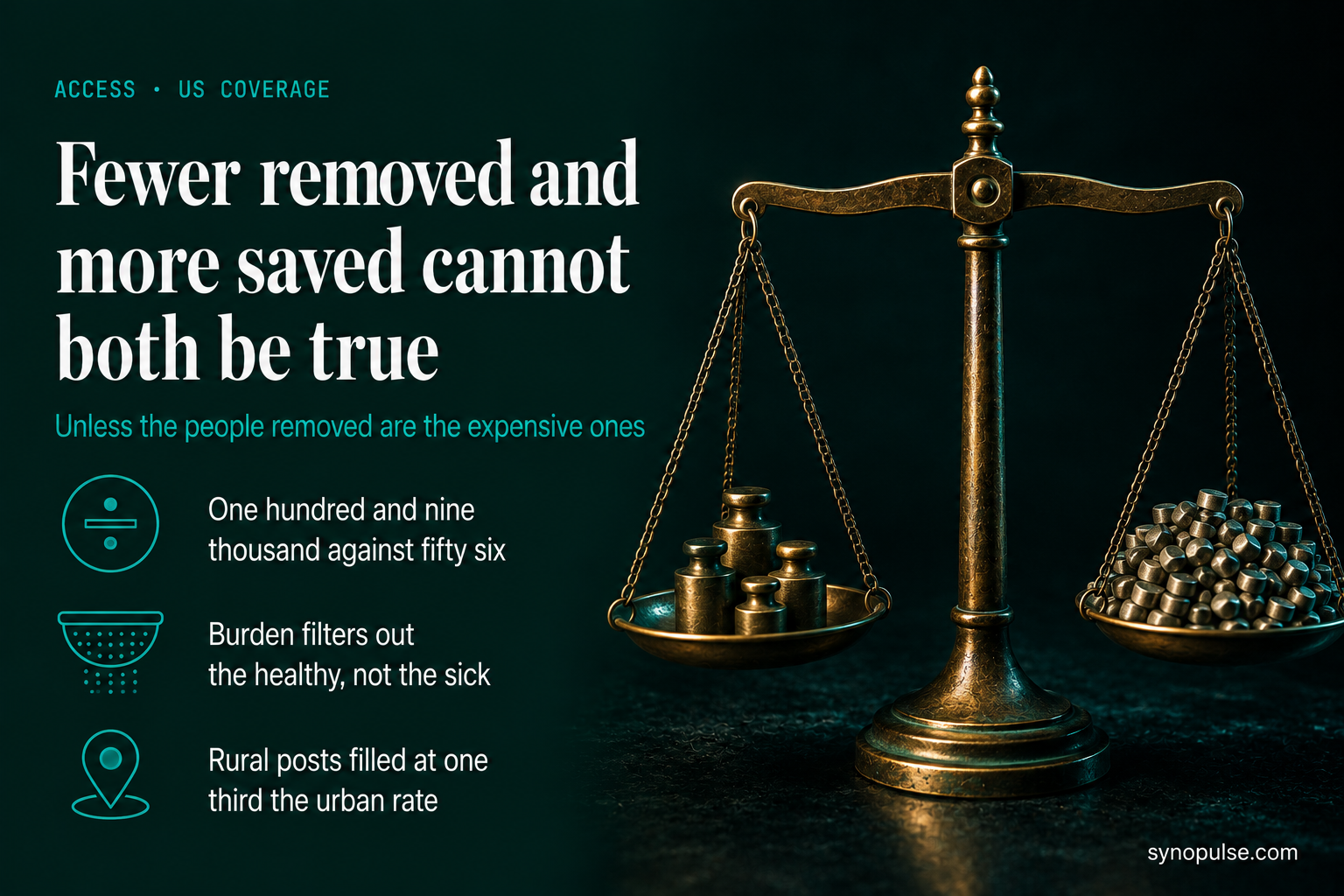
- Run the division. CMS: $350.3bn across 3.2 million people is roughly $109,000 each. CBO: about 10% less across 5.7 million is roughly $56,000. CMS is implicitly pricing each person removed at twice CBO’s assumption.
- The evidence cuts the other way. People who exit when administrative burden rises are generally the healthier ones, so savings per disenrollee should fall, not double. The 29% employment assumption is the load-bearing input, and it exceeds the literature by more than six times.
- Coverage and clinicians are being withdrawn from the same counties. Rural areas filled nursing posts at one-third the urban rate, and 2% of new physicians choose them. Coverage loss lands where 13,254 primary care providers are already missing.
Read the original source (Brookings Institution) →
Healthcare staffing projections to 2030 (AMN Healthcare) →
GeographyUnited States