
Biotech’s 2026 IPO Class Raised $6.9bn on Late-Stage Assets and Would Be $473m Under Water Without Veradermics
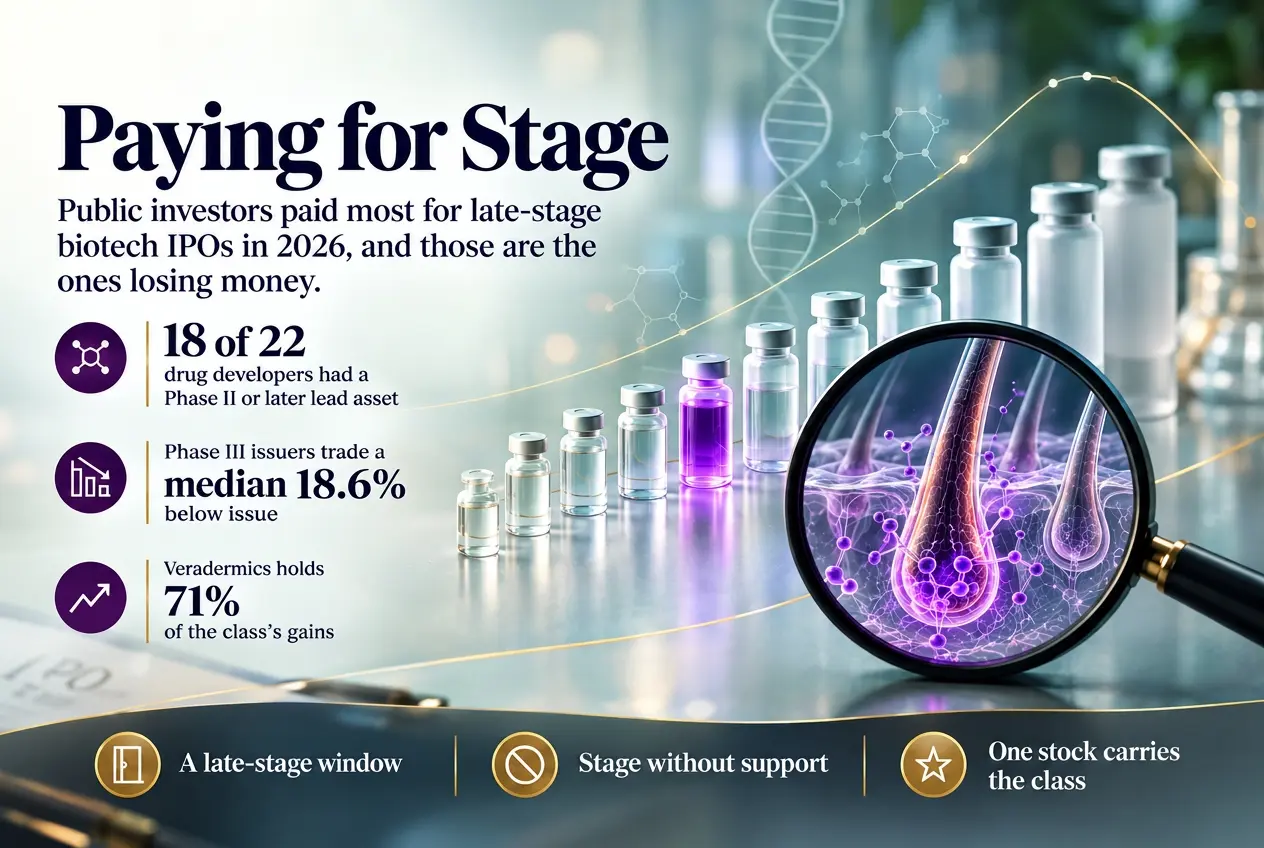
Public investors kept the IPO window open in 2026 for one kind of drug developer: late-stage, raising about $300m, at $16 to $18 a share. Twenty-two priced between January and September and raised $6.9bn. The late-stage issuers are the ones losing money: the eight Phase III companies other than Veradermics are down $674m, while the 13 at Phase I and II are up $201m.
Six drug developers priced in the first quarter and nine in the third
Twenty-five companies priced initial public offerings on US exchanges between 8 January and 24 September 2026, and 22 of them were drug developers. The other three were MiniMed, the diabetes device business that Medtronic still controls; Mobia Medical, which sells a stroke rehabilitation implant; and Alamar Biosciences, a proteomics tools company. The 25 raised $7.8bn in base offerings, and the drug developers raised $6.9bn of it.
The window stayed open all year. Drug developers priced in every month except March, in three bursts: five in February, four in April and five in August.
The pace rose as the year went on: six drug developers in the first quarter, seven in the second and nine in the third. Every one of them priced 20 to 27 days after the tape records its offering as announced, so the deals that got done moved fast. The 12 older filings, from January to August, that the tape still records as unpriced are a different market: the nine with a stated size propose between $15m and $85m.
The median drug developer raised $301m. Only two raised less than $150m.
The median base offering in the class was $300.8m, and half the drug developers raised between $214m and $382m. Scribe Therapeutics, at $128.7m, and Vogenx, at $81.3m, were the only two below $150m.
The money concentrated at the top. Parabilis Medicines sold $670.0m of stock in June and Kailera Therapeutics $625.0m in April, and the two took 18.8% of the class’s proceeds between them. The five largest offerings took 36.8%. Below them the market was crowded: 13 of the 22 raised between $250m and $400m.
Price per share barely moved. Eighteen of the 22 priced between $16 and $18, so the spread in proceeds came from the number of shares sold. A drug developer preparing to file into this market should plan on a raise near $300m. The two offerings under $150m are the exceptions, and both came in the second half.
Eighteen of 22 came with Phase II or later assets, and Phase III took half the money
Public investors bought clinical proximity. Nine of the 22 drug developers had a Phase III lead asset at pricing, nine a Phase II asset and four a Phase I asset. No preclinical or platform company priced between January and September.
The money followed the stage. Phase III companies raised $3.43bn, 49.8% of the class total, at a median $382.5m. They ran seven of the eight largest offerings, and only Parabilis, at Phase II, broke the run.
| Lead asset at pricing | IPOs | Share of IPOs | Base proceeds | Share of proceeds | Median raise |
|---|---|---|---|---|---|
| Phase I | 4 | 18.2% | $885.4m | 12.8% | $219.5m |
| Phase II | 9 | 40.9% | $2,582.3m | 37.4% | $279.0m |
| Phase III | 9 | 40.9% | $3,433.3m | 49.8% | $382.5m |
| All drug developers | 22 | 100.0% | $6,901.0m | 100.0% | $300.8m |
The filter held through the year: 11 of the 13 first-half drug developers were at Phase II or later, and seven of the nine in the second half. One correction to the tape matters here. It records Apnimed as approved, but AD109, its oral treatment for obstructive sleep apnoea, is under FDA review with a decision date of 28 February 2027 after two Phase 3 trials, Apnimed said in August. This report counts it as Phase III.
Twelve of 22 trade below their IPO price. The average return is +21.3%.
At the 16 October close, the median 2026 drug-developer IPO traded 2.8% below its issue price. Twelve of the 22 were under water and 10 above. The mean return was +21.3%, and the gap between the two measures is one stock.
Six issuers have lost a fifth or more of their issue price. Eikon Therapeutics is down 58.8% from its $18 February offering, Agomab Therapeutics 48.3%, and Electra Therapeutics 41.7% in the 29 days since it priced. At the other end, Hemab Therapeutics is up 67.1% and SpyGlass Pharma 50.0%.
Veradermics sits off the scale. It priced at $17 on 3 February and closed at $108.80, a return of 540.0%. Take it out and the mean return of the other 21 falls to −3.4%, next to their median of −4.6%. The class is one outlier and a distribution centred just below issue.
Veradermics made $1.38bn for its IPO buyers. The other 21 lost $473m between them.
Measured in dollars, the class made money. The 22 base offerings raised $6.90bn, and those shares were worth $7.81bn at the 16 October close: a gain of $911m, or 13.2%.
Veradermics accounts for all of it and more. Its $256.3m base offering was worth $1.64bn, a gain of $1.38bn and 70.8% of every dollar gained across the class. The other 21 offerings raised $6.64bn and were worth $6.17bn, a loss of $473m, or 7.1%.
| Company | Priced | Lead asset | Base offering | IPO price | 16 Oct close | Return | Value change |
|---|---|---|---|---|---|---|---|
| Veradermics | 3 Feb | Phase III | $256.3m | $17.00 | $108.80 | +540.0% | +$1,384.0m |
| Hemab Therapeutics | 30 Apr | Phase II | $301.5m | $18.00 | $30.07 | +67.1% | +$202.2m |
| Avalyn Pharma | 29 Apr | Phase II | $300.0m | $18.00 | $23.66 | +31.4% | +$94.3m |
| Parabilis Medicines | 9 Jun | Phase II | $670.0m | $20.00 | $22.75 | +13.8% | +$92.1m |
| SpyGlass Pharma | 5 Feb | Phase I | $150.0m | $16.00 | $24.00 | +50.0% | +$75.0m |
| Scribe Therapeutics | 23 Jul | Phase I | $128.7m | $15.00 | $20.08 | +33.9% | +$43.6m |
| Apnimed | 30 Jul | Phase III | $192.0m | $16.00 | $17.76 | +11.0% | +$21.1m |
| ADARx Pharmaceuticals | 24 Sep | Phase III | $446.3m | $17.00 | $17.65 | +3.8% | +$17.1m |
| Braveheart Bio | 5 Aug | Phase III | $382.5m | $18.00 | $18.71 | +3.9% | +$15.1m |
| Vogenx | 11 Aug | Phase II | $81.3m | $13.00 | $14.53 | +11.8% | +$9.6m |
| Seaport Therapeutics | 30 Apr | Phase II | $254.9m | $18.00 | $17.83 | −0.9% | −$2.4m |
| Odyssey Therapeutics | 7 May | Phase II | $279.0m | $18.00 | $17.17 | −4.6% | −$12.9m |
| BlossomHill Therapeutics | 6 Aug | Phase II | $150.0m | $16.00 | $13.94 | −12.9% | −$19.3m |
| Aktis Oncology | 8 Jan | Phase I | $317.7m | $18.00 | $15.06 | −16.3% | −$51.9m |
| Attovia Therapeutics | 4 Aug | Phase I | $289.0m | $17.00 | $13.73 | −19.2% | −$55.6m |
| Kardigan | 17 Jun | Phase III | $400.0m | $16.00 | $13.03 | −18.6% | −$74.3m |
| Latigo Biotherapeutics | 6 Aug | Phase II | $345.6m | $18.00 | $14.00 | −22.2% | −$76.8m |
| Agomab Therapeutics | 5 Feb | Phase II | $200.0m | $16.00 | $8.28 | −48.3% | −$96.5m |
| Generate Biomedicines | 26 Feb | Phase III | $400.0m | $16.00 | $12.09 | −24.4% | −$97.8m |
| Electra Therapeutics | 17 Sep | Phase III | $350.0m | $15.00 | $8.75 | −41.7% | −$145.8m |
| Kailera Therapeutics | 16 Apr | Phase III | $625.0m | $16.00 | $11.25 | −29.7% | −$185.5m |
| Eikon Therapeutics | 4 Feb | Phase III | $381.2m | $18.00 | $7.42 | −58.8% | −$224.1m |
| All 22 | $6,901.0m | +13.2% | +$911.3m | ||||
| Excluding Veradermics | $6,644.7m | −7.1% | −$472.7m |
The Veradermics gain rests on clinical data, and the company has already used it. Veradermics has reported Part A results from Study 302, a Phase 2/3 trial of its oral minoxidil, VDPHL01, in men with pattern hair loss, according to its first-quarter report. On 29 April it sold 3.84 million shares at $100, raising $384.4m before costs, its SEC filing shows. That follow-on raised more than its IPO base offering, 12 weeks after the IPO.
Phase III issuers took half the money and trade a median 18.6% below issue
The nine Phase III issuers trade a median 18.6% below their IPO price, and four of the nine are above it. The case for a late-stage IPO is that an asset closer to a product carries less risk, and so far the 2026 aftermarket has not paid for it. The 13 Phase I and II issuers trade a median 0.9% below, with six above.
In dollars the gap is wider. Set Veradermics aside and the other eight Phase III offerings have lost $674m on $3.18bn, or 21.2%. The 13 Phase I and II offerings have gained $201m.
Four of the five largest dollar losses in the class belong to Phase III companies: Eikon, Kailera, Electra and Generate Biomedicines. Public investors paid most for the companies closest to a product, and so far those companies have cost them most.
Public investors paid most for the companies closest to a product, and so far those companies have cost them most.
The two other labels that commanded size did no better. The five offerings of $400m or more have a dollar-weighted return of −9.8%, with two of five above issue. The five companies the tape tags with artificial intelligence or machine learning raised a median $400m, against $289m for the rest, and return −5.8%, with two of five above issue. With five companies each, both readings are indicative.
For issuers, stage bought access and size. Aftermarket support has had to come from data, as it did for Veradermics.
Nine of the 22 have traded for under three months, and October’s Phase I deals priced at half the class median
Nine of the 22 priced in the third quarter, between 22 and 85 days before the 16 October close, and time is the first thing that could break this reading. Those nine trade at a median +3.8%, with five above issue, against a median −4.6% for the 13 first-half issuers. A single price date on a young class is a thin base for a verdict on stage.
The second is that the filter has started to move. Four drug developers priced in October before the 16 October close, outside this report’s January to September series, and three are Phase I companies: TRexBio, Iambic Therapeutics and City Therapeutics. Their median raise was $150.0m, half the class median. Retension Pharmaceuticals, at Phase II, raised $45.0m.
| Company | Priced | Lead asset | IPO price | Base offering |
|---|---|---|---|---|
| TRexBio | 8 Oct | Phase I | $14.00 | $116.7m |
| Retension Pharmaceuticals | 8 Oct | Phase II | $12.00 | $45.0m |
| Iambic Therapeutics | 14 Oct | Phase I | $16.00 | $150.0m |
| City Therapeutics | 15 Oct | Phase I | $18.00 | $200.0m |
| Four October IPOs | $511.7m | |||
| For comparison: Parabilis Medicines, June | $670.0m |
The October deals fit the pattern at a smaller size: public investors will now take earlier-stage risk for about half the money. Lycia Therapeutics, which the tape records at discovery stage, filed publicly on 5 October. If a Phase I or discovery-stage company prices above $301m, the stage premium has gone. If the Phase III names recover first, the market was early on them.
What we are watching
- 01Veradermics’ confirmatory Phase 3 data.The company said in May that topline results from Study 304 are due in the second half of 2026. Veradermics carries 70.8% of the class’s gains; a fall back to its $17 issue price would leave the 22 offerings $473m under water.
- 02Apnimed’s FDA decision, 28 February 2027.AD109 is the first lead asset from the 2026 class with a decision date. An approval would give the class its first product; a complete response letter would add to the Phase III losses.
- 03Size in the fourth-quarter queue.October’s three Phase I issuers raised a median $150.0m. A Phase I offering above the class median of $300.8m would be the first evidence that public investors have stopped paying for stage.
- 04The Phase III median on 31 March 2027.The nine Phase III issuers trade a median 18.6% below issue. A median back above issue by the end of the first quarter would mean the market has started to price late-stage assets as lower risk.
Analysis of biopharma initial public offerings priced on US exchanges from January to September 2026. Figures reflect data available at the time of publication and are subject to revision as terms are disclosed.