
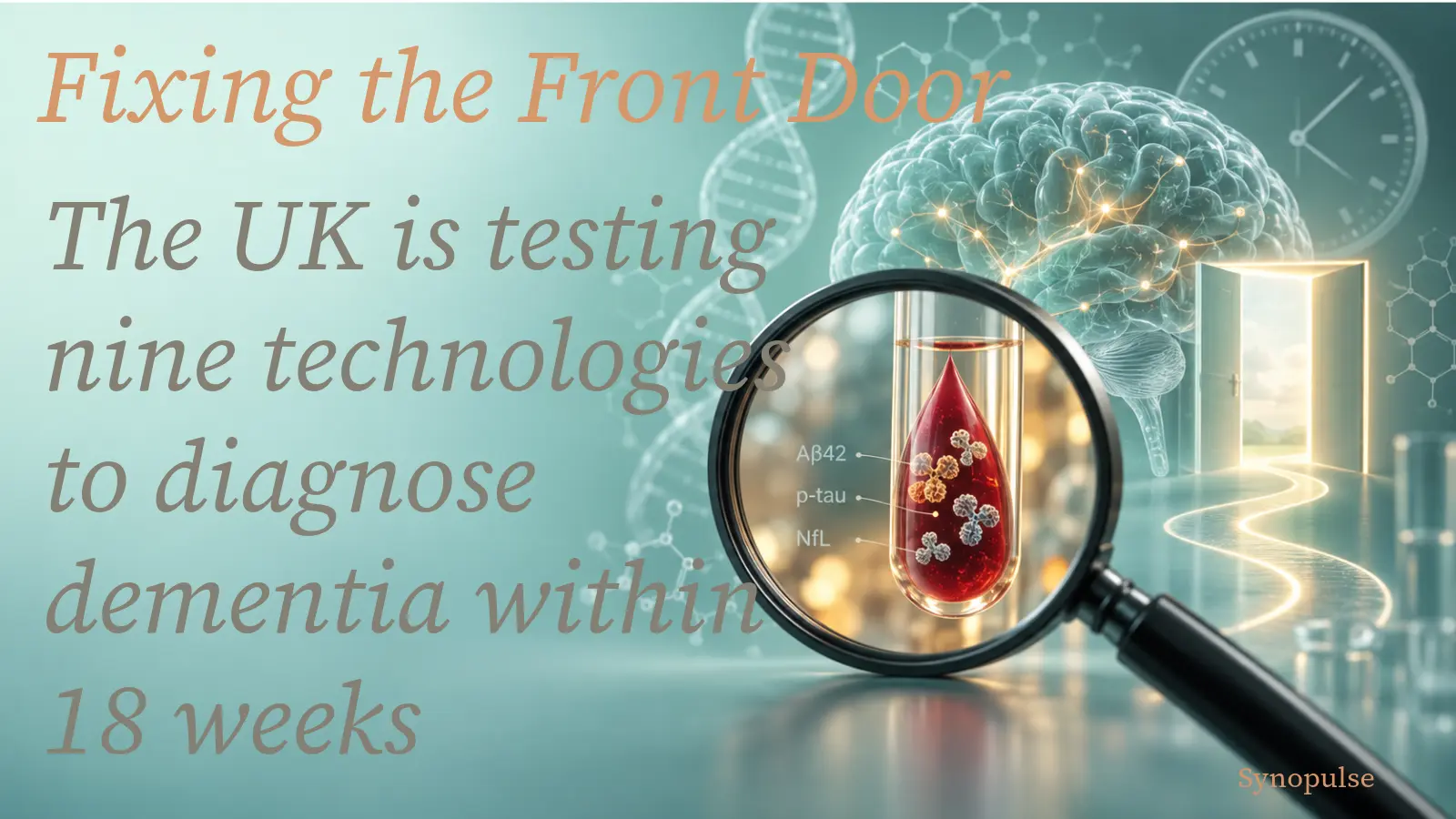
The UK Wants 92% of Dementia Referrals Diagnosed Within 18 Weeks by 2029, Up From About 60%, and Is Testing Nine Technologies to Get There
UK Research and Innovation said on 2 October that up to £80 million from its R&D Missions Accelerator Programme will fund real-world NHS testing of nine technologies to speed dementia diagnosis and predict progression. They include a blood biomarker panel from the University of Oxford and Dementias Platform UK, faster MRI from UCL, a 15-minute remote cognitive test from Cognitron, Imperial’s Minder home-monitoring platform and a Cambridge AI decision-support tool. Funding follows milestones rather than single grants, evaluations are due to start in January 2027 and run for up to two years, and technologies must be deployable in the NHS from 2029. NICE’s advice service will help the projects build their evidence plans.
Britain is paying to fix the front of the dementia pathway before it settles the back. The challenge funds diagnosis, not treatment, and its target turns a waiting-time figure into a procurement brief. A technology that shortens time to diagnosis, carries UK clearance and can be deployed from 2029 now has a defined route into the NHS.
- Diagnostics companies: the blood test is the commercial prize, and the evaluation is not free. A blood biomarker panel validated in the READ-OUT study is among the nine, and a test that triages memory clinic referrals would reduce reliance on scans and lumbar punctures. UKRI’s terms require commercial partners to provide training, clinical and technical support at no cost during the evaluation.
- Makers of disease-modifying Alzheimer’s drugs: eligibility starts with diagnosis. Treatments that work early in the disease depend on fast, biomarker-confirmed diagnosis. A pathway built to diagnose within 18 weeks is a precondition for any use of them at scale in the NHS, whatever the price negotiation decides.
- Signposts: contracts, protocols and the first cuts. Commercial agreements are due this autumn and clinical protocols by the end of 2026, ahead of the January start. Under the milestone model, watch which projects lose funding first, and what evidence NICE helps the survivors produce.
Read the original source (UKRI) →
Read the challenge terms (UKRI) →
Read the NICE blog →