
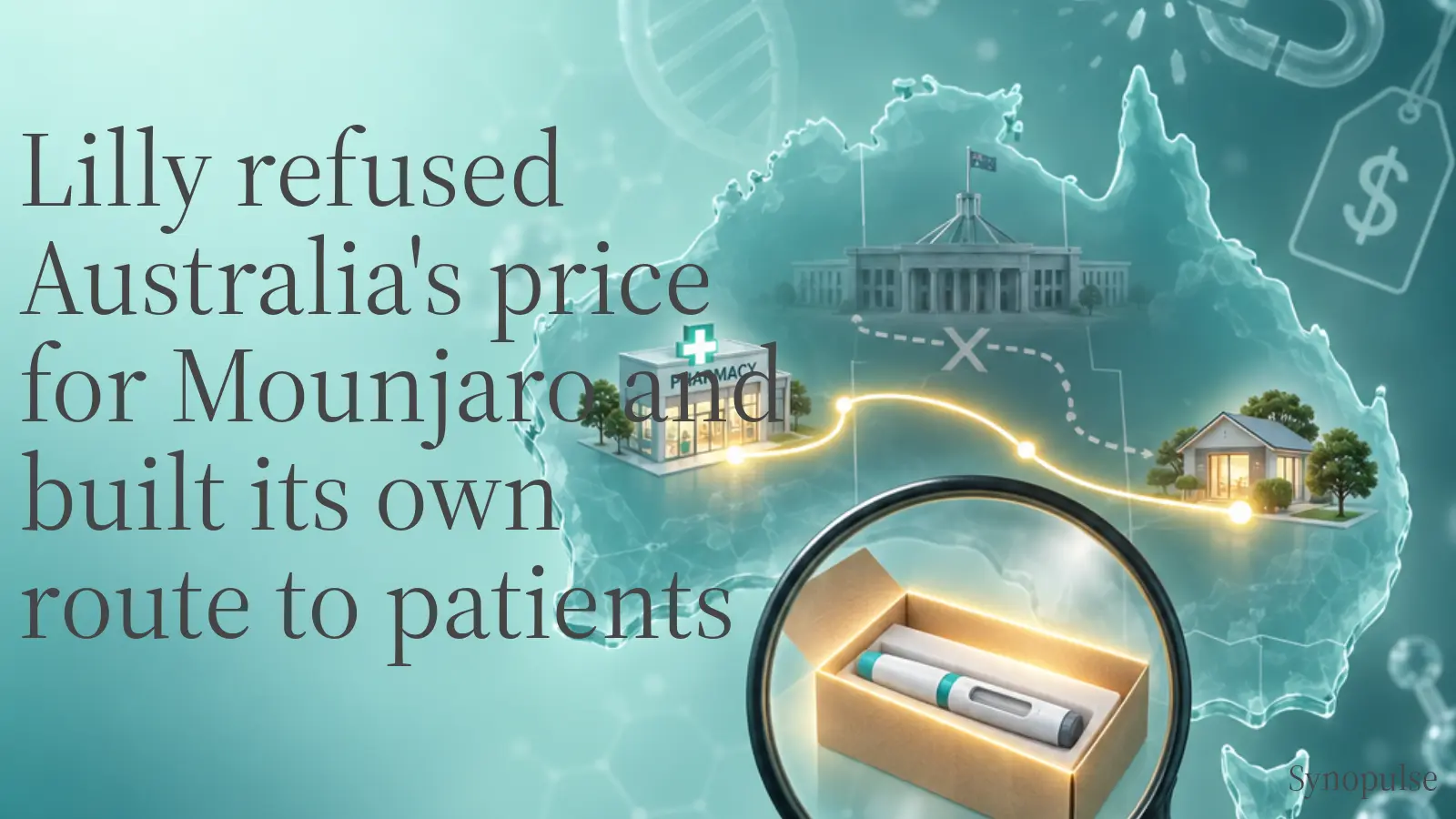
Australia Set a Price Lilly Refused, So Lilly Built a Channel Around the PBS
Eli Lilly made four attempts to put Mounjaro on Australia’s Pharmaceutical Benefits Scheme, walked away in April, and in September opened its own route to patients. LillyDirect takes a doctor’s e-script, passes it to a partner pharmacy and delivers the drug to the door. Doctors and pharmacists say it is unsafe. The larger question is what it does to a single-payer system whose bargaining power rests on the threat of leaving a drug unlisted.
Lilly’s April complaint was about the pharmacy margin as much as the price
When Lilly Australia announced on 24 April that Mounjaro would not be listed for type 2 diabetes, it said the Pharmaceutical Benefits Advisory Committee had recommended the drug and acknowledged its clinical value after four unsuccessful attempts, but on conditions the company would not accept. Lilly said the price on offer was lower than any reimbursed price elsewhere, including in the UK and in China, and that strict funding caps placed a disproportionate share of the financial risk on the company.
The third grievance received less attention. Lilly said that under existing policies a significant share of the proposed spending would flow to wholesalers and pharmacies rather than to Lilly, making long-term supply through the scheme unsustainable. General manager Manny Simons added that an obesity listing now looked hard to secure, and that Lilly would work with the government on potential solutions outside the PBS.
Lilly estimated that 450,000 Australians with type 2 diabetes would miss out on subsidised access. Medicines Australia, the industry body, called the listing process broken. The scheme’s status record now shows the process as ceased because the manufacturer did not proceed.
Five months later, the solution outside the PBS turned out to be Lilly’s own channel
LillyDirect launched in Australia on 22 September. A patient uploads an e-script, the platform verifies it and routes it to a licensed third-party pharmacist, and the medicine is delivered to the patient’s home, with the digital health company Evermed partnering with pharmacies to dispense. Mounjaro is the first product, for chronic weight management, type 2 diabetes and obstructive sleep apnoea with obesity, and Lilly has said other medicines not funded by the PBS will follow.
Simons described the platform as a direct response to the growing difficulty of securing government funding for new medicines. Lilly maintains that it operates inside existing rules: Australian doctors prescribe, Australian pharmacists review and dispense, and Australian privacy and regulatory requirements apply throughout. The model is an adaptation of LillyDirect in the United States, where it has run since 2024.
The loudest opposition came from pharmacy, which is where the money moves
The Pharmacy Guild of Australia and the Pharmaceutical Society of Australia issued a joint statement calling the model clinically inferior, warning that it sets a dangerous precedent and urging policymakers to protect the existing arrangements for dispensing. Guild president Trent Twomey warned against the Americanisation of Australian healthcare. The Royal Australian College of GPs called it a fragmented free-for-all, and its president, Michael Wright, said a dispenser without access to a patient’s full record creates risk.
The safety concerns are real, and GLP-1 drugs need oversight. But the economics explain why pharmacy, rather than the government, is leading the fight. On a PBS-listed medicine, part of every payment goes to wholesalers and community pharmacies under nationally set arrangements, and Lilly named that share in April as a reason the listing could not work. A self-pay drug dispensed through partner pharmacies chosen by the manufacturer moves that margin out of the community network.
| Under a PBS listing | Through LillyDirect | |
|---|---|---|
| Price | Negotiated with government, with funding caps | Set in the private market |
| Who pays | Government subsidy plus patient co-payment | The patient, in full |
| Dispensing | Any community pharmacy | Licensed partner pharmacies, through Evermed |
| Distribution margin | Wholesaler and pharmacy share under national arrangements | Routed through partners Lilly selects |
| Clinical contact | Prescriber and a local pharmacist | Prescriber and a remote pharmacist, disputed by GP and pharmacy bodies |
| Government lever | Price, caps and listing conditions | Regulation only; no price lever |
Exclusion only works as leverage when the excluded drug has no market
The PBS negotiates from a position of strength because, for most medicines, an unlisted drug is a drug few Australians can afford. That logic holds for a high-cost oncology therapy. It weakens for an obesity and diabetes drug with large consumer demand, where enough patients will pay privately to sustain a market without the scheme.
In that case exclusion removes the subsidy and leaves the drug in the market. Patients who can pay buy Mounjaro at full price, the 450,000 people with type 2 diabetes that Lilly counted go without subsidised access, and the government gives up both the price negotiation and the oversight that comes with a listing.
LillyDirect also changes the next negotiation. Lilly chief executive David Ricks said in August that he still wanted a PBS deal. Every month the private channel grows, a future listing becomes more expensive for Lilly to accept, because subsidised supply would cannibalise full-price sales. The government’s walk-away threat weakens in the same proportion.
What the model selects for
Any reimbursement system that negotiates by threatening exclusion assumes the excluded drug has nowhere else to go. Obesity drugs are the first large class to break that assumption, because the patient is willing to be the payer and the manufacturer is willing to be the channel.
Australia is where the logic is playing out first, but it will not be the last. The products most exposed are those patients will buy for themselves; the systems most exposed are those, like the PBS, built on the expectation that no listing means no market. The behaviour this selects for is a manufacturer that answers a rejected price by building its own pharmacy.