
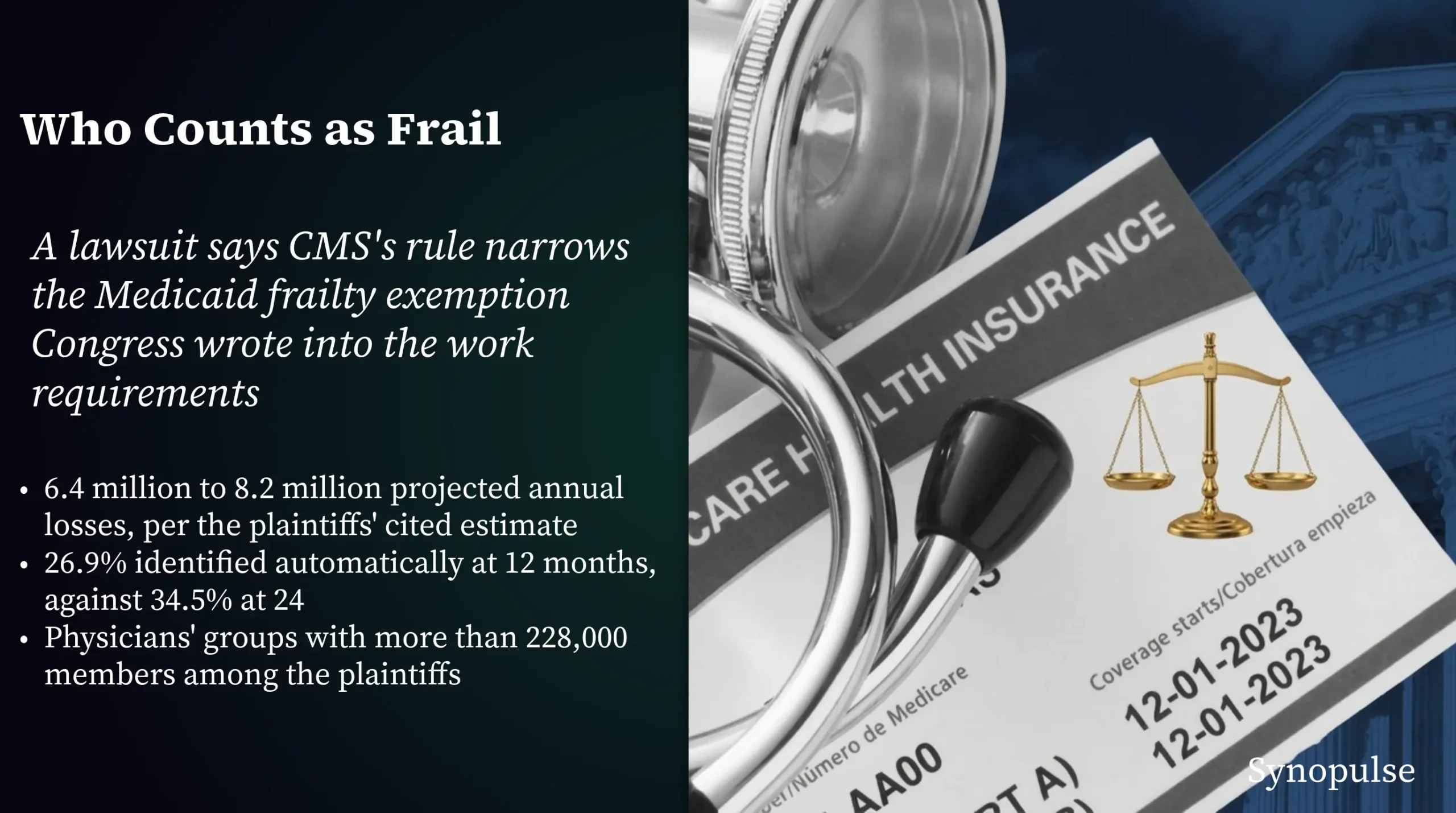
Plaintiffs Say CMS’ Frailty Rule Raises Projected Medicaid Losses From 6.4 Million to 8.2 Million a Year
- Five Medicaid enrollees from Illinois, Indiana, Kentucky, Missouri and North Carolina sued HHS and CMS on 18 September 2026 in the US District Court for the District of Maryland. They are joined by the American College of Physicians, the American Academy of Pediatrics, the Society for Adolescent Health and Medicine, Doctors for America, two New Hampshire medical groups and the City of Columbus.
- The suit challenges CMS’ June interim final rule on Medicaid work requirements. It argues the rule requires people in the five medically frail categories Congress named to also show their condition significantly impairs their ability to comply, and excludes people with a substance use disorder in stable recovery of five or more years.
- It also challenges limits on verification: states may use only claims and encounter data from the past 12 months, and from 2028 may accept self-attestation of frailty only once per enrollment period. The plaintiffs cite a Manatt estimate that coverage losses rise from about 6.4 million a year under the statute to about 8.2 million under the rule, roughly 30% more.
- In the rule, CMS said older claims may not reflect a person’s current condition, and that work requirements can help beneficiaries escape isolation and dependency and achieve self-sufficiency. A judge rejected a bid by 25 states and Washington, DC to pause the requirements in July. The plaintiffs seek a stay, vacatur and an injunction.
Access read
The statute names who is medically frail. The rule decides who can prove it, and the lawsuit is about that gap.
- The lookback window is the lever. Research the plaintiffs cite found a 12-month claims lookback identifies 26.9% of beneficiaries as frail automatically, against 34.5% at 24 months and 39.3% at 36. Anyone the data misses must document frailty, and CMS’s own impact estimate attributes nearly 43% of projected coverage losses to procedural disenrollment, as Synopulse reported on 22 September.
- The rule makes doctors eligibility assessors. It anticipates clinicians documenting both frailty and inability to meet the requirement. The ACP, with 161,000 members, and the AAP, with 67,000, are suing over that role, which the complaint says will be unpaid and will displace clinical time.
- Chronic therapy patients are the test case. Two of the five named plaintiffs have diabetes, one managed with a GLP-1, and another takes daily HIV medication. According to the complaint, CMS said in the rule that it does not expect people with type 1 or type 2 diabetes to typically meet the frailty standard. For manufacturers, those are the Medicaid patients on long-term branded therapy whose coverage the rule now decides.