
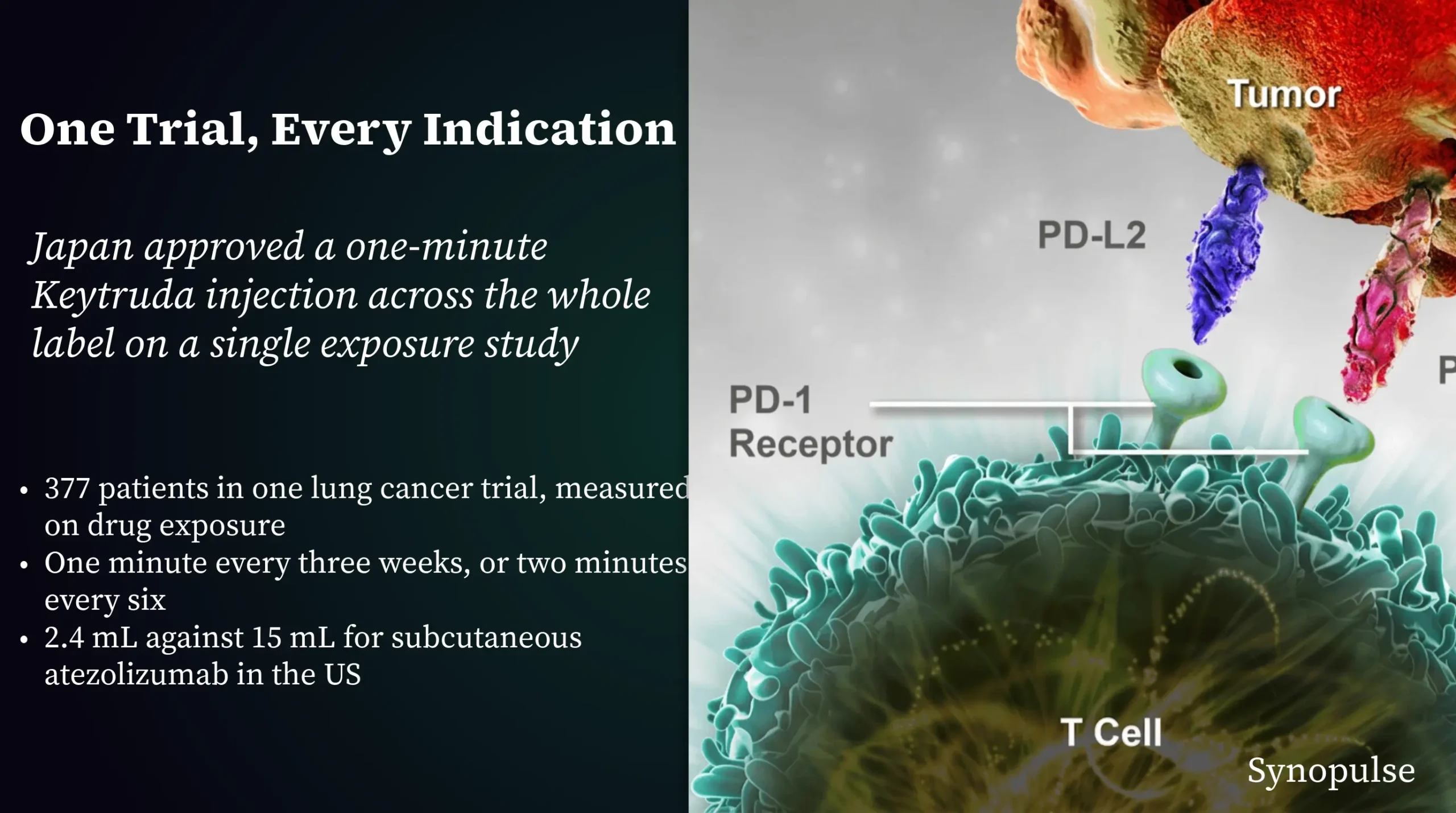
Merck Moved Every Japanese Keytruda Indication to a One-Minute Injection on a Single Lung Cancer Trial
- Merck said on 21 September 2026 that Japan’s Ministry of Health, Labour and Welfare approved Keytruda Qlex (pembrolizumab and berahyaluronidase alfa) for subcutaneous use across every indication Keytruda holds in Japan. It will be sold as KEYJECT, given in one minute every three weeks or two minutes every six weeks.
- The approval rests on the Phase 3 MK-3475A-D77 trial, which randomised 377 patients with treatment-naive metastatic non-small cell lung cancer 2:1 to KEYJECT or intravenous Keytruda every six weeks, each with platinum doublet chemotherapy. The primary endpoint was pharmacokinetic exposure, which was comparable.
- In descriptive analyses, overall response was 45% on KEYJECT against 42% on intravenous Keytruda, with no notable differences in progression-free or overall survival. Berahyaluronidase alfa, the enzyme that allows subcutaneous delivery, is a hyaluronidase variant developed and manufactured by Alteogen.
- The FDA approved Keytruda Qlex in September 2025 and the European Commission approved the product as Keytruda SC in November 2025. Merck calls KEYJECT the first and only subcutaneous checkpoint inhibitor in Japan that a healthcare provider can give in as little as one minute.
CI read
The molecule did not change and neither did the evidence base behind any individual indication. What Japan approved is a route, carried across the whole label by one exposure-matching study.
- One pharmacokinetic trial carried the full label. D77 tested a single setting, first-line metastatic NSCLC, against an exposure endpoint, and its efficacy readouts were descriptive. The US, the EU and now Japan have all accepted that bridge to every indication, which makes matched exposure, not outcomes, the regulatory currency for each subcutaneous checkpoint inhibitor that follows.
- The contest is measured in minutes and millilitres. Merck qualifies its Japanese first by injection time, and the US comparison shows why. On one published review of the three approved US products, Keytruda Qlex is 2.4 mL against 15 mL for subcutaneous atezolizumab, while four-weekly subcutaneous nivolumab needs two vials and six to ten minutes.
- This is Japan’s second big-brand route change in a week. Leqembi Pen cleared on 16 September and KEYJECT five days later. In a market that lists prices on a fixed clock and cuts them on volume, delivery is where incumbents are competing, and Japan is the only one of the three regions where Merck gave the product its own brand name.