
This Money Buys Equipment, Not Operations. Your 2031 Answer Decides the 2027 Deal.
Six CMS announcements in seven days, and every one is a slice of the same pot. If you run rural accounts, the useful work is not in the headlines. It is in three things the releases tell you plainly: where the money actually sits, what it can legally buy, and when it stops.
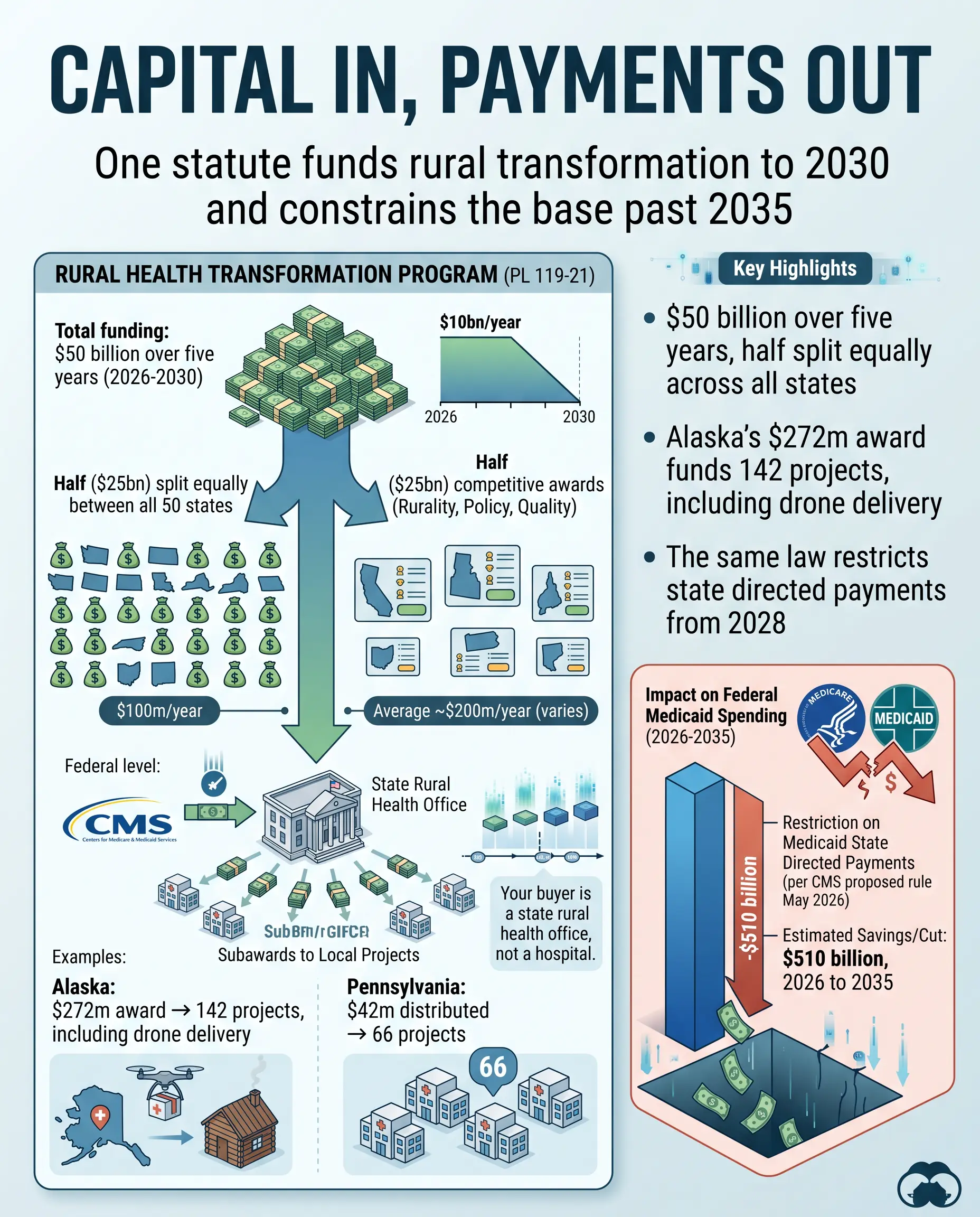
The Rural Health Transformation Program comes from Public Law 119-21. Fifty billion dollars, ten billion a year, 2026 through 2030, then nothing. CMS awarded all fifty states on 29 December 2025. First-year awards average two hundred million, ranging from $147,250,806 for New Jersey to $281,319,361 for Texas.
Half the pot is split equally between states by statute. The other half is competitive, scored on rurality metrics, state policy actions and application quality. So roughly a hundred million per state per year lands before anyone assesses need, and award size is a weak proxy for market size.
Money flows through state governments as subawards. Alaska is running 142 projects inside a $272 million award. Pennsylvania had already pushed $42 million to 66 projects. Your buyer is a state rural health office, not a hospital.
The same statute restricts Medicaid state directed payments. CMS’s own May 2026 proposed rule scores that at $510 billion off federal Medicaid spending, 2026 to 2035.
A reader can stop here with the full picture. The sections below are the detail.
Do not use award size as market size
The statute splits the pot in half. Twenty-five billion goes out equally across fifty states over five years, which is a hundred million per state per year before anyone looks at a rural population figure. Only the other half is scored.
Strip the floor and the picture changes. New Jersey’s competitive share is around forty-seven million. Texas takes around a hundred and eighty-one million. That second number reflects what CMS actually assessed, and it is the one to build a territory model on. Anyone ranking states by headline award is ranking them partly by the fact that they exist.
The practical consequence is that small-population states with strong applications punch well above their patient counts. Alaska pulled $272 million. Allocate field resource by award size and you will overweight states where the addressable population cannot support the coverage you put in.
Your buyer just changed, and so did the sales cycle
This money does not land on hospital balance sheets. It lands with state governments, which then subaward. Alaska is administering 142 separate projects. Pennsylvania has 66 live already with more coming.
That is a different motion entirely. One state decision can replace twenty separate hospital procurements, and Alaska shows exactly how: three point one million dollars put an artificial intelligence imaging network across twenty-one acute care hospitals in a single award. No vendor was winning twenty-one rural imaging deals individually inside a year. The state bought once.
It cuts the other way too. Miss the state process and you are not competing on a level field afterwards, because the budget for that category is already committed. State rural health offices are small, they are administering more money than they have ever handled, and they are working to CMS progress reporting. They will favour vendors who deploy fast and produce documentation over vendors with better products and slower implementations.
The access angleKnow what this money can buy. It is capital: equipment, software licences, initial deployments, training, infrastructure. Alaska bought robotic surgery capability, a treatment campus, health information exchange connectivity and residency funding. Pennsylvania bought screening technology and equipment to open additional operating rooms. If your product is a one-time purchase with a clean implementation, this is the best rural window in a decade and it is open now. If your product is priced per patient per month, this window is a trap, because the buyer has no visible funding line past 2030 and cannot commit you into a recurring obligation on money that expires. Price the deal inside the window, and walk into the room with a year six answer already written, because the procurement officer will ask and a blank stare loses it.
One statute, two directions, and your customer feels both
The same law that created this programme restricted state directed payments at section 71116. CMS’s proposed rule scores that at $510 billion off federal Medicaid spending through 2035.
Do not put those two numbers side by side and call it a net. The transformation money is rural-targeted; the payment restriction is not, and most of those dollars go to urban and academic systems. Nobody has isolated the rural share and I am not going to invent it.
You do not need the net to see the shape. Capital arrives now and stops in 2030. The payment restriction phases in from 2028 and runs past 2035. A rural chief financial officer is being handed money to buy things at exactly the point the revenue that runs those things is being constrained. That CFO already knows it. It is why sustainability comes up early in every conversation now, and why the vendor who raises it first does better than the one who waits to be asked.
Six announcements, one pot, and a double-counting trap
The awards were made in December. The releases dated 19 to 25 August are project-level allocations inside totals that already existed, and both the Alaska and Pennsylvania releases say so in the text.
Build a rural spend tracker off press releases and you will double-count, because the same dollars appear in the December state table and again in an August project announcement. Use the December table as the denominator and treat the state releases as texture on how the money is moving.
What I would watch
Whether any state writes post-2030 sustainability into its subaward terms. The first one that does changes how every proposal in that state has to be structured, and it will happen because a state auditor asks, not because CMS requires it.
Whether CMS publishes project-level data in a usable form. Right now the announcements are narrative. A dataset would show which categories are clearing and which states are underspending, and underspending states are where a late but well-prepared vendor wins.
And the state directed payment final rule, because that is the number deciding whether rural accounts finish this decade able to operate what they just bought.
None of this is an argument against the programme. Drone delivery to villages that go a fortnight without medication in winter, and a first robotic surgery capability in a region that had none, are real. But a five-year capital programme is a five-year capital programme. Build the plan around what it buys and when it ends, not around the size of the announcement.