
Trodelvy Now Covers First-Line TNBC Across PD-L1 Status. The Two Regimens Are Not Equally Tolerated.
- The European Commission authorised Gilead‘s Trodelvy (sacituzumab govitecan) with Keytruda on 19 August 2026 for previously untreated unresectable locally advanced or metastatic TNBC where tumours express PD-L1 at a combined positive score of 10 or above. It covers all 27 EU member states plus Norway, Iceland and Liechtenstein.
- Paired with the recent monotherapy authorisation for first-line patients who are not candidates for PD-1 or PD-L1 inhibitors, Gilead now holds first-line coverage across PD-L1 status. It is the first and only ADC plus immunotherapy combination approved in first-line metastatic TNBC in the EU.
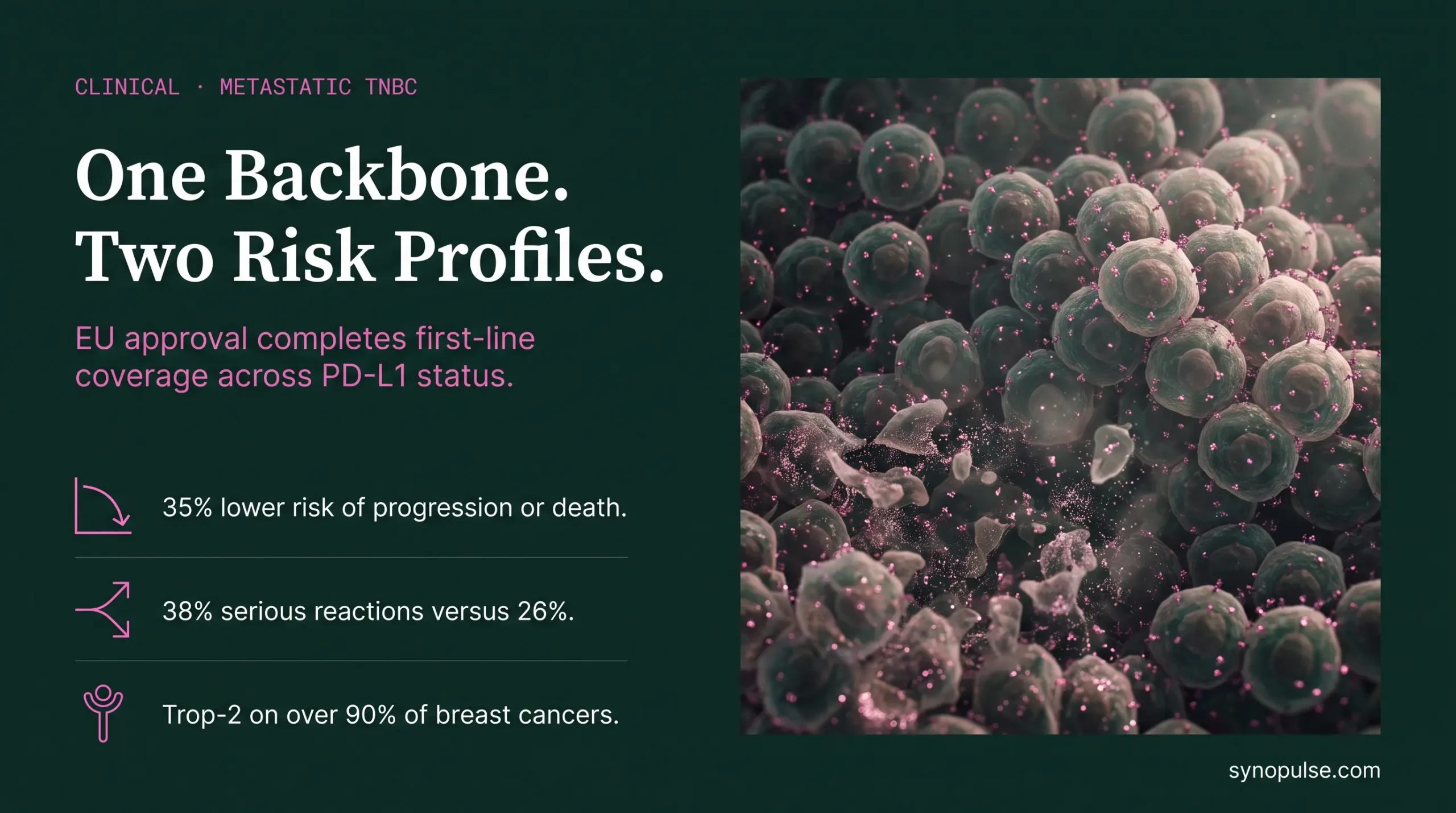
- The combination approval rests on Phase 3 ASCENT-04, also known as KEYNOTE-D19, which showed a 35% reduction in the risk of disease progression or death against standard chemotherapy plus Keytruda. The release reports progression-free survival for this study and no overall survival figure.
- Trodelvy is a Trop-2 directed ADC carrying SN-38 on a hydrolysable linker, with Trop-2 expressed in more than 90% of breast and lung cancers. More than 75,000 breast cancer patients have been treated since 2020. The product carries a boxed warning for neutropenia and diarrhoea.
Clinical read
Backbone across PD-L1 status is one label covering two quite different experiences. The biomarker no longer only determines which regimen a patient receives. It now largely determines what that regimen costs them in tolerability.
- The combination roughly doubles serious adverse reactions against the monotherapy arm. In ASCENT-04 serious adverse reactions occurred in 38% of patients against 26% in ASCENT-03, and permanent discontinuation of Trodelvy ran at 7% against 3.6%. Same drug, same line, different companion.
- Fatal adverse reactions are itemised and worth reading. ASCENT-04 recorded fatal adverse reactions in 3.2% of patients against 2.5% in ASCENT-03. Febrile neutropenia was the most frequent serious reaction at 7%. Build the PD-L1-positive conversation around monitoring and prophylaxis, not around the efficacy delta alone.
- This is a franchise move, not only an indication. Trop-2 sits on more than 90% of breast and lung cancers, and Gilead is running Phase 3 studies in lung and gynaecological tumours. First-line TNBC across PD-L1 status secures the anchor indication before Trop-2 competitors reach the same setting.