
NICE Backed a Weekly Insulin Before It Has a Licence, Then Told Prescribers to Pick the Cheapest Option
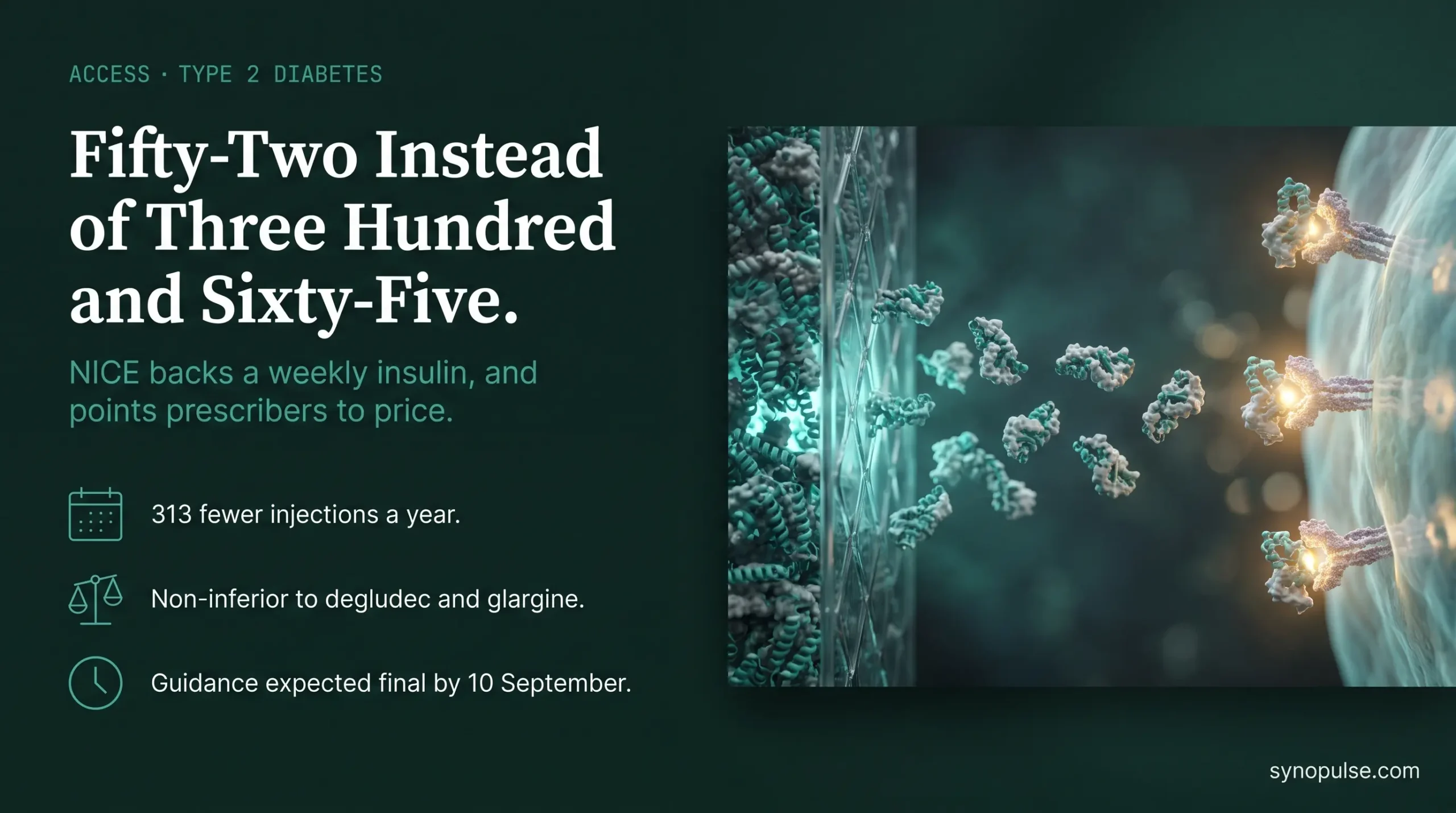
- NICE published final draft guidance recommending insulin efsitora alfa (Onswik), from Eli Lilly, for adults with type 2 diabetes. Given once weekly by pre-filled subcutaneous pen, it would cut annual injections from 365 to 52 for someone switching from a daily basal regimen, a reduction of 313 injections.
- The recommendation is conditional on the MHRA licensing the product, which has not happened. An appeal period is open and, barring appeals, the guidance is expected to be finalised by 10 September 2026. There is currently nothing to prescribe.
- The evidence is non-inferiority rather than superiority. Efsitora controlled blood glucose as well as insulin degludec and insulin glargine U100 across 26 to 52 weeks. In QWINT-1, 795 insulin-naive adults saw HbA1c fall 1.19 points against 1.16 for glargine, with fewer dose adjustments (median 2 against 8).
- NICE tells prescribers to discuss options and choose the least expensive treatment meeting the person’s needs, accounting for dosage, administration costs, price per dose and commercial arrangements. It names the likely beneficiaries as people who need help injecting, including frailer patients and those with sight loss, limited hand movement or learning disabilities.
Access read
The headline is 313 fewer injections. NICE’s own instruction points elsewhere. It tells prescribers to choose the least expensive option that meets the need, which for a non-inferior insulin moves the entire argument off glucose control.
- Non-inferiority plus a cost-minimisation instruction is a narrow opening, not a preferential one. Efsitora matched degludec and glargine U100 across 26 to 52 weeks. Guidance directing prescribers to weigh price per dose against basal insulins already under biosimilar pressure sets a low ceiling on what Lilly can charge.
- The value sits in carer time, not in HbA1c. NICE names people who need help injecting, and 52 district nurse or carer visits instead of 365 is the argument that actually pays. Build the submission on administration cost per patient-year, because the glycaemic case is explicitly a tie.
- There is no product, and the guidance is not final. The recommendation depends on an MHRA licence that does not exist, with an appeal window open and finalisation expected by 10 September. Anyone briefing commissioners or patients now is managing expectations against a licence nobody has seen.
Read the original source (NICE) →
CompaniesEli Lilly
GeographyUnited Kingdom