
Oman Is Offering Drug Manufacturers the One Thing Government Procurement Normally Destroys
- Oman’s Public Authority for Special Economic Zones and Free Zones (OPAZ) is promoting an incentive package to attract pharmaceutical and medical device manufacturing, comprising preferential access to government procurement, tax and customs exemptions, full foreign ownership and further incentives.
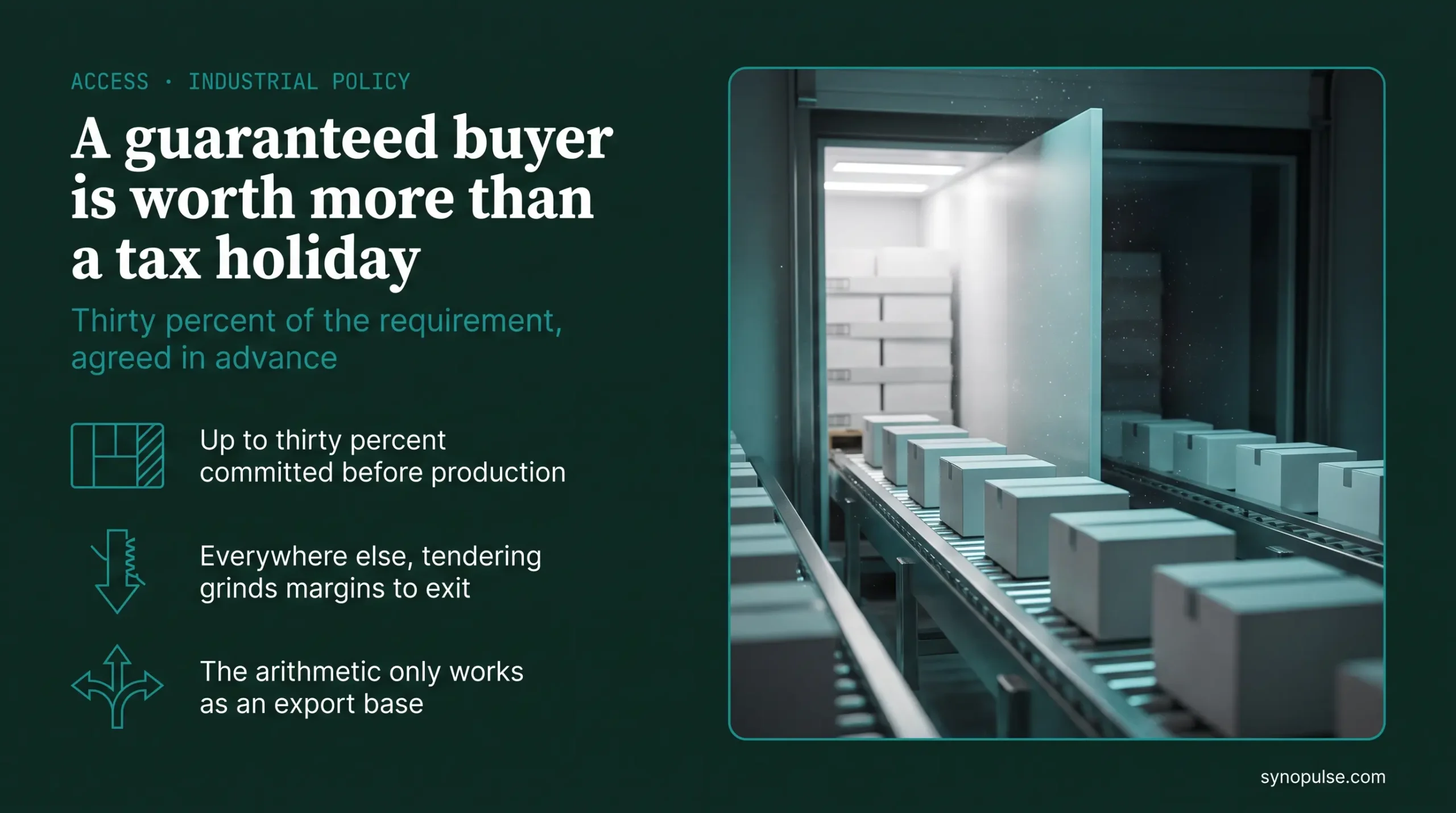
- At its centre are advance purchase agreements covering up to 30% of the Ministry of Health’s requirements for locally manufactured pharmaceutical products. The Ministry is the Sultanate’s largest customer for medicines.
- Oman’s industrial parks currently host as many as 13 pharmaceutical projects and manufacturing centres. OPAZ frames the package as part of a broader effort to establish Oman as a regional centre for pharmaceutical and medical industries.
- The mechanism has precedent. In February 2025 the Ministry of Health signed advance purchase agreements with local medical factories, describing the objective in its own announcement as pharmaceutical security, continuity of supply, and reducing dependency on imports.
Access read
Strip out the incentives that every jurisdiction offers. Tax holidays, customs exemptions and full foreign ownership are table stakes across the Gulf and tell an investor nothing. The instrument that matters is the advance purchase agreement, because government medicine procurement almost everywhere runs on lowest-bidder tendering that ratchets prices down until manufacturers exit the category, which is precisely how the generic shortages every health system now complains about are produced. Oman is doing the reverse, and guaranteeing a share of demand at pre-agreed terms is the opposite of how ministries usually buy medicines.
- An offtake is a price floor, and somebody pays for it. Committing up to 30% of the Ministry’s requirement to local manufacturers at agreed terms means the Ministry has decided, for that slice, not to buy the cheapest qualifying product available. That premium is the price of resilience, and the Ministry’s own framing names it: pharmaceutical security, continuity of supply, reduced import dependency. This is supply policy wearing an investment promotion suit. Anyone assessing it should stop reading it as an incentive scheme and start reading it as a health system deliberately choosing to overpay for domestic capacity it would otherwise never have.
- Competitive frame: the arithmetic only works as an export base, and misreading that is the expensive error. Oman is a small market, so 30% of one ministry’s requirement is not a volume that justifies building a plant on its own. What the offtake actually does is make the debt financeable, because a confirmed buyer for a defined share of output is worth more to a lender than any quantity of land and tax relief. The anchor tenant covers the financing; the return has to come from the GCC and adjacent export markets. Read this as an invitation to sell into Oman and the numbers will never work. Read it as subsidised entry to a regional manufacturing base and they might.
- What to watch: the terms nobody has published, and what the 13 plants actually make. Up to 30% is a ceiling rather than a commitment, and pre-agreed pricing is only as valuable as its tenor, its indexation and whether it survives a budget cycle. Demand all three before modelling anything. Then ask the harder question about the existing projects, which is whether they perform formulation and fill or genuinely produce active ingredient. The first relocates packaging and the second relocates dependency, and a country importing all of its API has moved its supply risk one step down the chain rather than removing it. That distinction decides whether this is industrial policy or industrial theatre.
Read the original source (OPAZ, via Oman Observer) →