
CMS Opened a Same-Day Coverage Lane for Devices and Closed the Payment Route Underneath It
Eight days separate the two decisions, and they run in opposite directions. On 31 July CMS finalised the removal of the add-on payment route that let Breakthrough Devices earn extra hospital money without proving substantial clinical improvement. On 7 August it published a pathway promising national Medicare coverage within 60 days of FDA authorisation. Same agency, same cohort of devices, one getting covered faster and paid for less.
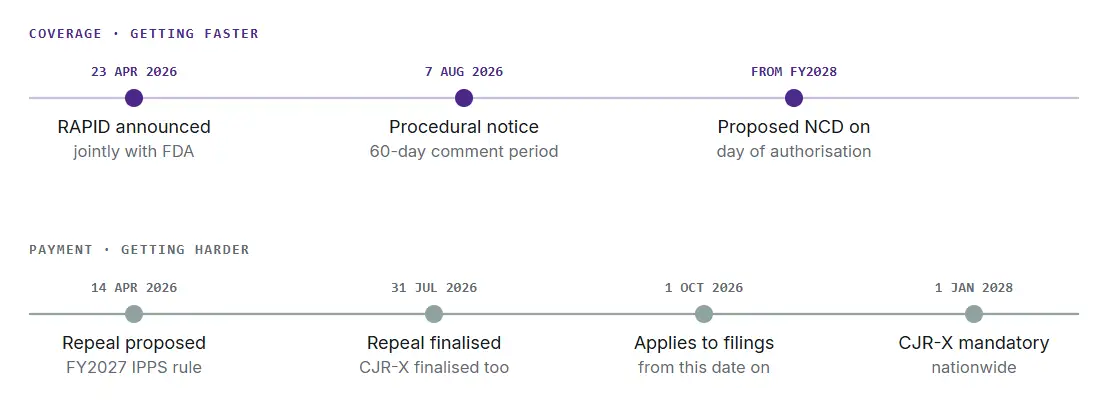
- Coverage and payment moved apart in the same fortnight. The 31 July inpatient payment rule ended the alternative add-on payment pathway for Breakthrough Devices from FY2028 applications. The 7 August procedural notice promises a proposed national coverage determination on the day of FDA authorisation, with a final one targeted at 60 days for Class II and 90 days for Class III.
- The new lane’s on-ramp has not been authorised yet. Class II eligibility requires participation in FDA’s Total Product Life Cycle Advisory Program, which is still a pilot. Expanding it to all product areas is a MDUFA VI commitment, and MDUFA V does not expire until 30 September 2027, with FDA’s recommendations due to Congress by 15 January 2027.
- The buyer’s economics changed in the same rule. CJR-X makes hospitals accountable for hip, knee and ankle episodes nationwide from 1 January 2028, the same window in which the add-on payment change starts to bite.
These are three levers on one decision, and only one of them is being read as good news. Coverage determines whether Medicare pays at all. Add-on payment determines how much a hospital receives for using something new. Episode accountability determines whether that hospital wants to. A device can now clear all three federal gates on evidence and still meet a buyer with no financial reason to try it. A reader can stop here with the full picture. The sections below are the detail.
Two decisions, eight days apart, pointing opposite ways
On 31 July CMS issued the FY2027 inpatient payment final rule, setting a 2.3% rate increase and an estimated $2.1bn rise in hospital payments. Inside it, CMS finalised the repeal of the alternative pathway that allowed devices carrying FDA Breakthrough designation to qualify for new technology add-on payments without demonstrating substantial clinical improvement. From FY2028 applications, every applicant faces the same three-part test regardless of designation.
Eight days later CMS published the RAPID coverage pathway procedural notice. For devices completing it, a proposed national coverage determination is issued the same day FDA grants market authorisation, with a 30-day comment window and a final determination targeted around 60 days for Class II and 90 days for Class III. National coverage could begin roughly two months after authorisation, against a historical gap measured in years.
Read the CMS fact sheet on the payment rule and the repeal does not appear. The summary leads instead with an estimated $779m increase in payments for inpatient cases involving new medical technologies in FY2027, driven by new add-on approvals. Both statements are true. They describe different cohorts and different years, and only one of them is in the headline.
Medicare device coverage and payment milestones as published, April 2026 to January 2028. Nodes are ordered by date; horizontal spacing is ordinal rather than to scale.
CMS-1849-F · CMS-3487-NC · Agency documents as issued, compiled 12 August 2026
The fast lane’s on-ramp has not been funded yet
RAPID is narrower than the announcement suggests. A Class II device qualifies only if it holds Breakthrough designation, is participating in FDA’s Total Product Life Cycle Advisory Program, and plans a De Novo request. Class III devices qualify with Breakthrough designation and a planned premarket approval application, without the TAP requirement. In vitro diagnostics are excluded entirely and stay with the Medicare Administrative Contractors.
The binding constraint is timing. Only devices at the investigational device exemption pre-submission stage may enter. Anything already authorised, or with an IDE study underway, is outside the pathway. RAPID is available only to programmes that have not yet started, which means the first determination issued under it is several years away regardless of how quickly the notice is finalised.
Then there is the TAP dependency. TAP began as a pilot weighted toward cardiovascular devices. Moving it to a full programme across all product areas, and formally facilitating FDA engagement with CMS for TAP technologies where a coverage determination would help, are commitments in the draft MDUFA VI letter covering fiscal years 2028 to 2032. As the Bipartisan Policy Center sets out, FDA must send Congress its recommended fee revenues and performance goals by 15 January 2027, and the current programme runs until 30 September 2027. CMS has built the eligibility gate for its coverage accelerator out of a programme whose expansion is still a negotiating position, at a device centre that lost staff in the wider department reductions.
The people who buy the devices had their incentives changed in the same rule
CJR-X was finalised in that 31 July package. From 1 January 2028 it is mandatory nationwide for Original Medicare hip, knee and ankle replacements across inpatient and hospital outpatient settings, with hospitals measured against episode target prices and either receiving reconciliation payments or repaying Medicare.
Orthopaedic manufacturers have been relaxed about it in recent earnings calls, and on their own terms they are right. Implants are roughly 14 to 15 percent of procedure cost in an ambulatory surgery centre, and the savings CMS is reaching for sit in surgical time, site of care and readmissions rather than implant price. Stryker and Zimmer Biomet both told analysts they expect little impact, and neither is wrong about pricing.
The exposure is not price. It is adoption. A hospital carrying accountability for ninety days of episode spending, without the add-on payment that used to offset the cost of trying something new, has a weaker case for adopting a newly covered device than it had a year ago. That is a volume question for every manufacturer whose product enters through a surgical episode, not only in orthopaedics.
For beneficiaries this is the gap that matters. A national coverage determination establishes that Medicare will pay. It does not establish a rate, and it does not oblige a hospital to stock anything. RAPID determinations may also carry coverage with evidence development, which CMS says should be time-limited, so some devices will arrive covered, unsupported by add-on payment, and carrying an evidence obligation into a buyer already holding episode risk.
Two things to watch before the comment window closes. Whether the final notice says anything about how RAPID evidence interacts with the substantial clinical improvement test that add-on payment now requires, since a single evidence package serving both would resolve most of this. And whether the TAP expansion survives the reauthorisation intact, because without it the Class II half of the pathway has no working entrance.